Lymphedema Treatment: Stages, CDT & a 24-Hour Care Plan
Most people come to us knowing one piece of their lymphedema treatment. They have a garment, or they have a pump, or a therapist taught them a massage sequence. What they usually do not have is a picture of how the pieces fit together across a full day.
That gap is the reason so many patients feel like they are working hard and getting nowhere. You can do everything right between 9 a.m. and 5 p.m. and still wake up with a limb that has quietly refilled overnight. Lymphedema does not observe business hours, and neither can the plan.
This guide lays out what complete lymphedema treatment actually includes, how the pieces protect each other, and what a realistic 24-hour routine looks like from morning through sleep. It is written for patients managing lymphedema or lipedema, for caregivers running the routine alongside someone, and for referring clinicians who want a clear resource to hand a newly diagnosed patient. We will also cover the stages, what can and cannot be reversed, and the mistakes we see most often across our patients in North Jersey.
Quick Answer: What Is Lymphedema Treatment?
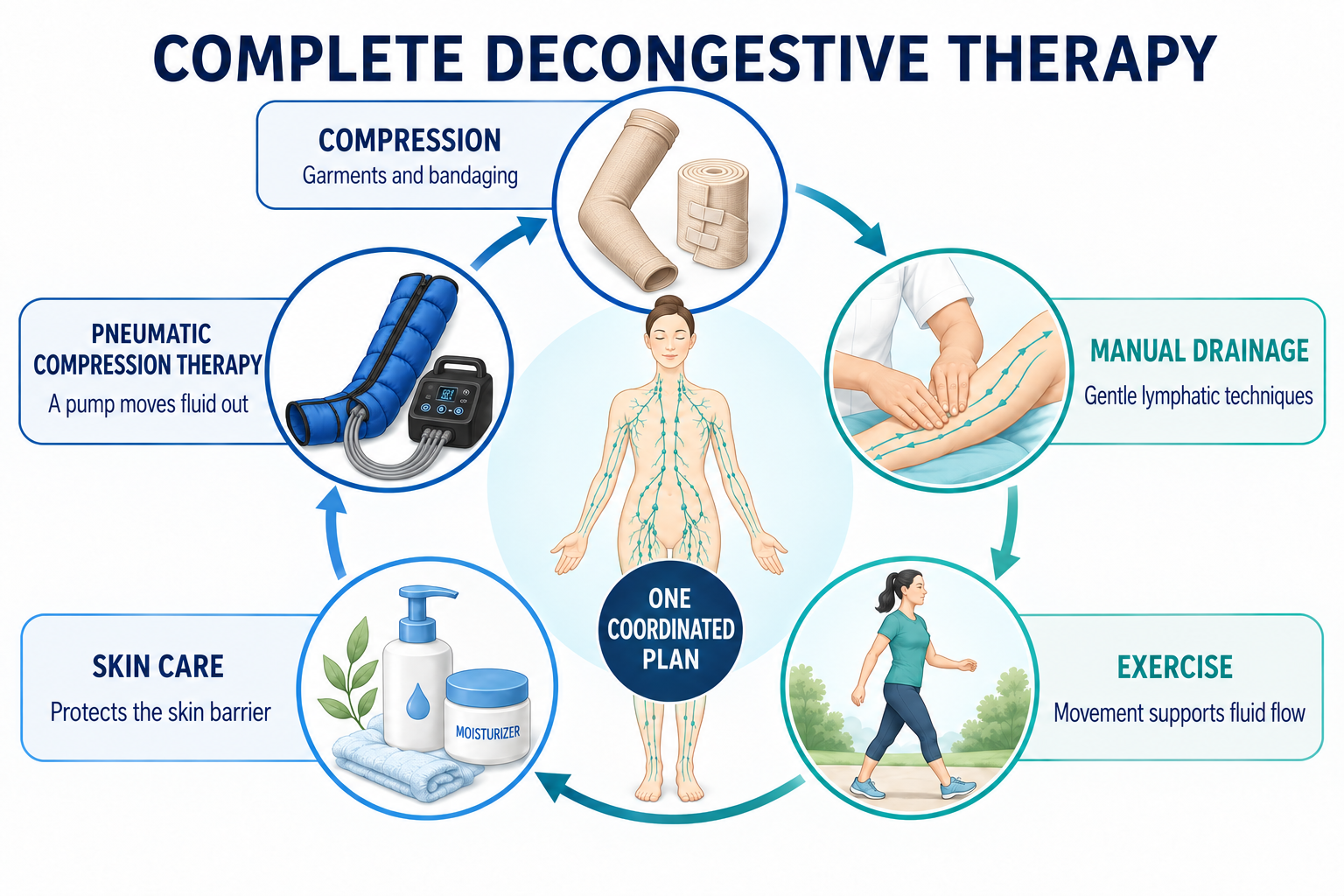
Lymphedema treatment is a combination of therapies delivered together, not a single intervention. The standard of care is complete decongestive therapy, and the 2023 American Cancer Society and Lymphology Association of North America expert consensus identifies its essential components as examination, compression, manual techniques including manual lymph drainage, exercise, skin care, education, and self-management. The consensus also states that this care should be delivered by practitioners specifically trained in lymphedema management, preferably a certified lymphedema therapist, and that the individual's etiology, presentation, and comorbidities determine which components apply and for how long. Treatment runs in two phases: an intensive decongestive phase to reduce volume, followed by a lifelong maintenance phase to hold the result. Lymphedema is chronic and not curable, but it is highly controllable when the plan runs around the clock rather than in pieces.
Why the Pieces Only Work Together
Here is the mechanical reality that explains almost every frustrated patient we meet.
A pump moves fluid out of the limb. A garment keeps it from coming back. Movement drives the muscle pump that makes compression effective at all. Skin care prevents the infection that undoes months of progress in a week. Take any one of those away and the others lose most of their value.
The clearest example is the overnight window. Your daytime garment is elastic and works by resisting muscle movement. While you sleep, you are still, so that garment loses much of its effect at exactly the hours when gravity and inactivity are working against you. Whatever reduction you earned during the day starts to reverse. A nighttime garment is not an optional upgrade. It is preservation of everything the day accomplished.
That is the framing I give every patient: the daytime work builds the result, and the nighttime work is what you actually get to keep.
The Stages of Lymphedema, and What Is Reversible
Understanding your stage tells you how urgent the plan is. The American Cancer Society describes four stages: stage 0 with no visible swelling but a feeling of heaviness, fullness, or tightness, and which is reversible; stage 1 with visible swelling that improves when the limb is raised, usually reversible; stage 2 with more swelling that does not improve with elevation, which may be reversible if treated early; and stage 3 with extreme swelling that often limits self-care or everyday activities.
The reversibility line is the part patients most need to hear. According to Breastcancer.org's stage-by-stage breakdown, by stage 2 the scarring of soft tissue under the skin worsens and pitting may disappear, and while a specialist can help manage it, the tissue damage is not reversible. At stage 3 the affected area enlarges and becomes misshapen, infection risk rises, the skin hardens and thickens, and lymph can leak through damaged tissue.
Read that as a timeline, not a diagnosis. Every month of consistent treatment early is worth more than a year of aggressive treatment later, because you are protecting tissue that cannot be rebuilt once it fibroses.

The Components of a Complete Plan
1. Compression Garments
The daily foundation. Daytime garments are graduated and elastic, worn during waking hours. The expert consensus is direct on timing: patients with early stage lymphedema should be fitted for a compression garment when they are diagnosed, and those with moderate and late-stage lymphedema should have a minimum of two weeks of tailored intervention. Not after a trial period. At diagnosis.
For arm and hand specifics, see our guide to lymphedema sleeves, gauntlets, and compression classes.
2. Nighttime Garments
Foam or quilted chamber garments that deliver low, sustained containment while you sleep, when muscle movement is not available to activate an elastic garment. We go deeper in Nighttime Compression Garments for Lymphedema.
3. Pneumatic Compression Pumps
For patients whose swelling is not controlled by garments and manual drainage alone, a pump provides sequential mechanical drainage at home. Typical sessions run 30 to 60 minutes, once or twice daily. See How Does a Lymphedema Pump Work? and How to Use a Lymphedema Pump at Home.
4. Manual Lymphatic Drainage and Self-MLD
A trained therapist performs manual drainage during the intensive phase and teaches a simplified version you continue at home during maintenance. This is the component most often abandoned once formal therapy ends, and it is worth protecting.
5. Movement and Lymphedema Exercises
Exercise is a listed component of decongestive therapy, not a risk to be avoided. Muscle contraction is what drives lymph toward central drainage. The old advice to rest the affected limb has been reversed. What still requires care is the type of activity, and Macmillan Cancer Support notes that while exercise can improve lymphoedema symptoms, some sports raise the risk of damaging the skin, so a specialist should advise on precautions for a specific sport. Wear your compression while exercising.
6. Skin Care
The least glamorous component and arguably the one with the highest stakes. That same Macmillan guidance explains that lymphoedema makes skin dry and itchy, which makes cracks and breaks more likely and raises the risk of cellulitis, and that good skin care reduces that risk. Daily washing, daily moisturizing, prompt first aid on any cut or bite, and knowing the signs of infection.
Does Complete Treatment Actually Work?
Yes, and the volume numbers are substantial. A study of phase I decongestive therapy across upper and lower limb patients found that the median percentage reduction in excess volume was 66.5 percent for upper limb lymphedema and 71.5 percent for lower limb lymphedema, with no side effects recorded during treatment. The authors describe the two-phase structure directly: phase I mobilizes and reduces congested protein-rich fluid and softens increased connective tissue, while phase II optimizes and preserves what phase I achieved.
That second sentence is the whole argument for the 24-hour plan. Phase II is not a wind-down. It is the part that decides whether the reduction lasts.
What a Real 24-Hour Routine Looks Like
This is a template, not a prescription. Your clinician sets your specifics.
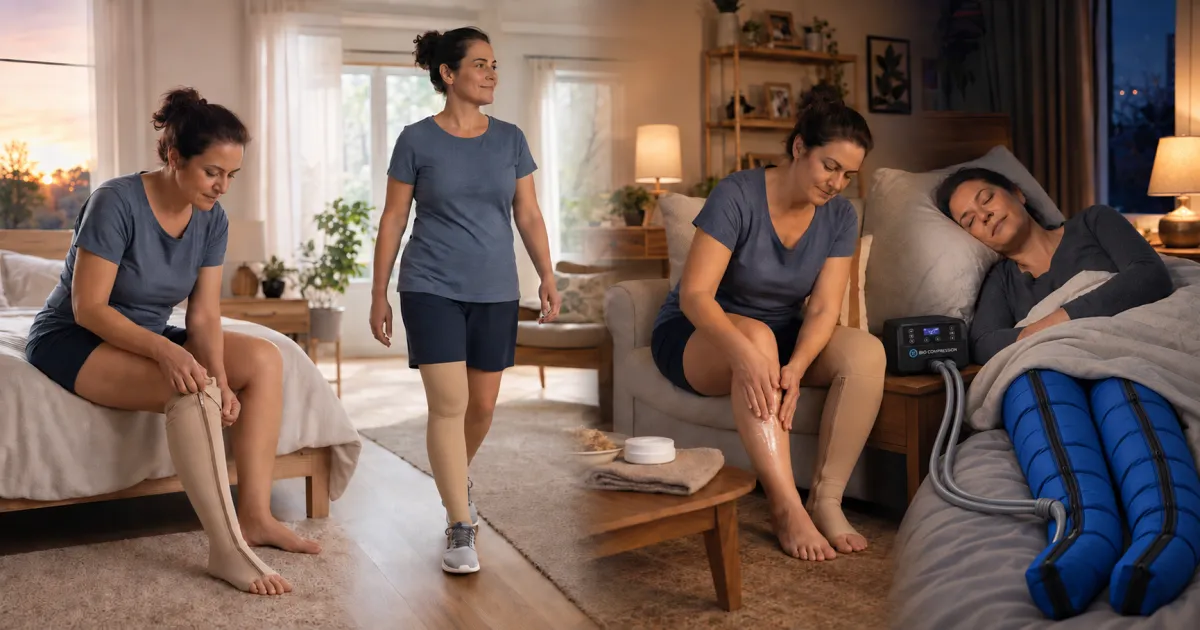
Morning. Inspect the limb before anything goes on it. Look for redness, warmth, new firmness, or breaks in the skin. Moisturize. Put the daytime garment on before you have been upright long, ideally before swelling has a chance to build. Check that it is smooth with no bunching at the wrist, elbow, ankle, or knee.
Midday. Move. Walking, light resistance work, or your prescribed exercise sequence, with the garment on. If you sit for work, stand and move on a schedule rather than when you remember.
Afternoon or early evening. Pump session if one is prescribed, usually 30 to 60 minutes. Garment goes back on immediately afterward. This is the single most skipped step in the routine, and it is the one that decides whether the session held.
Evening. Self-MLD if your therapist taught you a sequence. Wash and moisturize. Inspect again, especially between toes and in skin folds.
Night. Nighttime garment on. Elevate where practical. This is the preservation window.
Weekly. Wash garments per manufacturer instructions and rotate to your second set. Check garment elasticity. Note any change in fit, which is often the earliest sign that either the limb or the garment has changed.
From Our Fitting Room
Patients treat maintenance as optional. Phase I feels like treatment because a therapist is involved. Phase II feels like homework. The patients who hold their gains are the ones who treat the maintenance routine with the same seriousness.
The pump gets blamed for the garment's job. "The pump isn't working" almost always means the garment is not going back on between sessions, or the garment has lost its compression.
Skin care gets skipped until it cannot be. We see patients who never thought about moisturizer until their first cellulitis admission. One infection can cost more progress than six months of good adherence built.
Nighttime is treated as a luxury. It is the most commonly declined item and the one I would fight hardest for. If you are doing daytime work and skipping the night, you are refilling the tub every evening.
Nobody told them it was lifelong. Patients finish an intensive phase, feel better, and reasonably assume they are done. Setting that expectation at the start prevents a lot of discouragement at month four.
When to Call Someone
Call your care team promptly for redness, warmth, fever, chills, or a rapidly spreading rash on the affected limb. Those can indicate cellulitis, which needs medical treatment, not an adjustment to your routine. Also call for a sudden increase in swelling, new pain, or skin that is breaking down or weeping.
Call us if a garment leaves deep marks, rolls, cuts in at a joint, causes numbness or tingling, no longer fits the way it did, or if your pump is not running correctly. Any of those means something in the plan needs adjusting.
Frequently Asked Questions
Can lymphedema be cured? No. Lymphedema is a chronic condition caused by permanent damage or impairment to the lymphatic system, and that damage cannot be repaired. It can be controlled well, and in stage 0 and stage 1 swelling can often be reduced substantially or eliminated, but the underlying impairment remains and treatment continues for life.
What is complete decongestive therapy? Complete decongestive therapy, sometimes called CDT or complex decongestive therapy, is the standard of care for lymphedema. Its essential components are examination, compression, manual techniques including manual lymph drainage, exercise, skin care, education, and self-management, delivered by a trained clinician, preferably a certified lymphedema therapist.
What are the two phases of lymphedema treatment? Phase I is the intensive or decongestive phase, which mobilizes and reduces congested protein-rich fluid and softens connective tissue. Phase II is the maintenance phase, which preserves the reduction achieved in phase I. Phase II is lifelong.
Can I do lymphedema treatment at home? Most of it, yes. After the intensive phase, the daily routine is home-based: garments, pump sessions if prescribed, self-MLD, exercise, and skin care. You continue to see your therapist and DME provider periodically for reassessment, refitting, and garment replacement.
Do I still need a garment if I have a pump? Yes, and this is the most important pairing to get right. The pump moves fluid out. The garment keeps it from coming back. Using a pump without wearing a garment between sessions undoes much of each session by the following day.
Are lymphedema exercises safe? Yes. Movement is a component of decongestive therapy, not a risk to avoid. Muscle contraction drives lymph toward central drainage. Wear your compression while exercising, progress gradually, and ask your specialist about precautions for any specific sport, since some activities raise the risk of skin injury.
Why is skin care part of lymphedema treatment? Because lymphedema makes skin dry and prone to cracking, which raises the risk of cellulitis. Infection causes swelling to worsen and can reverse months of progress. Daily washing, daily moisturizing, and prompt first aid on any break in the skin are treatment, not hygiene advice.
How long until I see results? Volume reduction during the intensive phase is often substantial within weeks. Holding it is the longer project. Expect to feel meaningful improvement early and to stay on the maintenance routine indefinitely.
Key Takeaways
Lymphedema treatment is a combination therapy: compression, manual techniques, exercise, skin care, education, and self-management, plus a pump when indicated.
Treatment runs in two phases, and the maintenance phase is lifelong.
Daytime work builds the reduction. Nighttime compression is what preserves it.
The pump moves fluid out and the garment keeps it out. Neither substitutes for the other.
Stage 0 and stage 1 swelling is often reversible. By stage 2, tissue damage is not.
Early stage patients should be fitted for a compression garment at diagnosis, not after a waiting period.
Skin care prevents cellulitis, and cellulitis can undo months of progress.
Movement is part of the therapy. Wear compression while you exercise.
Next Steps
Patients: If your routine has gaps, or you are managing lymphedema with only one piece of the plan in place, we can help you build the rest. MCB DME handles measurement, fitting, insurance verification, and direct billing for garments, nighttime products, and pumps. Start at mcbdme.com/patients or contact our team. We are at 293 Lafayette Avenue, Suite 104, Hawthorne, NJ 07506, serving patients across Bergen County, Passaic County, and Northern New Jersey. For quick questions any time, ask Lumi, our 24/7 chatbot in the bottom right corner of every page on mcbdme.com.
Referring providers: We coordinate the DME side of a complete plan, from garment fitting through pump delivery and training, and we handle prior authorization. Prescription forms and referral support are at mcbdme.com/providers. See also When to Refer a Patient for a Lymphedema Pump.
Related reading: Lymphedema Services | Compression Therapy | Lymphedema Sleeve Guide | How Long Does Lymphedema Pump Treatment Take? | The Lymphedema Treatment Act in 2026
Medical disclaimer: This article is for educational purposes only and is not a substitute for medical advice. Always consult a licensed healthcare professional about your specific condition, and follow your prescribing clinician's instructions regarding your treatment plan.