Lymphedema Sleeve Guide: Sizing, mmHg, Gauntlets & Coverage
Swelling in your arm, hand, or chest after cancer treatment is not something you have to live around. It is a treatable condition with a well-established standard of care, and compression is the center of it.
A lymphedema sleeve is different from the compression most people picture. It is not a pair of stockings, and it is not the sleeve a pitcher wears. It is a medical grade garment sized to your arm, prescribed at a specific pressure, and usually paired with a hand piece and replaced on a schedule. Get the combination right and you protect your range of motion, lower your infection risk, and keep swelling from becoming permanent tissue change. Get it wrong, or wear nothing at all, and the arm tends to get worse rather than stay the same.
This guide is for patients living with arm or hand swelling, for caregivers learning the routine alongside someone they love, and for anyone handed a prescription for a "compression sleeve" without much explanation of what happens next. We will cover what each garment does, how pressure is chosen, what Medicare now pays for, and the mistakes we see most often in our fitting room in Hawthorne.
Quick Answer: What Is a Lymphedema Sleeve?
A lymphedema sleeve is a prescription-grade graduated compression garment worn on the arm to control lymphedema, edema, and post-surgical swelling. Pressure is highest at the wrist and decreases toward the shoulder, which moves fluid toward working lymph nodes instead of letting it pool in the hand. A full lymphedema compression sleeve runs wrist to upper arm and is usually paired with a gauntlet or glove when the hand is affected. It is not the same product as an athletic or retail arm sleeve, which is not made to therapeutic pressure. Since January 2024, Medicare Part B covers these garments for anyone with a lymphedema diagnosis and a prescription.
Why Arm and Hand Swelling Needs to Be Taken Seriously
Upper extremity lymphedema is common after cancer treatment, and how common depends heavily on what kind of surgery you had. In Susan G. Komen's breakdown of post-surgical lymphedema rates, fewer than five percent of women who had sentinel node biopsies developed lymphedema one year after breast surgery, while 10 to 20 percent of women who had axillary dissection developed it. That same analysis notes Black women are three and a half times more likely than white women to develop breast cancer-related lymphedema.
Across the broader research the range is wider still. The American Physical Therapy Association's clinical practice guideline on upper quadrant lymphedema puts incidence estimates at 6 to 70 percent in breast cancer patients, about 5 percent in upper extremity melanoma, and as high as 73.5 percent in head and neck cancer, with the spread reflecting differences in how studies define and measure the condition.
Timing matters too. MedlinePlus guidance on lymphedema self-care notes that lymphedema may begin 6 to 8 weeks after surgery or after radiation treatment, though it can also appear years later. That delay is why so many patients dismiss the first signs.
What is at stake is not just appearance. According to the National Cancer Institute's clinical summary on lymphedema, patients commonly report heaviness or fullness from the weight of the limb, a tight sensation in the skin, or reduced flexibility in the affected joint. With upper extremity involvement, people often notice they cannot fit the arm into clothing, or that rings, watches, and bracelets no longer fit. Left unmanaged, protein-rich fluid sitting in tissue drives skin changes, raises the risk of cellulitis, and eventually produces fibrosis that compression can no longer fully reverse.
The single most useful thing to understand: compression is not a treatment you complete. It is a maintenance therapy you stay on.

The Four Garments That Make Up Upper Extremity Compression
1. The Arm Sleeve: Full Arm or Below the Elbow
The workhorse. A full arm compression sleeve runs from the wrist to the upper arm or shoulder, applying the most pressure at the wrist and tapering upward. Some patients with swelling confined to the forearm do well with a shorter garment, and some with shoulder involvement need a sleeve with a shoulder attachment.
Sleeves come in two knit constructions:
Circular knit. Made on a cylinder without a seam, thinner and more cosmetically discreet. Best for limbs with a fairly normal shape and mild to moderate swelling.
Flat knit. Made as a flat panel and seamed, thicker and less elastic. Better for limbs with shape distortion, skin folds, or advanced swelling, because it will not cut into a crease the way a circular knit can.
2. The Hand Piece: Lymphedema Sleeve and Gauntlet
This is the piece patients most often skip, and skipping it causes a specific, predictable problem. A sleeve that stops at the wrist pushes fluid up the arm but leaves the hand unsupported, so fluid backs up into the fingers and back of the hand. This is why most patients need a hand and arm compression sleeve combination rather than a sleeve alone.
A gauntlet covers the hand and thumb without individual fingers. A glove covers each finger and is used when finger swelling is present.
If your swelling includes the hand, the sleeve alone is not the prescription. It is half of one.
3. Nighttime Garments
Daytime sleeves are elastic and depend on your muscles moving against them. Overnight, you are still, and standard sleeves lose much of their effect. Nighttime garments use foam or quilted chambers to provide low, sustained containment while you sleep. We cover this in depth in Nighttime Compression Garments for Lymphedema.
4. Shoulder and Arm Compression, Chest, and Trunk
Arm lymphedema after axillary surgery frequently involves the chest wall, breast, or shoulder, because that is where the disrupted drainage pathway actually sits. Compression bras, vests, and shoulder caps address swelling the sleeve cannot reach. Truncal swelling is chronically under-treated, largely because patients do not know these garments exist.
How Compression Pressure Is Chosen
Compression is measured in millimeters of mercury (mmHg), and more is not better. Too much pressure on an upper limb can collapse the superficial lymphatic vessels you are trying to help.
For early or mild arm lymphedema, the evidence points low. A 12-month prospective study of early compression in mild breast cancer-related lymphedema reports that the International Lymphedema Framework recommends low compression of 14 to 18 mmHg for mild upper limb lymphedema without shape distortion, and most women in the study were prescribed a round knit arm sleeve in compression class 1, which is 15 to 21 mmHg. The authors concluded a class 1 sleeve can be applied immediately after early diagnosis to prevent progression and keep mild arm lymphedema from becoming chronic.
Moderate to severe swelling, or a limb with significant shape change, generally moves to 20-30 mmHg or 30-40 mmHg, and often to flat knit or custom construction. That decision belongs to your prescribing clinician and your certified fitter together, based on measurement, not on how the arm looks.
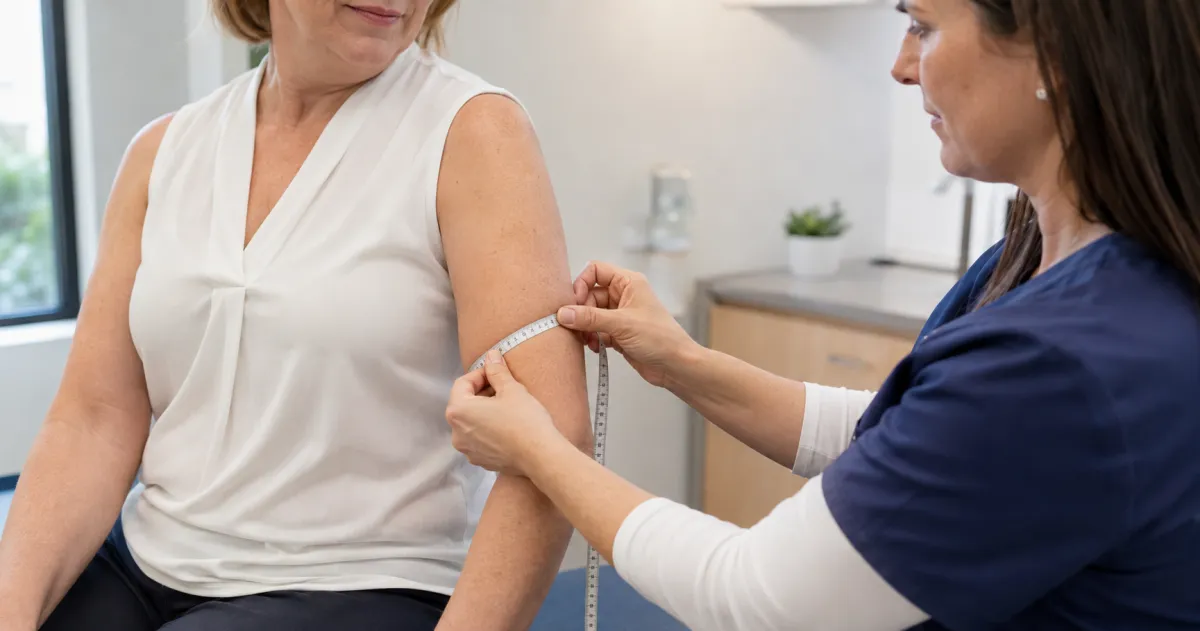
Speaking of measurement: the NCI summary referenced above notes that the most common diagnostic method is circumferential measurement of the arm at specific anatomical landmarks, comparing the affected arm to the unaffected one. The APTA guideline goes further, finding that a volume ratio of 1.04 between limbs may indicate upper extremity lymphedema. In plain terms, a four percent difference is enough to act on. That is a small number, and it is the argument for getting measured early rather than waiting until the difference is obvious.
What Medicare Covers in 2026
This changed, and many patients still do not know it. Medicare's coverage page for lymphedema compression treatment items confirms that Part B covers standard and custom-fitted gradient compression garments, gradient compression wraps with adjustable straps, and compression bandaging supplies. You must have a lymphedema diagnosis and your doctor or other qualified provider must order the items. After you meet the Part B deductible, you pay 20 percent of the Medicare-approved amount.
The covered list is broader than most people expect. CMS's detail on the benefit category includes both daytime and nighttime garments at different compression levels, bandaging systems and supplies for the initial decongestion phase and the maintenance phase, and aids for putting garments on and taking them off. Medicare pays for both standard and custom fitted garments, with custom fitted defined as uniquely sized and shaped to the exact dimensions of the affected body part.
For the full picture on eligibility, quantity limits, and reorder schedules, see What the Lymphedema Treatment Act Means for NJ Patients in 2026.
From Our Fitting Room: What We See Most
After years of fitting upper extremity patients across Bergen and Passaic County, a few patterns repeat.
The hand gets forgotten. A patient comes in with a well-fitted sleeve and a swollen hand, frustrated that compression "is not working." It is working. It is just stopping at the wrist.
Patients wear a garment past its life. Elastic fatigues. A sleeve worn daily loses meaningful compression in roughly three to six months, and a garment that still fits comfortably is often a garment that has stopped doing its job. Comfort is not the test. Replacement schedule is.
One sleeve is not enough. You need a second garment in rotation so one can be washed and dried while the other is worn. Patients who own a single sleeve wear it dirty or skip days.
Retail sleeves get mistaken for medical ones. An athletic or drugstore arm sleeve is not made to a therapeutic pressure profile and is not a substitute for a prescribed lymphedema sleeve. We fit medical grade garments from the major lymphedema manufacturers, and we will tell you honestly when an off-the-shelf option will serve you just as well as a custom one.
Off-the-shelf gets stretched past its purpose. Ready-to-wear works well for limbs within standard sizing. For an arm with shape distortion, a deep wrist crease, or a large upper arm relative to the forearm, an off-the-shelf sleeve will tourniquet somewhere. That is when custom is not a luxury.
People stop moving the arm. Old advice told breast cancer patients to protect the limb by avoiding exertion. Current guidance is the opposite. Controlled movement drives the muscle pump that makes compression work at all. Talk to your care team about what is appropriate, but the default is not rest.
How to Get Fitted: The Actual Steps
Get the diagnosis documented. Your physician records the lymphedema diagnosis with the appropriate ICD-10 code and notes affected body parts.
Get a standard written order. It should specify anatomical location, garment type (daytime or nighttime), compression level in mmHg, standard versus custom, and quantity.
Schedule a fitting. At MCB DME the fitting is free. We measure at defined landmarks on both arms, assess skin condition and limb shape, and recommend knit type and pressure.
We verify benefits and handle authorization. You do not chase your insurer. We do.
Garments arrive and we fit them on you. Standard garments are usually delivered and fitted 5 to 7 business days after insurance authorization, and custom garments take approximately 6 to 8 weeks.
We set your reorder schedule. Based on your coverage, so you are not left in a worn-out sleeve.

When to Call Someone
Contact your care team promptly if you notice a new tight or heavy feeling in the arm, rings or sleeves suddenly fitting differently, redness or warmth in the limb, fever, or a rapid increase in swelling. Redness with warmth and fever can signal cellulitis, which is a medical situation, not a garment-fit situation.
Call us if your garment leaves deep marks, rolls, cuts at the wrist or elbow, causes numbness or tingling, or if your hand swells while wearing your sleeve. Any of those means the fit or the prescription needs revisiting.
Frequently Asked Questions
How many hours a day should I wear an arm compression sleeve? Most patients wear a daytime medical arm compression sleeve during waking hours, generally 12 or more hours, and remove it for sleep unless a nighttime garment is prescribed. Follow your clinician's specific instruction.
Can you sleep with a compression sleeve on your arm? Not with a standard daytime sleeve. Daytime sleeves are elastic and rely on muscle movement to work, and wearing one overnight can create pressure points. If you need overnight containment, ask about a dedicated nighttime garment, which uses foam or quilted chambers to deliver low, sustained pressure while you sleep.
Does an arm compression sleeve actually work? Yes, when it is medical grade, correctly sized, and worn consistently. Graduated compression reduces swelling, protects range of motion, and lowers infection risk. Research on mild breast cancer-related lymphedema found that a class 1 sleeve applied soon after early diagnosis helped prevent progression to chronic swelling. Retail and athletic sleeves are not equivalent and are not prescribed at therapeutic pressures.
Do I need a gauntlet if only my arm is swollen? If the hand is genuinely unaffected, a sleeve alone may be appropriate. But a sleeve can push fluid into an unsupported hand, which is why a hand and arm compression sleeve combination is reassessed at every fitting. If your hand swells while wearing your sleeve, the prescription is incomplete.
Which arm do you wear a compression sleeve on? The affected arm, meaning the side where lymph nodes were removed, radiated, or where swelling is present. Compression is not worn preventively on the unaffected arm. If both arms are affected, both are fitted and measured separately.
What is the difference between circular knit and flat knit arm sleeves? Circular knit is seamless, thinner, and more discreet, suited to mild or moderate swelling with normal limb shape. Flat knit is seamed, firmer, and better for limbs with shape distortion, skin folds, or advanced swelling, because it will not cut into a crease.
What mmHg arm compression sleeve do I need? Pressure is prescribed, not chosen by preference. The International Lymphedema Framework recommends 14 to 18 mmHg for mild upper limb lymphedema without shape distortion, and class 1 sleeves at 15 to 21 mmHg are commonly prescribed for mild cases. Moderate to severe swelling typically moves to 20-30 mmHg or 30-40 mmHg with flat knit or custom construction. More pressure is not better, because excess pressure can collapse the superficial lymphatic vessels.
How often should I replace my medical arm compression sleeve? Roughly every three to six months with daily wear. Elastic loses recoil long before a garment looks worn out, so comfort is not the test. Keep two sleeves in rotation so one can be washed while the other is worn.
Key Takeaways
A lymphedema sleeve is part of a system: sleeve, hand piece, nighttime garment, and sometimes shoulder or truncal compression.
A sleeve without a gauntlet or glove can push fluid into the hand. If your hand swells, the prescription is incomplete.
Pressure is prescribed, not guessed. Mild upper limb lymphedema is often managed at 15 to 21 mmHg, not the highest number available.
A four percent volume difference between limbs is clinically meaningful. Get measured early.
Medical grade garments are not the same product as athletic or retail arm sleeves.
Medicare Part B has covered lymphedema compression garments, wraps, and bandaging supplies since January 2024, day and night, standard and custom.
Replace garments every three to six months and keep two in rotation.
Movement is part of the therapy, not a risk to avoid.
Next Steps
Patients: If you are dealing with arm, hand, or chest swelling, schedule a free fitting at our Hawthorne showroom or ask about a telehealth measurement. Searching for a lymphedema sleeve near you in North Jersey? Our fitting room is at 293 Lafayette Avenue, Suite 104, Hawthorne, NJ 07506, and we serve patients across Bergen and Passaic County. Start at mcbdme.com/patients or contact our team. For quick questions any time, ask Lumi, our 24/7 chatbot in the bottom right corner of every page on mcbdme.com.
Referring providers: We handle measurement, manufacturer selection, custom orders, insurance verification, and direct billing for upper extremity compression. Prescription forms and fitter information are at mcbdme.com/providers, and documentation requirements are laid out in A NJ Doctor's Guide to Referring Lymphedema Patients for DME.
Related reading: Lymphedema Services | Compression Therapy | Nighttime Compression Garments | How to Use a Lymphedema Pump at Home
Medical disclaimer: This article is for educational purposes only and is not a substitute for medical advice. Always consult a licensed healthcare professional about your specific condition, and follow your prescribing clinician's instructions regarding compression level and wear schedule.