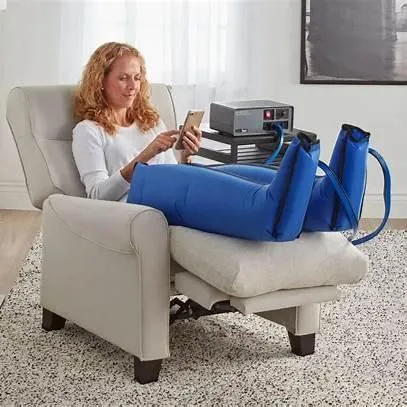
How Long Does Lymphedema Pump Treatment Take?
If your doctor has recommended a lymphedema pump (also called a pneumatic compression device, or PCD), one of the very first questions you probably have is the most practical one: how long does this actually take?
The short answer most patients want first: a typical home lymphedema pump session is 30 to 60 minutes, used once or twice a day, every day. We recommend 1 hour for maximum benefit.
The longer answer has more layers, because "how long" can mean five different things at once: how long is a single session, how often per week, how long before symptoms improve, how long is the intensive phase, and how long do you need to stay on the pump overall. This guide walks through each one, plus the realistic timeline for getting the pump in the first place under Medicare and most commercial insurance.
This article is written for patients managing lymphedema or lipedema, their caregivers, and referring clinicians who want a clear resource to share. For our local product details, see our lymphedema therapy page. For quick questions, Lumi, our 24/7 chatbot, is available at the bottom right of every page on mcbdme.com.
The Quick Answer (for the patient skimming on their phone)
Session length: 30 to 60 minutes is typical. Some protocols run up to 90 or 120 minutes.
Frequency: Once or twice per day, most days of the week.
Time to visible improvement: A few weeks of consistent daily use, with continued gains over several months.
How long you keep using it: Lymphedema is a lifelong condition. The pump is typically used long-term, often indefinitely, with adjusted frequency once you reach a maintenance phase.
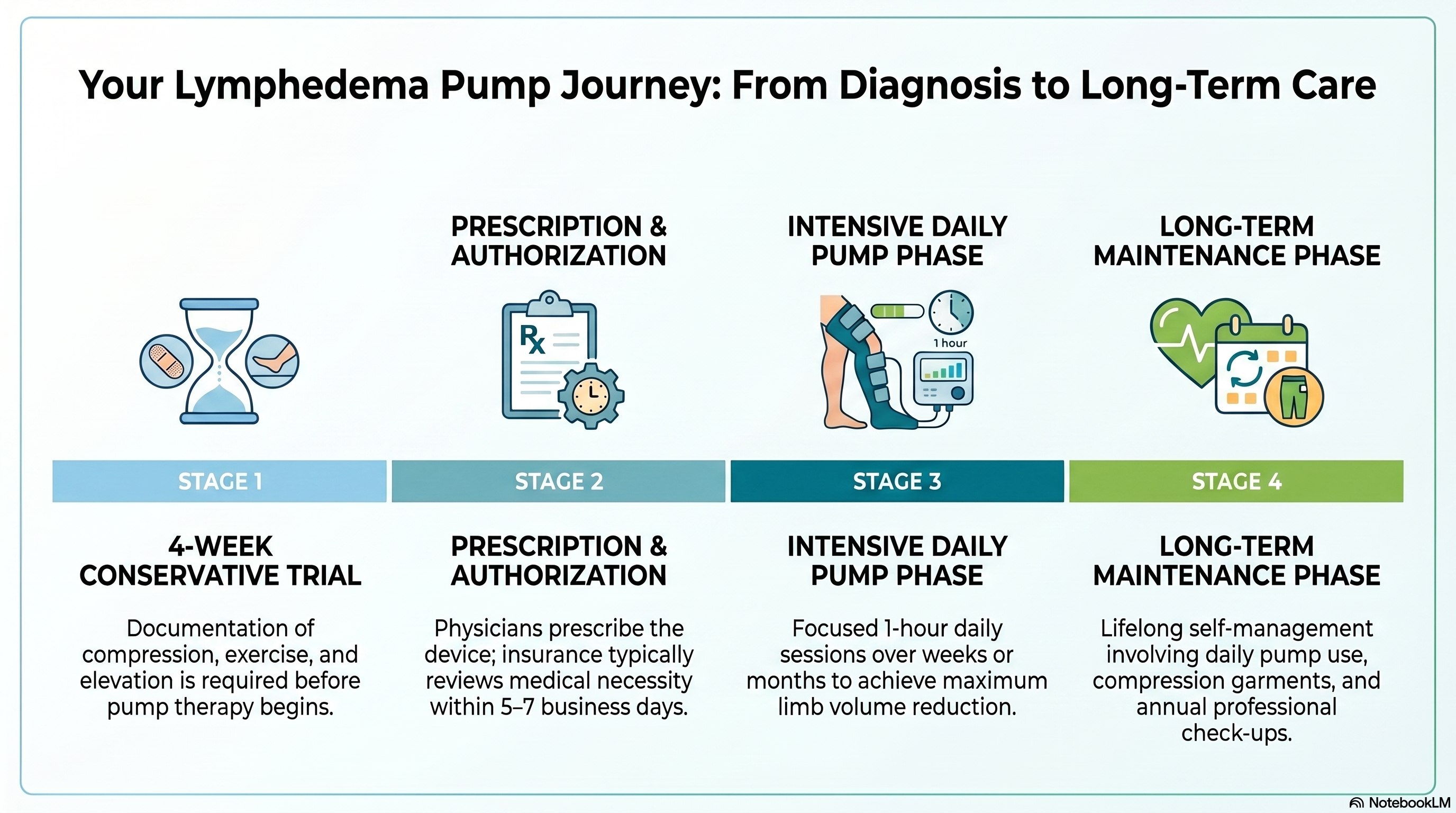
From prescription to delivery: Plan on roughly 4 to 8 weeks total, because Medicare requires a documented 4-week trial of conservative therapy (garments, exercise, elevation) before approving the pump.
Everything else below explains the why.
How Long Is a Single Pump Session?
For most patients using home lymphedema pumps, a single session runs 30 to 60 minutes. Some protocols and some patients (particularly those with more advanced lymphedema or larger limb volumes) use sessions of 60 to 90 minutes, and a few clinical pathways extend to 120 minutes.
A few things drive the actual number your prescribing clinician will recommend:
Pump type. Single-chamber pumps (HCPCS code E0650) typically use shorter sessions. Multi-chamber sequential pumps (E0651) and advanced calibrated-gradient devices (E0652) often have manufacturer-recommended cycle lengths in the 45 to 60 minute range.
Severity and stage of your lymphedema.
Whether you are in the intensive (reduction) phase or the maintenance phase.
Your therapist's complete decongestive therapy plan, including whether you are also doing manual lymphatic drainage and bandaging or wearing compression garments.
What you should not do is set the timer based on what feels convenient. The evidence supporting pneumatic compression therapy is built on consistent sessions at the prescribed duration, not "however long I have today."
How Often Should You Use the Pump?
Once or twice per day is the most common schedule. Twice-daily protocols are more common during the initial intensive reduction phase. Once-daily protocols are more common in the maintenance phase or in patients with milder disease.
Most patients run their daily session at a consistent time. Evenings are popular because patients can pair the session with reading, watching TV, or relaxing on a couch. Some patients prefer mornings to reduce limb size before putting on their daytime garment.
A few practical points:
The pump session does not replace your daytime compression garment. Garments hold the gains the pump produces.
Skipping sessions for several days in a row typically allows fluid to reaccumulate. The therapy works through daily lymphatic clearance, not occasional flushing.
If you find yourself routinely too tired, busy, or uncomfortable to sit through your prescribed session, that is something to flag to your therapist or DME provider. The plan can usually be adjusted.
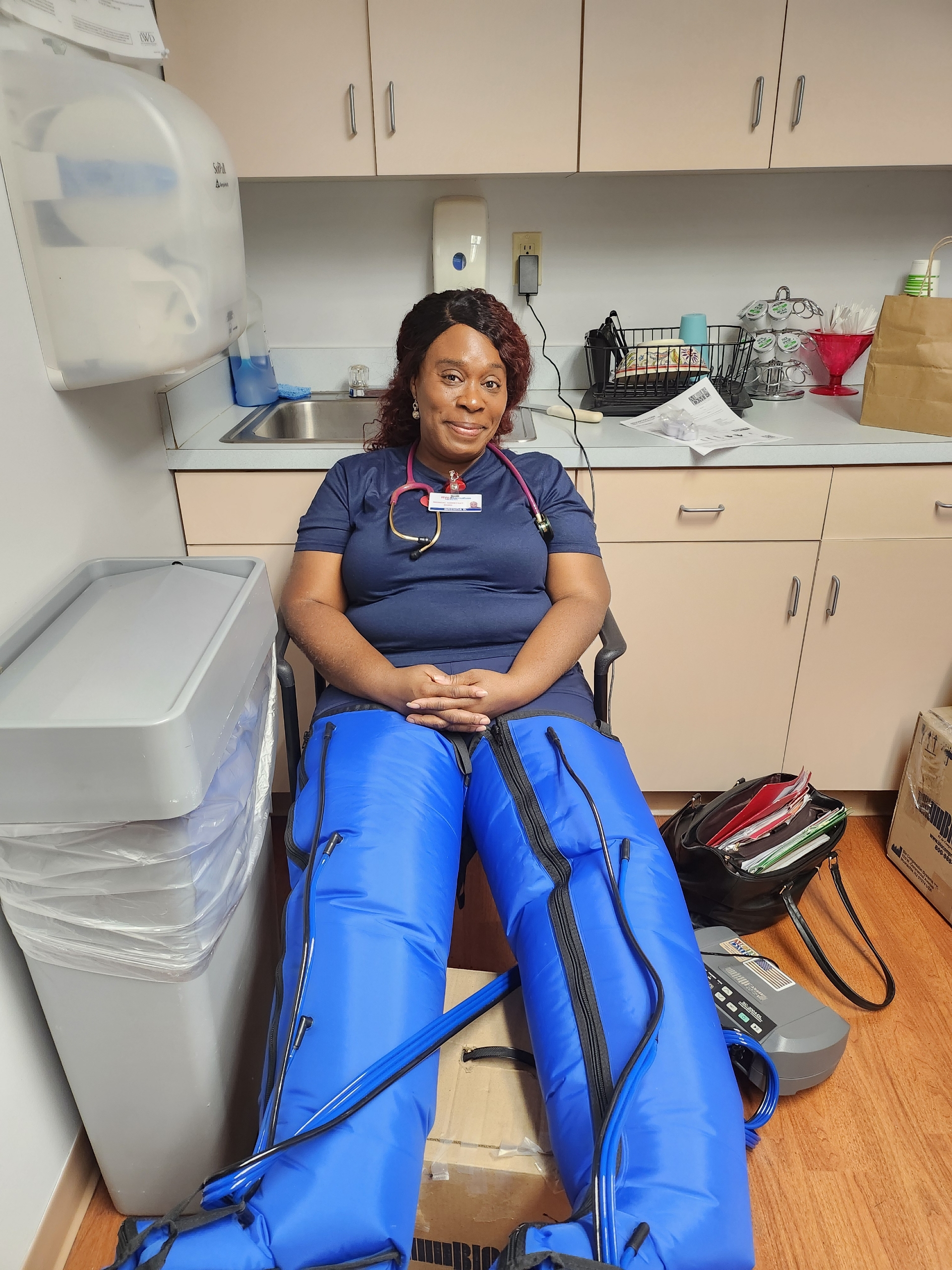
How Long Before You See Results?
This is the question patients most want answered upfront, and the honest answer is minutess, not days.
You may notice some immediate softening or a small reduction in limb size after your very first sessions. That is real, but it is also reversible. The clinically meaningful change (sustained reduction in limb circumference, improved skin texture, less heaviness, fewer infections) typically develops over 2 to 12 weeks of consistent daily use, with continued gains over several more months for some patients.
Two things to keep in mind during this window:
Measure, do not guess. Most therapists track limb circumference at defined points (for example, every 4 cm along the limb) at baseline and every few weeks. Visual estimation is unreliable. The numbers will often improve before the limb "looks" different to you in the mirror.
Stick with the plan even when progress feels slow. Lymphatic remodeling is gradual. Patients who abandon the pump after one or two weeks because "it isn't working" generally have not given the therapy a fair trial.
If you are several weeks in and seeing no measurable change at all, that is a reason to call your prescribing clinician, your lymphedema therapist, or your DME provider. The pump configuration, garment fit, daily duration, or pressure setting may need to be reconsidered. It is not a reason to quietly give up.
The Intensive Phase vs. The Maintenance Phase
Lymphedema care, including pump therapy, has two natural phases.
Phase 1: Intensive reduction. Goal: shrink the affected limb as much as possible. This phase typically involves daily (often twice-daily) pump sessions, often combined with bandaging, manual lymphatic drainage performed by a certified lymphedema therapist, exercise, and skin care. This phase commonly lasts a few weeks to a few months.
Phase 2: Maintenance. Goal: keep the limb at its reduced size and prevent setbacks. Daily or near-daily pump use continues, but session frequency and the rest of the care plan often relax to a sustainable rhythm. Compression garments (daytime, and often nighttime as well) play a larger role. See our companion guide on nighttime compression garments for lymphedema for more on the garment side of maintenance.
The pump is not a "use it for six weeks and you're done" device. For most patients, it is part of long-term care, like a CPAP machine for sleep apnea or insulin for diabetes. The intensity changes; the underlying need usually does not.
How Long Will You Need to Keep Using the Pump?
Lymphedema is a chronic, progressive condition. There is no cure, and stopping treatment generally leads to fluid re-accumulation, increased risk of skin infections (cellulitis), and a slow drift back toward worse symptoms.
That said, "lifelong" does not mean "the same intensity forever." Many patients move from twice-daily pump sessions during reduction to once-daily or every-other-day sessions during stable maintenance. Some patients eventually use the pump primarily during flares, after long flights, or during periods of higher symptom burden, while relying on garments the rest of the time. Your therapist and prescribing clinician should re-evaluate the plan at least annually.
The pump itself has a defined Medicare-recognized reasonable useful lifetime of 5 years, after which a replacement is potentially covered if medical necessity continues.

How Long Does It Take to Get the Pump in the First Place?
This is the timeline that most surprises patients. It is not the device itself that takes time. It is the documented conservative therapy trial that Medicare and most commercial payers require before approving the pump.
Under Medicare National Coverage Determination 280.6, pneumatic compression devices for lymphedema are covered in the home setting only if:
The patient has undergone a four-week trial of conservative therapy, and
The treating physician determines there has been no significant improvement, or significant symptoms remain after the trial.
The conservative therapy trial must include:
An appropriate compression bandage system or compression garment providing adequate graduated compression,
Exercise, and
Elevation of the limb.
In practice, most patients can expect the following sequence:
Diagnosis and referral to a lymphedema therapist or vascular specialist (timing varies).
Four-week conservative therapy trial with documented use of compression, exercise, and elevation.
Reassessment by the prescribing clinician at the end of the trial. If significant symptoms remain, a pump is medically indicated.
Written order and face-to-face encounter documenting medical necessity.
DME provider intake. MCB DME verifies benefits, completes prior authorization where required, and coordinates delivery. This typically takes a few business days to two weeks depending on the payer.
Delivery, fitting, and education in the patient's home, with full instruction on use, garment care, and pressure settings.
Realistically, plan on 4 to 8 weeks from "this might be a good idea" to "the pump is in my home and I am using it." Most of that is the conservative therapy trial, not the supplier side.
For more on how the broader process works, see our for patients page and our compression therapy overview.
What Affects How Long YOUR Treatment Takes?
The averages above are useful as a frame, but the patient in front of us is rarely an average. Factors that legitimately stretch or shorten your specific timeline include:
Severity and stage at diagnosis. Earlier-stage lymphedema responds faster.
Cause. Cancer-treatment-related lymphedema, primary (congenital) lymphedema, post-surgical edema, and phlebolymphedema (related to chronic venous insufficiency) have different trajectories.
Body location. Lower limbs typically require more time than upper limbs to show measurable reduction.
Coexisting conditions. Obesity, diabetes, recurrent cellulitis, and venous disease all influence pace.
Adherence. Patients using the pump as prescribed every day, every week, see results faster than patients with stop-and-start use.
The rest of the care plan. Patients combining pump therapy with garments, manual lymphatic drainage, skin care, and exercise reliably outperform patients relying on the pump alone. The National Lymphedema Network treats pneumatic compression as one piece of complete decongestive therapy, not a standalone fix.
Garment fit. Poorly fitting garments worn between pump sessions allow fluid to creep back in.
Common Mistakes That Extend the Timeline
Skipping sessions or doing "as needed" use. This is the single most common reason patients feel "the pump isn't working."
Treating the pump as the entire plan. Pump alone, without garments, exercise, and elevation, underperforms.
Stopping at the end of the intensive phase. Without maintenance, gains regress.
Wearing the wrong garment between sessions. Off-the-shelf garments at the wrong compression class or wrong size negate much of the pump's benefit.
Not flagging problems early. If something hurts, slips, or seems wrong, call the DME provider before deciding the therapy is not for you.
When to Call Your Clinician or DME Provider
Reach out promptly if you experience any of the following:
New or worsening pain during pump sessions,
New numbness, tingling, or skin color changes,
Increased swelling above the cuff (proximally) during or after sessions,
Open wounds, blisters, or skin breakdown under the garment,
Signs of infection (redness, heat, fever, red streaks, rapidly worsening swelling), which can indicate cellulitis and need urgent medical attention,
No measurable improvement after 6 to 8 weeks of consistent use.
For ongoing day-to-day questions about your specific MCB DME equipment, fit, or settings, Lumi (our 24/7 chatbot at mcbdme.com) can route you to the right resource between appointments.
Frequently Asked Questions
Can I split my pump session into shorter blocks?
In some cases yes. Talk to your prescribing clinician or therapist before changing the schedule. Sessions are designed around the time it takes to move lymphatic fluid through the pump's cycle, so cutting them too short can undercut the benefit.
Can I use the pump for longer than prescribed?
Not usually a good idea without clinical guidance. Excessive pressure or duration can be uncomfortable and, in rare cases, contribute to fluid shifts above the cuff. Stick to the prescribed plan and discuss any changes with your therapist or physician.
Does Medicare cover lymphedema pumps in 2026?
Yes, under NCD 280.6, once a four-week conservative therapy trial is documented and the treating clinician confirms significant symptoms remain. Most commercial insurers follow similar criteria.
What is the difference between an E0650, E0651, and E0652 pump?
These are the HCPCS codes Medicare uses for pneumatic compression devices: E0650 (non-segmented), E0651 (segmented without calibrated gradient pressure), and E0652 (segmented with calibrated gradient pressure, the "advanced" devices). The right choice depends on your diagnosis, body location, and the prescribing clinician's judgment.
Is the pump the same as an arterial pump for PAD?
No. Lymphedema pumps are clinically very different from arterial pumps used for peripheral arterial disease. They use different pressures, different cycle speeds, and different HCPCS codes. See our arterial compression therapy guide for the contrast.
Will my pump be replaced if it breaks?
MCB DME services and repairs all dispensed equipment. Medicare and most commercial insurers consider lymphedema pumps to have a 5-year reasonable useful lifetime, after which a replacement may be covered if medical necessity continues.
Can I travel with my pump?
Yes. Most modern lymphedema pumps are designed for home use but are portable. We can advise on travel cases, voltage considerations for international travel, and TSA documentation.
Key Takeaways
A typical home lymphedema pump session runs 30 to 60 minutes, once or twice daily.
Visible, sustained results usually develop over 2 to 12 weeks of consistent daily use.
Treatment is long-term, not a short-course intervention. Intensity adjusts over time; the underlying need usually does not.
Medicare requires a documented 4-week conservative therapy trial (garments, exercise, elevation) before approving a pump, which is the main reason getting the device takes 4 to 8 weeks from first conversation to delivery.
The pump works best as part of complete decongestive therapy, alongside compression garments, exercise, manual lymphatic drainage where appropriate, and good skin care.
Lymphedema pumps and arterial pumps are different devices for different conditions and are not interchangeable.
Next Steps
If you or a family member has been diagnosed with lymphedema, lipedema, or phlebolymphedema, and your clinician has mentioned pump therapy as a next step, MCB DME can help you map out the timeline, verify your benefits, and coordinate with your prescribing physician and lymphedema therapist.
Patients: Visit our lymphedema therapy page for product information, or contact our team to start a benefits check. For quick questions, ask Lumi (24/7 chatbot, bottom right of every page on mcbdme.com).
Referring clinicians: Visit our providers page for prescription forms, conservative therapy documentation templates, and referral support.
Related Resources:
Arterial Compression Therapy for PAD: The Clinical Case for a Non-Surgical Option
How Compression Therapy Supports Mobility in Arthritis Patients
MCB DME is a durable medical equipment provider based in Hawthorne, New Jersey, specializing in lymphedema management, compression therapy, arterial compression, bracing, diabetic and orthopedic footwear, and prosthetics. MCB DME is a Medicare-enrolled DMEPOS supplier and bills Medicare, Medicaid, and most commercial insurance plans directly for covered items.
Disclaimer: This article is for educational purposes only and is not a substitute for medical advice. Treatment plans for lymphedema and pump therapy schedules should be individualized with a lymphedema therapist, vascular specialist, oncologist, or primary care physician familiar with your case. Coverage, documentation requirements, and HCPCS coding are subject to change; always verify current payer policies for guidance specific to your situation.