Nighttime Compression Garments for Lymphedema | MCB DME
Lymphedema doesn’t take the night off. The lymphatic system continues working — slowly, gravity-dependent, and without the muscle-pump support of daytime activity — every hour you’re asleep. For people managing chronic lymphedema, edema, or lipo-lymphedema, that overnight stretch is when fluid quietly re-accumulates and progress made during the day starts to reverse.
This guide is for patients who already wear daytime compression and want to protect those gains, caregivers learning the routine alongside a loved one, and referring providers looking for a clear, current overview of what nighttime garments do, who qualifies, and which products patients are most likely to receive. We’ll walk through how nighttime garments work, the five most-prescribed options on the U.S. market — Mobiderm by Thuasne, circaid Profile by Medi, Juzo Night, the Sigvaris ChipSleeve, and TributeNight by L&R/Solaris — and exactly what the Lymphedema Treatment Act now covers under Medicare Part B.
By the end, you’ll know whether a nighttime garment fits your treatment plan, which features matter for your specific limb and lifestyle, and how to obtain one through MCB DME with insurance billing handled for you.
What Is a Nighttime Compression Garment?
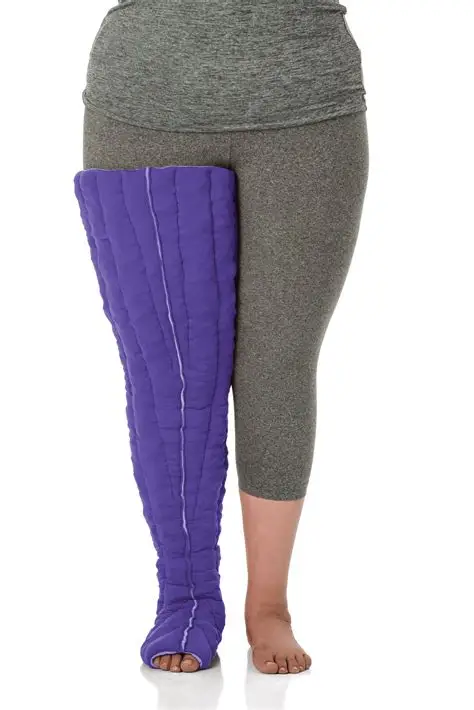
A nighttime compression garment is a low-stretch, foam-padded sleeve, stocking, or wrap designed to deliver gentle, sustained compression to a limb affected by lymphedema or chronic edema during sleep and other periods of low activity. Unlike daytime medical-grade stockings — which use higher elastic compression to counter gravity while you’re upright — nighttime garments apply lower pressure (typically 10–25 mmHg, often padded with foam blocks, chips, or channels) so they remain safe and comfortable for hours of horizontal rest.
Their job isn’t to replicate daytime therapy. Their job is to maintain limb volume overnight, prevent fluid rebound, soften fibrotic tissue, and reduce the burden of self-bandaging — which many patients find time-consuming, difficult to apply correctly, and a barrier to long-term compliance.
Why Nighttime Garments Are Foundational to Total Care
Complete decongestive therapy (CDT) — the gold standard for lymphedema management endorsed by organizations such as the Lymphology Association of North America— is built on four pillars: manual lymphatic drainage, compression, exercise, and skin care. Compression is the only one of the four that can theoretically continue 24 hours a day. When patients only compress during waking hours, they’re effectively giving the disease an unsupervised window every night.
The benefits of consistent nighttime compression include:
Volume stabilization. The MARILYN randomized pilot trial published in Supportive Care in Cancer found that adding an auto-adjustable nighttime sleeve during the maintenance phase of breast-cancer-related lymphedema helped stabilize limb volume compared to daytime hosiery alone (study on PubMed Central).
Easier morning donning. Patients who wear a nighttime garment frequently report that their daytime stocking goes on more easily because the limb hasn’t refilled overnight.
Softening of fibrotic tissue. Foam against the skin creates pressure differentials that gently mobilize hardened, indurated areas — something a smooth elastic stocking can’t do.
Better sleep quality. Patients who previously bandaged at night often report relief from the discomfort, slipping, and skin indentations of multi-layer wrapping.
Improved compliance. A garment that slides on in 30 seconds beats 15 minutes of self-bandaging — and that compliance gap is often the difference between stable and progressive disease.
For a deeper background on the underlying condition, see our overview at mcbdme.com/lymphedema.
How Nighttime Garments Work: The Foam Difference
Almost every nighttime garment on the U.S. market relies on some form of engineered foam layered between two fabric surfaces. The foam may be cut into:
Cubes or blocks(Thuasne Mobiderm) — discrete raised squares that create alternating high- and low-pressure zones.
Channels(medi circaid Profile, Juzo Night, Solaris TributeNight) — directional foam strips that guide lymph fluid toward functioning lymph nodes.
Loose chips(Sigvaris ChipSleeve) — open-cell foam pieces that conform around irregular limb shapes and fibrotic ridges.
When the garment is worn, gentle compression presses the foam into the skin. The peaks and valleys of the foam createpressure differentialsat the tissue level — a passive, all-night version of the manual lymphatic drainage techniques a certified therapist performs in clinic. This stimulates the initial lymphatic capillaries, encourages fluid re-absorption, and breaks up superficial fibrosis over time.
It’s a quiet kind of therapy. You don’t feel it working. You wake up to a limb that hasn’t refilled.
The Five Major Nighttime Garments — What Sets Each Apart
Patients are sometimes told “here’s your nighttime garment” without much explanation of why one was chosen over another. Here’s a clinical-style overview of the five most commonly dispensed options.
1. Mobiderm by Thuasne
Thuasne’s patented Mobiderm technology uses discrete foam blocks sewn between two non-woven layers. The blocks create localized pressure differentials that the manufacturer’s clinical literature describes as mobilizing edematous and indurated subcutaneous tissue. Mobiderm is available as:
Mobiderm Standard arm sleeves, gloves, and gauntlets— sized off-the-shelf, primarily for the maintenance phase.
Mobiderm Autofit— an adjustable, semi-open garment with hook-and-loop straps that allow patients to fine-tune compression as the limb changes. Autofit is available for arms and below-knee/full-leg, and is the version studied in the MARILYN trial.
Best fit for:patients who want clear evidence-based support and adjustable, self-managed nighttime compression. Mobiderm Autofit is particularly popular for breast-cancer-related upper-limb lymphedema.
2. circaid Profile by Medi
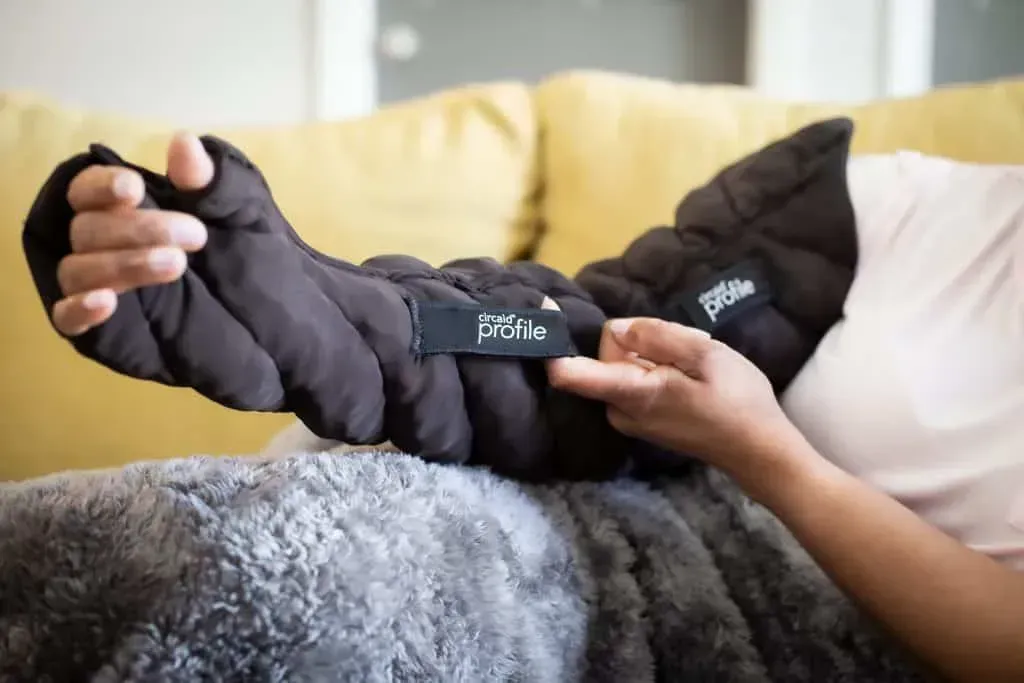
The circaid Profile is Medi’s foam sleeve solution for nighttime compression of the arm or leg. It features engineered directional foam channels designed to break down fibrotic tissue while moving lymph along anatomical pathways. Patient-friendly details include:
EZ-on tabs for one-handed donning.
A profile anchor system that holds the sleeve in place during sleep.
brrr° Triple Chill Effect fabric to reduce skin temperature — a meaningful comfort upgrade for hot sleepers.
A1-year “New You!” guarantee offering one free reduction alteration on custom-made garments when the patient’s limb shrinks.
Available in both ready-to-wear (sixteen sizes, two lengths) and custom configurations for upper and lower extremities.
Best fit for: patients who run warm at night, those new to nighttime garments who want something forgiving and easy to apply, and patients with significant fibrosis who benefit from Medi’s deep foam channels.
3. Juzo Night
Juzo Night is a lightweight nighttime arm sleeve with vertical stitched foam channels built into a soft outer fabric. Distinguishing features include:
Touch-fastener (hook-and-loop) tabs that allow individual adjustment along the length of the sleeve.
A removable incorporated lining that can be used or omitted depending on skin sensitivity.
Mild graduated compression suitable for transition and maintenance phases.
Juzo positions Juzo Night specifically as a complement to circular- or flat-knit daytime sleeves — patients use the daytime garment from morning to evening, then transition to Juzo Night at bedtime.
Best fit for: arm lymphedema patients in the maintenance phase who want individually adjustable compression and a particularly low-profile, lightweight feel.
4. Sigvaris ChipSleeve
The Sigvaris ChipSleeve takes a different approach: instead of structured foam blocks or channels, it uses open-cell foam chips loose-filled inside a four-way-stretch outer sleeve. An included Oversleeve layered on top compresses the chips into the limb and provides a moderate gradient of approximately 15–25 mmHg.
The result is a conforming, almost cocoon-like fit that adapts to irregular limb shapes — particularly useful for patients with significant tissue fibrosis or asymmetric swelling. The garment is latex- and rubber-free and includes cotton liners that protect the chips and extend washing intervals.
ChipSleeve is available for the arm, calf-and-foot, and full leg, and it can be used both as an independent nighttime garment and as a liner under bandages during the intensive decongestive phase.
Best fit for: patients with fibrotic, irregularly shaped limbs; anyone who has struggled to get a smooth fit from structured foam-channel garments; patients who want one garment that pulls double duty for bandage liner and standalone night use.
5. TributeNight by L&R / Solaris
The Solaris Collection — now part of L&R USA— has been a fixture in lymphedema therapist toolkits for over twenty years. TributeNight is a fully custom-made garment built from individual measurements taken by a trained fitter. Its defining features:
Bi-directional gradient compression developed using pressure-mapping technology, designed to move interstitial fluid toward intact collateral pathways.
Chevron and directional foam channels that create localized tissue stretch as well as fluid movement.
A breathable, wickable microfiber outer fabric with thermal release.
A Sure-Fit guarantee with free alterations or remakes within 45 days, plus one free reduction alteration as the patient’s limb shrinks within the one-year warranty window.
Because TributeNight is fully custom, it’s typically prescribed for complex, severe, or atypically shaped lymphedema— including head-and-neck, truncal, genital, and pediatric cases that off-the-shelf products can’t accommodate.
Best fit for: moderate-to-severe lymphedema, unusual limb geometries, and patients who have tried ready-to-wear products without success.
How to Use Your Nighttime Garment
Whichever product is prescribed, the principles are similar:
Apply 30–60 minutes before bed. This gives the foam time to begin engaging the tissue while you’re still upright.
Apply over clean, dry skin. Most manufacturers recommend a thin cotton liner (often included) to protect the foam from skin oils and lotion.
Smooth out folds and twists. Bunching changes the pressure profile and can cause uncomfortable indentations.
Check skin every morning. Look for unusual redness, indentations, or numbness. Mild marking that fades within 30 minutes is normal; persistent marks warrant a call to your therapist.
Wash according to the manufacturer’s instructions— typically machine wash gentle, mild detergent, no bleach, no fabric softener. Most foam garments tolerate low-heat dryer cycles, which can also help re-fluff foam chips.
Replace on schedule. Foam loses its therapeutic recoil over time. Most manufacturers and Medicare anticipate a two-year service life for nighttime garments.
For broader compression therapy guidance, see our service page at mcbdme.com/compression.
Insurance Coverage: What the Lymphedema Treatment Act Changed
Until 2024, Medicare did not pay for compression garments at all — a long-standing coverage gap that put thousands of dollars of out-of-pocket cost on patients managing a chronic disease. The Lymphedema Treatment Act (LTA), signed into law in late 2022 and effective January 1, 2024, changed that. Medicare Part B now covers lymphedema compression treatment items as a defined Durable Medical Equipment, Prosthetics, Orthotics, and Supplies (DMEPOS) benefit category.
What’s covered under the LTA:
Standard and custom-fitted daytime gradient compression garments (sleeves, stockings, gauntlets, gloves)
Nighttime compression garments, including the foam-padded products above
Compression bandaging systems and supplies for the decongestive phase
Adjustable wraps with hook-and-loop straps
Accessories— donning aids, fillers, linings, padding, zippers
Frequency limits (per affected body part):
Daytime garments:3 every 6 months
Nighttime garments:2 every 2 years
Replacement is also allowed for loss, theft, irreparable damage, or significant change in the patient’s condition.
What patients pay: Once the annual Medicare Part B deductible is met, Medicare pays 80% of the approved amount. The patient (or their Medigap/secondary insurance) pays the remaining 20%. Many commercial insurance plans have aligned their nighttime garment coverage with the Medicare framework, though specific limits vary by plan.
Eligibility requires:
A confirmed lymphedema diagnosis (covered ICD-10 codes include I89.0, Q82.0, I97.2, and I97.89)
A prescription from an authorized practitioner
The garment furnished by an enrolled DMEPOS supplier
MCB DME is a Medicare-enrolled DMEPOS supplier and bills directly for covered nighttime garments — patients don’t need to navigate the paperwork alone.
Expert Insight: What We See in Practice
A few patterns we’ve consistently observed working with referring lymphedema therapists and patients across northern New Jersey:
Compliance is the leading predictor of outcomes. Patients who can tolerate their nighttime garment for 5–7 nights a week do measurably better than patients who only manage 1–2 nights. Comfort matters more than maximum compression.
The first product isn’t always the right product. It’s common to trial one ready-to-wear option, identify what’s not working (heat, fit, application difficulty), and move to a different brand or to custom. Most manufacturers offer fit guarantees specifically to support this process.
Don’t wait until lymphedema is “bad enough.”Adding a nighttime garment in early-stage maintenance is far more effective than trying to recover after a flare.
Skin care is non-negotiable. Nighttime garments sit against skin for 8+ hours. A daily moisturizer (applied in the morning, well-absorbed before evening application) prevents most of the irritation we see clinically.
A travel letter helps. Patients flying with custom or foam-filled garments occasionally face questions at security. MCB DME holds an official BioCompression travel letter that any of our patients can request — see our contact page to ask for a copy.
Common Mistakes and Misconceptions
“My daytime stocking is enough.” Daytime stockings aren’t designed for horizontal wear and can actually cause harm overnight — indentations, slippage, and excessive proximal compression.
“It needs to feel tight to work.” Nighttime garments are intentionally lower in compression than daytime products. Tightness is not a quality measure.
“I’ll skip nights when I feel fine.” Lymphedema is silent until it isn’t. Consistent overnight compression is part of why some patients stay stable for years.
“Custom is always better.” Not necessarily — many patients are well-served by ready-to-wear sizes that arrive faster and cost less. Custom is the answer when a limb’s shape, severity, or location demands it.
“Insurance won’t cover it.” This was true through 2023. As of January 2024, it’s no longer true for Medicare beneficiaries, and most commercial plans have followed.
When to Seek Professional Help
Consult your lymphedema therapist or treating physician promptly if you experience:
New or worsening swelling that persists despite consistent garment use
Skin changes — redness, warmth, hardening, or breakdown
Discomfort, numbness, or color change in the limb after wearing the garment
A garment that no longer fits because of significant volume change (this is often a reason for a no-cost reduction alteration)
Any signs of infection — fever, streaking redness, increasing pain — which require urgent medical attention
If you don’t yet have a certified lymphedema therapist (CLT) involved in your care, the Lymphology Association of North America maintains a directory of certified specialists.
Frequently Asked Questions
Can I wear my daytime sleeve to bed if I don’t have a nighttime garment yet?
No. Daytime gradient compression is designed for an upright body fighting gravity. Worn lying down, it can cause indentations, slippage, and excessive proximal pressure. If a nighttime garment isn’t yet available, your therapist will typically prescribe self-bandaging until one arrives.
How long does a nighttime garment last?
Most manufacturers and Medicare anticipate a two-year service life. Foam loses recoil over time, and the therapeutic effect declines along with it. Replacement before two years is allowed when the garment is lost, damaged, or no longer fits.
Are nighttime compression garments covered by insurance?
Since January 1, 2024, Medicare Part B covers two nighttime compression garments per affected body part every two years for patients with a qualifying lymphedema diagnosis and prescription. Most commercial insurers have followed; coverage details vary by plan.
How do I choose between ready-to-wear and custom?
Start with ready-to-wear if your limb shape is reasonably standard and your lymphedema is mild to moderate. Move to custom (TributeNight, custom Mobiderm, custom circaid Profile) when limb geometry, severity, or unusual location prevents a good off-the-shelf fit. Your therapist’s measurements will guide the decision.
Will a nighttime compression garment be hot or sweaty?
Newer products specifically address this — circaid Profile uses brrr° cooling fabric, TributeNight uses moisture-wicking microfiber, and most foam designs now incorporate breathable outer layers. Heat sensitivity is a legitimate factor in product selection; tell your fitter.
Can I wear a nighttime garment during the day?
Some — like Mobiderm Autofit — are explicitly cleared for both day and night during certain treatment phases. Others are nighttime-only. Follow your therapist’s instructions; your prescription will specify.
What if my limb size changes?
Most major manufacturers offer at least one free reduction alteration when a custom garment is no longer the right size because of clinical improvement. medi’s “New You!” guarantee and Solaris’s reduction alteration policy are two examples.
How do I get one through MCB DME?
A prescription from your physician or nurse practitioner, plus your insurance information, is enough to start. We handle measurements, product selection, fitting, billing, and follow-up. Contact us at mcbdme.com/contactus.
Key Takeaways
Nighttime compression garments protect the volume gains made during daytime therapy and prevent overnight fluid rebound.
Foam — in blocks (Mobiderm), channels (circaid Profile, Juzo Night, TributeNight), or chips (ChipSleeve) — is the active therapeutic ingredient.
The five most-prescribed options each have a sweet spot: Mobiderm for evidence-backed adjustable arm therapy, circaid Profile for ease of use and cooling, Juzo Night for lightweight maintenance, ChipSleeve for irregular fibrotic limbs, and TributeNight for complex custom needs.
The Lymphedema Treatment Act made nighttime garments a Medicare-covered benefit as of January 1, 2024 — two garments per affected body part every two years.
Compliance, not maximum compression, drives outcomes. Comfort and ease of use are clinical features, not luxuries.
Next Steps
If you’ve been prescribed compression therapy, are wearing a daytime garment but waking up with morning swelling, or are a referring provider building a 24-hour care plan for a patient, a nighttime garment is likely the next conversation to have.
MCB DME is a Medicare-enrolled DMEPOS supplier serving patients across New Jersey and the broader region. Our team handles measurements, manufacturer selection, custom orders, insurance verification, and direct billing — and we work directly with referring physicians, lymphedema therapists, and oncology teams.
Patients: Visit mcbdme.com/patients or contact us to start the process.
Providers: Visit mcbdme.com/providers for prescription forms, fitter information, and referral support.
Other compression needs: Explore our full compression therapy services and lymphedema management resources.
Related Resources:
MCB DME is a durable medical equipment provider based in Hawthorne, New Jersey, specializing in lymphedema management, compression therapy, diabetic footwear, arterial pumps, and bracing and prosthetics. MCB DME is a Medicare-enrolled DMEPOS supplier and bills Medicare, Medicaid, and most commercial insurance plans directly for covered lymphedema compression treatment items.
Disclaimer: This article is for educational purposes only and is not a substitute for medical advice. Coverage, documentation requirements, and HCPCS coding are subject to change; always verify current payer policies for guidance specific to your situation. MCB DME does not guarantee insurance approval for specific devices or patients.