What the Lymphedema Treatment Act Means for NJ Patients in 2026 — And How to Get Your Supplies Covered

If you or someone you love has been managing lymphedema in New Jersey, you already know the daily reality: compression garments, bandaging supplies, careful skin care, and a relentless routine just to keep swelling under control. What you may not know is that a landmark federal law — one that took nearly a decade of advocacy to pass — is now fully in effect, and 2026 brings important updates that make it easier than ever to get your compression supplies covered.
This guide breaks down what the Lymphedema Treatment Act means for you right now, what changed at the start of 2026, and exactly how to work with your physician and a qualified DME supplier like MCB DME to get your compression garments covered at little to no out-of-pocket cost.
What Is the Lymphedema Treatment Act?
The Lymphedema Treatment Act (LTA) was signed into federal law on December 23, 2022, as part of the Consolidated Appropriations Act, and it took effect on January 1, 2024. The legislation received widespread support from patient advocacy groups, healthcare providers, lawmakers, and medical organizations such as the American Cancer Society and the National Lymphedema Network, and was designed to enhance Medicare coverage for doctor-prescribed compression supplies, which are essential for treating lymphedema.
Before the LTA, compression garments occupied a frustrating gray zone. Lymphedema treatment was considered a "secondary" benefit under Medicare and private insurance plans, resulting in limited or no coverage — putting a heavy financial burden on patients, who often had to pay out of pocket or forgo treatment altogether.
The LTA changed that by creating a brand-new dedicated benefit category within Medicare. This is the first time Medicare Part B has offered clear, dedicated coverage for devices specifically to treat lymphedema.
Who Qualifies?
Anyone who has a lymphedema diagnosis and Medicare coverage can receive LTA benefits. The coverage applies to people with primary lymphedema as well as lymphedema due to any other condition or cause, such as cancer-related lymphedema.
Lymphedema commonly develops after cancer treatments that remove or damage lymph nodes. It affects an estimated 3 to 5 million people nationally, with 1.5 to 3 million being Medicare beneficiaries. If you've had lymph nodes removed or damaged due to breast cancer, a pelvic surgery, or another surgical cause, you are among those most likely to qualify.
To receive coverage, you must meet all four of these conditions:
You have a formal lymphedema diagnosis documented in your medical record
You have Medicare Part B coverage
You have seen an authorized practitioner within the past 6 months who has documented a plan of care
You have a signed prescription for the specific compression items needed
If you have answered yes to all of the above, it is likely that Medicare will pay for your lymphedema products.
New Jersey falls under Medicare's Jurisdiction A, which covers CT, DE, MA, ME, MD, NH, NJ, NY, PA, RI, VT, and Washington D.C. Usmedicalcompressionalliance Claims from Bergen County patients are processed through this jurisdiction's DME MAC, and the billing guidance published by Noridian applies to all NJ suppliers.
What Does Medicare Actually Cover?
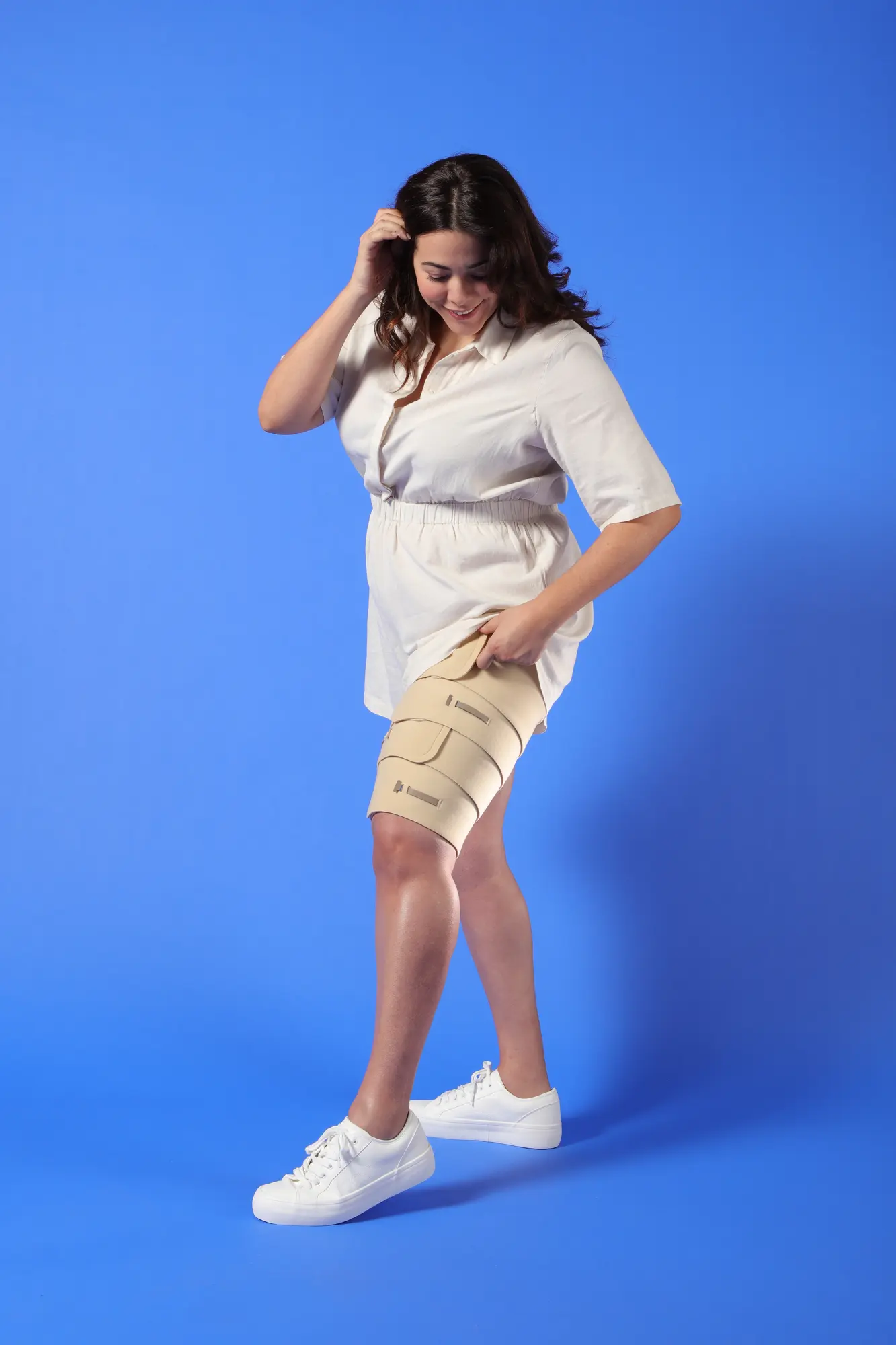
According to CMS, the benefit includes medically necessary treatment items for each affected body part, including standard and custom-fitted gradient compression garments for daytime and nighttime use, compression bandaging systems, and donning and doffing aids.
Here are the specific quantity limits:
Daytime compression garments: Up to three daytime garments per affected body part every six months.
Nighttime compression garments: Up to two nighttime garments per affected body part every two years.
Bandaging supplies: There is no set limit on bandaging supply coverage.
Accessories: Accessories such as zippers, linings, and padding necessary for the effective use of a garment are also covered.
Replacement garments: Medicare can pay for replacements when a garment or wrap is lost, stolen, or irreparably damaged, or when your medical condition changes enough that you need a new size or type.
If you have lymphedema in more than one limb, coverage can apply to each affected area — documentation and correct billing matter.
At MCB DME, we partner with leading compression vendors — including Thuasne — to offer both standard and custom-fitted garments that meet Medicare's coverage criteria. Our certified fitters handle measurements, fit consultation, and billing coordination at no additional charge to you.
What Does It Cost Out of Pocket?
Once your annual Part B deductible is met, you pay 20% of the Medicare-approved amount; Medicare pays the remaining 80%.
If you have Medigap or a supplemental plan, that 20% coinsurance may be partially or fully covered. Many Medicare beneficiaries also hold Medicaid (dual-eligible) or a retiree plan. Compression garments are also HSA-eligible medical expenses.
If cost-sharing remains a concern, ask your MCB DME specialist about manufacturer assistance programs — certain brands provide patient-assistance discounts for custom garments.
What's New in 2026?
While the core coverage rules haven't changed, 2026 brings mandatory billing updates that directly affect how your claims are processed — and whether they're approved on the first submission.
New billing modifiers are now required. Effective January 1, 2026, new modifiers are required to be appended to each HCPCS code billed for lymphedema compression treatment items. Billing claims without these modifiers will result in claim rejection.
The SC Modifier must be appended to all lymphedema compression treatment item claims submitted to the DME MACs when all of the statutory and reasonable and necessary requirements have been met. This modifier is the supplier's formal attestation that your order meets all coverage criteria. Per Noridian's updated guidance, claims billed without one of the required modifiers — SC, GA, GY, or GZ — will be rejected as missing information.
What this means for NJ patients: If your DME supplier is not current on 2026 billing requirements, your claim can be rejected through no fault of your own. This is one of the most important reasons to work with an experienced, Medicare-enrolled supplier like MCB DME in Hawthorne, where our team stays fully up to date on all CMS billing compliance requirements.
Updated fee schedules. The DMEPOS fee schedule that took effect January 1, 2026 includes 2.0%–2.8% CPI-U adjustments, helping keep reimbursement rates aligned with the actual cost of quality compression products.
Private insurance is following Medicare's lead. Out of practicality, most other medical policies model their coverage after Medicare. Other plans will see the financial sense in offering this coverage, and some already do. If you have private insurance and have been denied for compression garments, now is the time to appeal using the LTA as your reference.

Compression Pumps: The Other Half of Your Treatment Plan
Compression garments are essential for daily maintenance, but for many patients — especially those with moderate to severe lymphedema — a pneumatic compression pump is the other critical component of an effective treatment plan.
MCB DME is proud to be a partner provider for BioCompression Systems, a family-owned, New Jersey–made pump manufacturer with more than 40 years of clinical experience. Unlike simpler devices, BioCompression's pneumatic pumps are designed to mimic manual lymph drainage through non-peristaltic compression — each sleeve contains chambers that sequentially inflate and hold pressure, preventing backflow and effectively pushing lymph fluid into circulation.
As Michele Kattine of MCB DME has noted directly: "Most people don't understand what lymphedema is, why they have it, or how the pump helps them. Education is key. For many, compression garments and pumping together provide the best treatment."
Medicare and most private insurance plans cover lymphedema pumps when medically necessary and properly documented. MCB DME handles all prior authorizations, prescription coordination, and in-home setup — including staying with you for your first treatment session until you feel fully confident. Learn more about lymphedema pump coverage at MCB DME →
How to Get Your Supplies Covered: A Step-by-Step Guide for NJ Patients
Getting covered doesn't have to be complicated. Here's the practical path:
Step 1: Confirm your diagnosis is documented. Make sure your medical record contains a formal lymphedema diagnosis. Your primary care physician, oncologist, or lymphedema therapist can confirm this.
Step 2: Get a prescription. Items covered under Medicare Part B must be prescribed by a physician, or a physician assistant, nurse practitioner, or clinical nurse specialist to the extent authorized under state law. For custom-fitted garments, your provider should include a supporting clinical note.
Step 3: Confirm your provider visit is within 6 months. Medicare requires evidence of an active treatment relationship. If it has been more than six months since your last lymphedema-related visit, schedule an appointment before submitting your order.
Step 4: Choose a Medicare-enrolled DMEPOS supplier. Items must be provided by an enrolled DMEPOS supplier for Medicare Part B payment. MCB DME is a fully enrolled Medicare DMEPOS supplier serving Bergen County, Passaic County, and surrounding communities across Northern NJ. Visit our compression page →
Step 5: Come in for your fitting — it's included. Payment for all services associated with furnishing gradient compression garments — including fitting and measurements — is included in the bundled payment made to the DMEPOS supplier. Your fitting at MCB DME is at no extra cost.
Step 6: Know your reorder windows. Set a calendar reminder. Daytime garments can be reordered every six months; nighttime garments every two years. Staying on schedule keeps you in quality compression without any gaps in coverage.
Don't Leave Coverage on the Table
The Lymphedema Treatment Act represents nearly a decade of work by patients, clinicians, and advocates who refused to accept that daily medical necessities should be an out-of-pocket expense. In 2026, with updated billing requirements and refined fee schedules now in place, the system is more robust — but also more demanding of precise documentation and supplier compliance.
The good news for NJ patients: you don't have to navigate this alone.
MCB DME specializes in lymphedema compression supplies and works directly with Medicare to ensure your claims are submitted correctly, your garments are properly fitted, and your reorder schedule is maintained. We serve patients across Hawthorne, Ridgewood, Paterson, Wyckoff, Wayne, and throughout Bergen and Passaic counties.
Have questions about your coverage? Connect with Lumi, our 24/7 chatbot available on mcbdme.com, for immediate answers — or explore our full library of lymphedema resources including pump therapy guides, garment selection tips, and physician referral tools.
👉 Schedule a free fitting consultation at MCB DME →
📞 (973) 553-0777 | 293 Lafayette Avenue, Suite 104, Hawthorne, NJ 07506
MCB DME is a Medicare-enrolled DMEPOS supplier serving patients across Bergen County and Northern New Jersey. This blog is for informational purposes only and does not constitute medical or legal advice. Please consult your healthcare provider for guidance specific to your diagnosis and treatment plan.