Does Medicare Cover a Lymphedema Pump? (HCPCS, 2026)
If your clinician has recommended a pneumatic compression pump for lymphedema, the first practical question is usually the same: will Medicare actually pay for it, and what will I owe?
The short answer: Yes. Medicare covers lymphedema pumps (medically known as pneumatic compression devices) as durable medical equipment under Part B, following the rules in National Coverage Determination 280.6. Once you qualify, after your Part B deductible you generally pay 20% of the Medicare-approved amount, provided your supplier accepts assignment. The main condition is documentation: Medicare requires a four-week trial of conservative therapy first, and the device is billed under one of three HCPCS codes (E0650, E0651, or E0652) depending on how advanced it is. As a Medicare-enrolled DMEPOS supplier, MCB DME handles that coverage and documentation side directly.
This guide covers what Medicare requires, the HCPCS codes and how they affect coverage, your real out-of-pocket, how commercial insurance compares, where popular brand-name systems fit, and the separate 2026 garment benefit created by the Lymphedema Treatment Act.
This article is for patients and caregivers weighing a pump, and for referring clinicians who want a clear coverage reference. For our local options, see our lymphedema therapy page, or ask Lumi, our 24/7 chatbot, at the bottom right of every page on mcbdme.com.

The Quick Answer (for the patient skimming on their phone)
Is it covered? Yes — lymphedema pumps are covered DME under Medicare Part B (NCD 280.6).
What you pay: After the Part B deductible, generally 20% of the Medicare-approved amount when your supplier accepts assignment.
The main requirement: a documented four-week trial of conservative therapy (compression garment/bandaging, exercise, limb elevation) that didn't resolve your symptoms.
HCPCS codes: E0650 (single-chamber), E0651 (segmented), E0652 (segmented with calibrated gradient). E0652 is covered only when a simpler device won't meet your needs.
Commercial insurance: Most plans follow similar criteria; prior authorization is common.
Separate 2026 benefit: Thanks to the Lymphedema Treatment Act, Part B now also covers compression garments and supplies, not just the pump.
Everything below explains how this works in practice.
Does Medicare Cover Lymphedema Pumps? (Yes — Here's the Rule)
Pneumatic compression devices are covered durable medical equipment for treating lymphedema in the home, under Medicare's National Coverage Determination 280.6. The NCD spells out the conditions. Coverage applies in the home setting when:
The patient has completed a four-week trial of conservative therapy — an appropriate compression bandage system or garment, exercise, and elevation of the limb — and
The treating physician determines there has been no significant improvement, or significant symptoms remain after that trial.
The NCD also requires real physician oversight: a prescription, an evaluation establishing medical necessity, a treatment plan defining the pressure, frequency, and duration of use, and ongoing monitoring of how you respond. In other words, Medicare pays for a pump that's genuinely part of a managed treatment plan, not an off-the-shelf purchase.
That four-week trial is the single biggest reason getting a pump takes time. We map the full timeline in How Long Does Lymphedema Pump Treatment Take?
The HCPCS Codes: E0650, E0651, and E0652
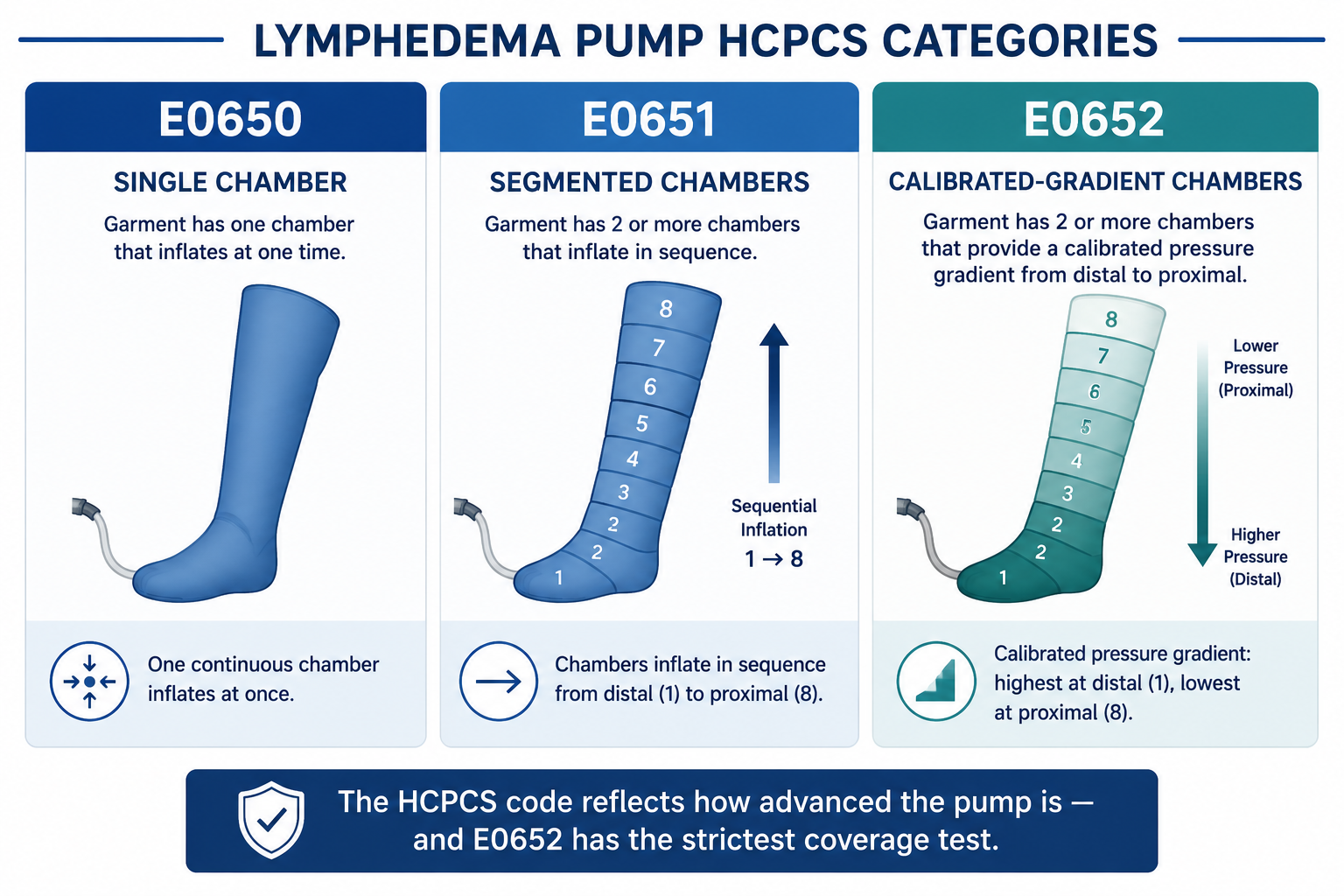
Medicare classifies lymphedema pumps under three HCPCS codes, and the code matters because it drives both capability and coverage:
E0650 — single-chamber (non-segmented) pump. The most basic category. One inflatable compartment.
E0651 — segmented pump without calibrated gradient pressure. Multiple chambers that inflate in sequence, a meaningful step up in capability.
E0652 — segmented pump with calibrated gradient pressure. The advanced category, with individually calibrated chambers. Per NCD 280.6, E0652 is covered only when the patient has unique characteristics that prevent satisfactory treatment with a simpler (non-segmented, or segmented-without-calibrated-gradient) device.
The practical takeaway: Medicare covers the device that fits your clinical need, not automatically the most advanced one. If your documentation supports E0652, it's covered; if a simpler device would work, that's what's approved. Patients searching for a "lymphedema pump HCPCS code" are usually trying to confirm exactly this, and the answer is that your prescriber and DME supplier select the code that matches your diagnosis and the medical-necessity documentation.
What You Actually Pay With Medicare
Here's the number that matters. Medicare Part B covers medically necessary DME, and per Medicare.gov, after you meet the Part B deductible you pay 20% of the Medicare-approved amount — as long as your supplier accepts assignment. A few practical points straight from Medicare's guidance:
Assignment matters. A supplier that participates in Medicare must accept assignment, meaning they can charge you only the deductible and the 20% coinsurance on the approved amount. A supplier that doesn't accept assignment may charge more.
Enrollment matters. Both your prescriber and your DME supplier should be enrolled in Medicare. MCB DME is a Medicare-enrolled DMEPOS supplier.
Rent vs. buy. Medicare covers different DME in different ways — some equipment is rented, some purchased, and some becomes your property after a set number of rental payments.
Supplemental coverage. A Medigap policy or secondary insurance may pick up part or all of that 20%.
So a patient who qualifies and uses an enrolled supplier that accepts assignment typically pays a modest coinsurance, not the pump's full sticker price. For the sticker prices themselves and a full cost breakdown, see our companion guide, How Much Does a Lymphedema Pump Cost?
What About Commercial Insurance?
Most commercial insurers cover lymphedema pumps under criteria similar to Medicare's: a documented conservative-therapy trial, demonstrated medical necessity, a written order, and, in many cases, prior authorization before the device ships. Your specific deductible, coinsurance, and copay depend on your plan. The smart first step is identical regardless of payer: a benefits check before anything is ordered, so you know your real out-of-pocket up front. Our team runs that verification as part of intake for patients.
Brand-Name Systems: Tactile Medical, Koya, and Others
Patients often search by brand and want a price, such as Tactile Medical lymphedema pump cost, Tactile Medical Entre system cost, Flexitouch cost, or Koya Dayspring cost. Two things are worth knowing.
First, every one of these systems still bills under the same E0650/E0651/E0652 framework above, so the coverage rules don't change with the brand, only the device's capability tier and your documentation do. Second, brand cash prices vary widely by configuration (number of garments, arm vs. leg vs. trunk coverage), and the figure that actually lands on your bill is your post-coverage coinsurance, not the cash price. That's why we don't publish single brand price tags here. For a feature-by-feature look at the major systems, see our lymphedema pump comparison.
The 2026 Lymphedema Treatment Act: Garments Are Now Covered Too
A pump isn't the whole picture. Because of the federal Lymphedema Treatment Act, Medicare Part B now covers lymphedema compression treatment items as a distinct benefit. Per Medicare.gov, Part B may cover gradient compression garments (standard and custom-fitted), gradient compression wraps with adjustable straps, and compression bandaging supplies for a patient diagnosed with lymphedema when a provider orders them. The cost-share is the familiar one: after the Part B deductible, you pay 20% of the Medicare-approved amount.
This matters for budgeting. The garments you wear between pump sessions used to come out of pocket; now they're a covered benefit alongside the pump. We break down what this change means for New Jersey patients in The Lymphedema Treatment Act and What It Means for NJ Patients, and you can read more about garment options in Nighttime Compression Garments for Lymphedema.

A Few Things Coverage Is NOT
It is not automatic. Without the documented four-week conservative-therapy trial and a medical-necessity record, even a covered device can be denied. The paperwork is the gate.
It is not the most advanced device by default. E0652 requires specific justification; Medicare otherwise covers the simpler device that meets your needs.
It is not the same as an arterial pump. Pumps for peripheral arterial disease use different codes and coverage rules — see our arterial compression therapy page.
Frequently Asked Questions
Does Medicare cover a lymphedema pump? Yes. Lymphedema pumps are covered as durable medical equipment under Medicare Part B, per National Coverage Determination 280.6, once you've completed a documented four-week trial of conservative therapy and your physician confirms significant symptoms remain. After your Part B deductible, you generally pay 20% of the Medicare-approved amount when your supplier accepts assignment.
Will Medicare pay for a lymphedema pump for legs? Yes, leg systems are covered under the same rules and HCPCS codes (E0650/E0651/E0652) as other pumps. The garment configuration affects the device selected, but the coverage criteria are the same.
What is the HCPCS code for a lymphedema pump? There are three: E0650 (single-chamber/non-segmented), E0651 (segmented without calibrated gradient), and E0652 (segmented with calibrated gradient pressure). Your prescriber and DME supplier select the code that matches your diagnosis and documentation. E0652 is covered only when a simpler device won't meet your clinical needs.
How much does a lymphedema pump cost with Medicare? After the Part B deductible, you generally pay 20% of the Medicare-approved amount if your supplier accepts assignment. Supplemental insurance may reduce that further. For cash/sticker prices by device type, see our cost guide.
Is a lymphedema pump covered by commercial insurance? Usually yes, under criteria similar to Medicare's, though prior authorization is common and your out-of-pocket depends on your plan. A benefits check before ordering tells you your real cost.
Does Medicare cover Tactile Medical, Flexitouch, or Koya pumps? Coverage follows the device's HCPCS category and your documentation, not the brand name. Any of these systems can be covered when the medical-necessity criteria in NCD 280.6 are met.
Does Medicare cover compression garments for lymphedema now? Yes. Because of the Lymphedema Treatment Act, Part B covers gradient compression garments, wraps, and bandaging supplies as a separate benefit, with the same 20% coinsurance after the deductible.
What documentation does Medicare require for a lymphedema pump? A physician's order, a record of the four-week conservative-therapy trial, your diagnosis with objective findings (such as limb measurements), the reason the device is needed, and a treatment plan with ongoing monitoring. MCB DME helps assemble this.
Key Takeaways
Medicare covers lymphedema pumps as DME under Part B (NCD 280.6) after a documented four-week conservative-therapy trial.
You generally pay 20% of the Medicare-approved amount after your Part B deductible, when your supplier accepts assignment.
Pumps bill under three HCPCS codes — E0650, E0651, E0652 — and E0652 (calibrated gradient) is covered only when a simpler device won't do.
Coverage rules are the same across brands like Tactile Medical, Flexitouch, and Koya; the brand doesn't change the criteria.
Commercial plans follow similar rules, often with prior authorization; a benefits check before ordering tells you your real out-of-pocket.
Since the Lymphedema Treatment Act, Part B also covers compression garments, wraps, and bandaging supplies as a separate benefit.
Next Steps
If a pump has been recommended and you want to know what it will cost you, MCB DME can verify your benefits, confirm coverage, and coordinate the documentation Medicare or your insurer requires.
Patients: Visit our lymphedema therapy page for product details, or contact our team to start a benefits check. For quick questions, ask Lumi (24/7 chatbot, bottom right of every page on mcbdme.com).
Referring clinicians: Visit our providers page for prescription forms and conservative-therapy documentation templates. See also When to Refer a Patient for a Lymphedema Pump.
Related Resources:
Lymphedema Pump Comparison: Lymphapress vs. Tactile vs. Koya vs. BioCompression
The Lymphedema Treatment Act 2026 — What It Means for NJ Patients
External references (authoritative sources):
Medicare National Coverage Determination 280.6 — Pneumatic Compression Devices (CMS)
Lymphedema Powered Compression Devices — Coverage (Medicare.gov)
Lymphedema Compression Treatment Items — Coverage (Medicare.gov)
MCB DME is a durable medical equipment provider based in Hawthorne, New Jersey, specializing in lymphedema management, compression therapy, arterial compression, bracing, diabetic and orthopedic footwear, and prosthetics. MCB DME is a Medicare-enrolled DMEPOS supplier and bills Medicare, Medicaid, and most commercial insurance plans directly for covered items.
Disclaimer: This article is for educational purposes only and is not a substitute for medical or financial advice. Coverage, pricing, documentation requirements, and HCPCS coding are subject to change and vary by plan; always verify current payer policies and your specific benefits before making decisions.