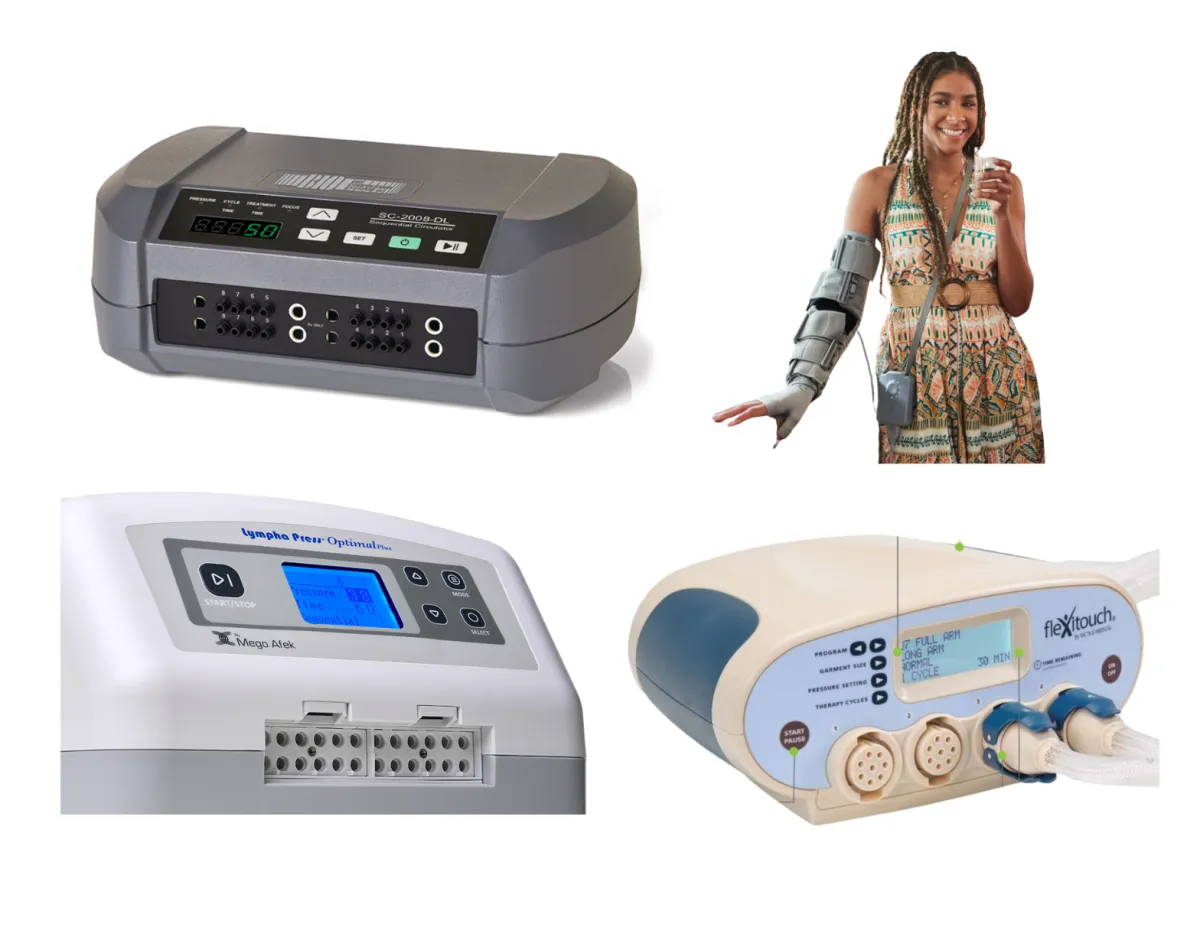
Lymphedema Pump Comparison: Which Pump Is Covered by Medicare?
If your doctor has prescribed a pneumatic compression device for lymphedema, you are likely staring at a list of brand names — Lymphapress, Tactile Medical, Koya Medical, BioCompression — without much context for what makes them different from each other, or which one is the right fit for your situation.
This guide breaks them down clearly, without manufacturer bias. We cover how each system works, who it is designed for, what the clinical evidence says, and where each one fits in the broader picture of lymphedema management. The goal is to help patients and healthcare providers make an informed decision — and to explain why the right pump for one person may be entirely wrong for another.
One important note before we begin: all four of these systems require a physician prescription and, in most cases, can be covered by Medicare or commercial insurance when medically necessary. MCB DME works with all of these platforms and can verify your coverage, handle prior authorization, and ensure proper fitting and setup — at no cost to you for those services. More on that at the end.
What Is a Lymphedema Pump and Why Does It Matter?
A lymphedema pump — formally called a pneumatic compression device (PCD) or advanced pneumatic compression device (APCD) — is a medical device that uses air-filled chambers in a specialized garment to apply sequential pressure to an affected limb. The chambers inflate in a wave-like pattern from the foot or hand toward the body, mimicking the natural pumping action of healthy lymph nodes and muscles.
Used correctly — typically one hour per day, twice a day — a pneumatic compression device can reduce limb volume, decrease the frequency of cellulitis infections, improve quality of life, and slow the progression of lymphedema.
In a 52-week clinical study, reduced cellulitis incidence from 21.4% to 6.1% and decreased skin hyperpigmentation from 75% to 40% of patients.
Compression pumps are not a cure — lymphedema has no cure — but they are one of the most important tools available for long-term disease management, particularly for patients who cannot access frequent manual lymphatic drainage sessions with a certified therapist.
The four systems reviewed here represent the major options available in the U.S. market today. They differ significantly in technology, garment design, portability, clinical evidence, and insurance coverage — all of which matter when choosing the right device.

Understanding the Technology: Pneumatic vs. Non-Pneumatic Compression
Before comparing brands, it helps to understand the fundamental technology divide in this space.
Pneumatic compression devices (APCDs) use air-filled chambers inside a garment sleeve. The chambers inflate and deflate sequentially, creating a programmed wave of pressure that moves fluid toward the lymph nodes. These are the traditional standard of care — stationary, plug-in devices that patients use for a set treatment session, typically sitting or lying down.
Non-pneumatic compression devices (NPCDs) are a newer category. Instead of air chambers, they use mechanical elements — springs, frames, or structured bands — to deliver compression. The key difference is that NPCDs are designed to be worn while moving, integrating treatment into daily activity rather than requiring a dedicated seated session.
Koya Medical's Dayspring is currently the only FDA-cleared NPCD for lymphedema in the U.S. market. The other three systems — Lymphapress, Tactile Medical, and BioCompression — are all APCDs (pneumatic), though they differ substantially in garment design, chamber count, and technology sophistication.
1. Lymphapress
What it is
Lymphapress is an Israeli-engineered pneumatic compression system that has been in clinical use for decades and is widely regarded as one of the most clinically sophisticated options available. It is manufactured by Lympha Press Ltd. and distributed in the United States.
How it works
Lymphapress garments use overlapping chambers — available in 16 or 24-chamber configurations — that apply a directional massage wave without gaps in treatment, designed on the principles of manual lymph drainage. The overlapping design is clinically significant: traditional non-overlapping chambers can create a "wedging" effect where fluid is pushed against a chamber boundary rather than smoothly along the limb. Lymphapress's overlapping architecture is specifically engineered to prevent this.
The Lymphapress Optimal Plus offers four therapy modes including a unique Pretherapy proximal-to-distal compression cycle designed to stimulate the lymphatics before the main treatment session, adjustable pressure ranges of 20 to 90 mmHg, and Smart Technology that learns each patient's unique measurements and calibrates pressure in each chamber accordingly.
Key products
Lymphapress PCD-51: A compact, sequential system designed for home use, capable of treating two limbs simultaneously. User-friendly display with anti-tamper mechanisms for consistent home treatment.
Lymphapress PCD-52: An upgraded model utilizing Smart Technology for calibrated gradient compression, bilateral treatment capability, and four therapy modes including Pretherapy, sequential, peristaltic (wave), and Post-Therapy Focus for targeted treatment of specific areas after the main session.
Lymphapress Optimal Plus: The flagship advanced system with the full suite of Smart Technology features, designed for complex or moderate-to-severe lymphedema requiring the highest level of clinical customization.
LymphaPod: A system specifically designed for larger patients, providing effective treatment for lymphedema in patients where standard sizing is not appropriate.
Clinical profile
Lymphapress has an extensive clinical evidence base accumulated over decades of use, with published studies supporting its efficacy in reducing limb volume, improving patient quality of life, and managing complex cases that have not responded to simpler compression systems.
Best for
Moderate to advanced lymphedema requiring multi-zone or whole-body treatment. Patients who have not achieved adequate control with simpler systems. Patients with concurrent lipedema or truncal involvement. Complex cases where garment flexibility and therapy mode customization are clinically important.
Insurance and access
Covered by Medicare and most commercial insurance plans when medically necessary and properly documented. Clinicians with complex patients have noted that patients may require extra steps to access depending on the patient's insurance plan and DME network.
2. Tactile Medical
What it is
Tactile Medical is a Minneapolis-based medical technology company and the dominant player in the U.S. advanced pneumatic compression market. Their Flexitouch Plus is broadly considered the category leader in terms of market share, insurance coverage, and clinical evidence volume.
How it works
The Flexitouch system features up to 32 curved garment chambers that provide repetitive sequential inflation and deflation to redirect fluid away from affected areas, using four-way stretch fabric designed to conform to anatomical contours. The programmable controller allows customized treatment programs and the system uses numbered push-and-click connectors designed for straightforward independent setup.
The Flexitouch is clinically distinct from basic pumps in its ability to treat not just the affected limb but also the trunk, chest, shoulder, and core — areas that must be cleared first to create a pathway for lymphatic fluid to drain from the limb. This proximal-first treatment approach is what separates it clinically from simpler, limb-only devices.
Key products
Flexitouch Plus: The flagship advanced pneumatic compression device, cleared for multiple indications including lymphedema (upper and lower), phlebolymphedema, lipedema, venous insufficiency, and wound healing. It is the only device with FDA clearance to treat head and neck lymphedema, a condition affecting a significant proportion of head and neck cancer survivors.
Nimbl: Launched commercially in late 2024, Nimbl is Tactile Medical's next-generation platform, indicated for upper and lower extremity lymphedema, chronic edema, venous insufficiency, and wound healing. Nimbl is positioned as a more portable, connected option that sits between the Entre Plus entry-level system and the full Flexitouch Plus.
Entre Plus: A simpler, more portable system designed for patients in earlier stages of lymphedema or those who need a straightforward daily maintenance device before qualifying for an advanced system.
Practical considerations
One real-world consideration worth noting: the Flexitouch Plus body core and leg wraps use Velcro closures that must be manually fitted at each session, which can be challenging for patients with limited flexibility or dexterity. This is a practical limitation that patients and caregivers should evaluate before committing to the system — particularly for elderly patients or those with limited hand and shoulder function.
Best for
Patients with well-established lymphedema requiring comprehensive limb and trunk treatment. Cancer survivors, particularly post-mastectomy and head and neck cancer patients. Patients who need the broadest possible insurance coverage and the deepest evidence base to support prior authorization. Patients whose providers specifically recommend advanced pneumatic compression as the clinical standard.
Insurance and access
Flexitouch Plus has the most established insurance coverage of any device in this category, with deep reimbursement relationships across Medicare and commercial plans.
3. Koya Medical (Dayspring)
What it is
Koya Medical is an Oakland, California-based company that has fundamentally reimagined compression therapy for lymphedema. Their Dayspring system is the first FDA-cleared non-pneumatic active compression device — meaning it does not use air chambers at all, and it is designed to be worn and used while moving.
How it works
The Dayspring system combines three mechanisms: a static compression layer from the inelastic fabric garment that applies constant containment pressure; non-pneumatic gradient sequential compression delivered through Flexframes powered by a mobile controller that mimic the body's fluid drainage mechanics; and muscle engagement through its wearable, mobile design that supports movement and activates the calf and thigh pumps to enhance lymphatic drainage and venous return. Koya Medical
The system includes a low-profile active garment made of soft, breathable mesh using Koya's proprietary Flexframe technology — spring-like segments that deliver controlled and customizable compression — along with a smart, rechargeable, Bluetooth-enabled controller and a companion mobile app that allows users and clinicians to customize treatments and review treatment history. Business Wire
The core clinical premise of Dayspring is that movement itself is therapeutic for lymphedema — and that a device worn during normal daily activity produces superior adherence and, in some studies, superior clinical outcomes compared to a device that requires the patient to sit stationary for an hour.
Practical considerations
Dayspring is designed for patients who value mobility and integration of treatment into daily life. It is particularly well-suited for patients who have struggled to adhere to traditional pump protocols due to schedule constraints or the inconvenience of sitting for one hour per day. The companion app also provides an engagement layer that traditional pumps do not offer.
Insurance coverage is still developing compared to the established players. Dayspring is currently covered by several national commercial and regional health plans, and CMS has issued HCPCS codes for the system — a significant milestone for Medicare access. However, patients should verify their specific coverage carefully, as payer adoption is not yet as broad as Flexitouch or Lymphapress.
Best for
Patients with active lifestyles who need treatment that does not interrupt their day. Patients with documented adherence challenges with traditional stationary pumps. Younger patients or working-age patients for whom a one-hour stationary treatment session is a genuine barrier. Patients with both lymphedema and venous insufficiency (phlebolymphedema) who benefit from the added muscle activation component. Patients and providers comfortable with newer technology and willing to navigate evolving insurance coverage.
4. BioCompression Systems
What it is
BioCompression Systems is a New Jersey-based, family-owned manufacturer that has produced pneumatic compression devices for over 40 years. They are one of the original and most established names in the space — and importantly, they manufacture all of their products domestically in Moonachie, New Jersey.
How it works
BioCompression's pumps use a non-peristaltic action to move fluid from distal to proximal, which improves both lymph flow and blood flow. Their design is described as quiet, comfortable, and easy to use. Biocompression
BioCompression uses calibrated gradient pressure — meaning pressure is highest at the distal part of the limb and decreases with each chamber moving toward the body — which functions in much the same manner as the body's own muscle pump to move lymphatic fluid through the channels. Biocompression
Their product line focuses on simplicity and reliability. BioCompression pumps are designed to be straightforward to use independently at home, with a clean interface and minimal setup requirements.
Key products
SC-2004-DL: A four-chamber sequential circulator for segmental pneumatic compression with gradient pressure. Lightweight, portable, and suitable for both unilateral and bilateral use. Biocompression
SC-2008-DL: An eight-chamber sequential circulator offering more precise segmental compression. Adjustable pressure up to 120 mmHg, focus therapy mode for localized treatment of specific chambers, pause function, and a built-in compliance meter that tracks hours of usage. CGM Monitors Weight is approximately 3.65 lbs — notably lighter than many competing systems.
SC-4004-DL and SC-4008-DL: Higher-chamber-count systems for more advanced or complex lymphedema presentations requiring greater segmental precision.
What distinguishes BioCompression
BioCompression's defining advantage is its combination of clinical reliability, domestic manufacturing, and straightforward design. As PJ Ross, RN, CLT at Bio Compression explained in an interview with MCB DME, BioCompression's non-peristaltic pumps mimic manual lymph drainage to help patients heal and thrive at home — and the company has been repairing and supporting pumps for decades, including devices that are 20 years old. That longevity and serviceability is a meaningful consideration for patients who depend on their device for daily management.
BioCompression also offers wound healing as a distinct clinical focus alongside lymphedema — making it particularly relevant for patients with chronic venous wounds, diabetic ulcers, or stasis ulcers alongside lymphedema.
Practical considerations
BioCompression pumps are less technologically complex than Lymphapress or Tactile's Flexitouch — they do not offer multi-mode therapy, Smart Technology calibration, or trunk garments. This simplicity is a feature for many patients: the device is easy to set up, easy to use, and dependable over long periods of use. For patients who need a reliable daily maintenance pump without the complexity of advanced systems, BioCompression is an excellent clinical fit.
Best for
Patients in earlier or moderate stages of lymphedema seeking a reliable, straightforward daily maintenance device. Patients who are technically conservative and prefer a simple, proven system. Patients with concurrent venous wounds or diabetic ulcers who benefit from BioCompression's wound care focus. Patients managed by clinicians who have established relationships with BioCompression and value the domestic manufacturing and long-term serviceability. Patients whose insurance plans favor simpler pneumatic systems.

How to Choose: Matching the Pump to the Patient
Choosing a lymphedema pump is not a brand preference decision — it is a clinical matching exercise. Here is a practical framework.
Choose Lymphapress when:
The patient has moderate to advanced lymphedema involving multiple limbs, trunk, or bilateral presentations. The patient has not achieved adequate control with simpler systems. The clinical team wants maximum flexibility in treatment modes, garment coverage, and pressure customization. The patient's insurance plan allows access to Lymphapress through an in-network DME provider.
Choose Tactile Medical (Flexitouch Plus) when:
The patient has upper or lower extremity lymphedema requiring trunk and proximal clearance alongside limb treatment. The patient is a cancer survivor, particularly post-mastectomy or post-head-and-neck cancer treatment — Flexitouch Plus is the only system FDA-cleared for head and neck lymphedema. Insurance coverage is a limiting factor and the strongest reimbursement pathway matters. The patient needs the broadest evidence base to support continued authorization.
Choose Tactile Medical Nimbl when:
The patient needs something more portable and connected than a traditional advanced system, but their clinical presentation still warrants pneumatic compression. The patient's provider wants real-time compliance data via Bluetooth integration. The patient is earlier in their lymphedema journey and may not yet qualify for Flexitouch Plus.
Choose Koya Medical Dayspring when:
The patient has documented difficulty adhering to traditional stationary pump protocols. The patient is active and needs treatment that integrates with daily life rather than interrupting it. The patient has both lymphedema and venous insufficiency (phlebolymphedema) and would benefit from the muscle activation component. The patient and provider are comfortable navigating newer insurance pathways.
Choose BioCompression when:
The patient has mild to moderate lymphedema and needs a reliable, straightforward daily maintenance device. The clinical presentation does not require trunk treatment or advanced therapy modes. Simplicity of use is a priority — particularly for elderly patients or those managing independently without caregiver assistance. The provider values domestic manufacturing and long-term serviceability.

Frequently Asked Questions
Does insurance cover lymphedema pumps?
Yes — Medicare and most commercial insurance plans cover pneumatic compression devices for lymphedema when medically necessary and properly prescribed. Coverage levels and prior authorization requirements vary by plan and by device. BioCompression has strong Medicare coverage histories. MCB DME handles all insurance verification, prior authorizations, and billing for each of these systems — contact our team for a free benefits check.
Can I use a lymphedema pump without seeing a therapist first?
A prescription from a physician is required for all of these devices. In most cases, a physician will also refer patients to a certified lymphedema therapist (CLT) before prescribing a pump, as the pump is intended to complement — not replace — complete decongestive therapy. The CLT evaluation also informs which device and garment configuration is most appropriate for the patient's specific anatomy and stage.
What is the difference between a basic pump and an advanced pneumatic compression device?
Basic pumps (such as the BioCompression SC-2004 or the Tactile Entre Plus) have fewer chambers, simpler pressure controls, and treat the limb only. Advanced pneumatic compression devices (APCDs) — such as the Lymphapress Optimal Plus and the Tactile Flexitouch Plus — have more chambers, multiple therapy modes, and include trunk and core garments to clear the proximal lymphatic pathway before treating the limb. APCDs are generally prescribed for moderate to advanced lymphedema where limb-only treatment is insufficient.
How long does a treatment session take?
For pneumatic systems, the standard prescribed session is typically one hour per day, twice a day. For Koya Dayspring, treatment is designed to be worn during normal daily activities — there is no fixed stationary session requirement, and the system is intended to be used continuously as part of the patient's routine.
How do I know which pump is right for me?
The right pump depends on your lymphedema stage, affected areas, daily routine, insurance plan, and the clinical judgment of your physician and lymphedema therapist. MCB DME's team works through exactly this process with every patient — we evaluate your clinical needs, verify what your insurance covers, and match you with the appropriate system. Visit our lymphedema page or contact us directly to get started.
Can I switch pumps if the one I have isn't working?
Yes, though switching typically requires a new physician order and insurance authorization. If you feel your current device is not adequately controlling your lymphedema, document the changes you are observing — measurements, photographs, symptom diary — and bring that information to your physician. A CLT evaluation can also provide objective data to support a change in device. MCB DME can help coordinate that transition, including all insurance paperwork. Contact our patients page or call us at (973) 553-0777.
Key Takeaways
Lymphapress, Tactile Medical, Koya Dayspring, and BioCompression each occupy a distinct clinical niche — none is universally "the best"
BioCompression has the broadest insurance coverage and deepest evidence base, and is manufactured in the USA.
Koya Dayspring is the only non-pneumatic wearable system, with compelling adherence data — and an insurance coverage profile that is still developing
BioCompression is the most straightforward, reliable daily maintenance option for mild to moderate lymphedema, with domestic manufacturing and long-term serviceability
The right device is determined by clinical stage, affected anatomy, lifestyle, and insurance — a decision best made with your physician, CLT, and DME provider
Next Steps: MCB DME Can Help You Access Any of These Systems
MCB DME is a Hawthorne, New Jersey-based durable medical equipment provider that works with all four of the systems reviewed in this guide. We serve patients and referring providers throughout New Jersey.
Our team handles:
Lymphedema pump authorization and setup for all major platforms
Compression garment fittings to complement your pump therapy
Insurance verification and prior authorization for Medicare and commercial plans
Coordination with your physician and lymphedema therapist to ensure the right device reaches you
Ongoing support after setup
For healthcare providers referring patients, visit our providers page. For patients ready to get started, visit our patients page or call us directly at (973) 553-0777.
Related Topics You May Find Helpful
What Is Lymphedema and Why Do I Have It: A Comprehensive Guide
How Do You Know You Have Lymphedema? Signs, Symptoms & What to Do
How to Catch Lymphedema Early: A Step-by-Step Detection Guide
Made in the USA: Bio Compression's Breakthrough in Lymphedema Care
Flat Knit vs. Circular Knit Compression Garments: How to Choose
About MCB DME
MCB DME is a durable medical equipment provider based in Hawthorne, New Jersey. We specialize in lymphedema management, compression therapy, diabetic footwear, arterial pumps, bracing, and prosthetics — serving patients and healthcare providers throughout New Jersey. Our team handles insurance verification, prior authorizations, and billing directly, so patients can focus on their health rather than the paperwork.
This article is for educational purposes only and does not constitute medical advice. Device selection should be made in consultation with a qualified healthcare provider and certified lymphedema therapist.