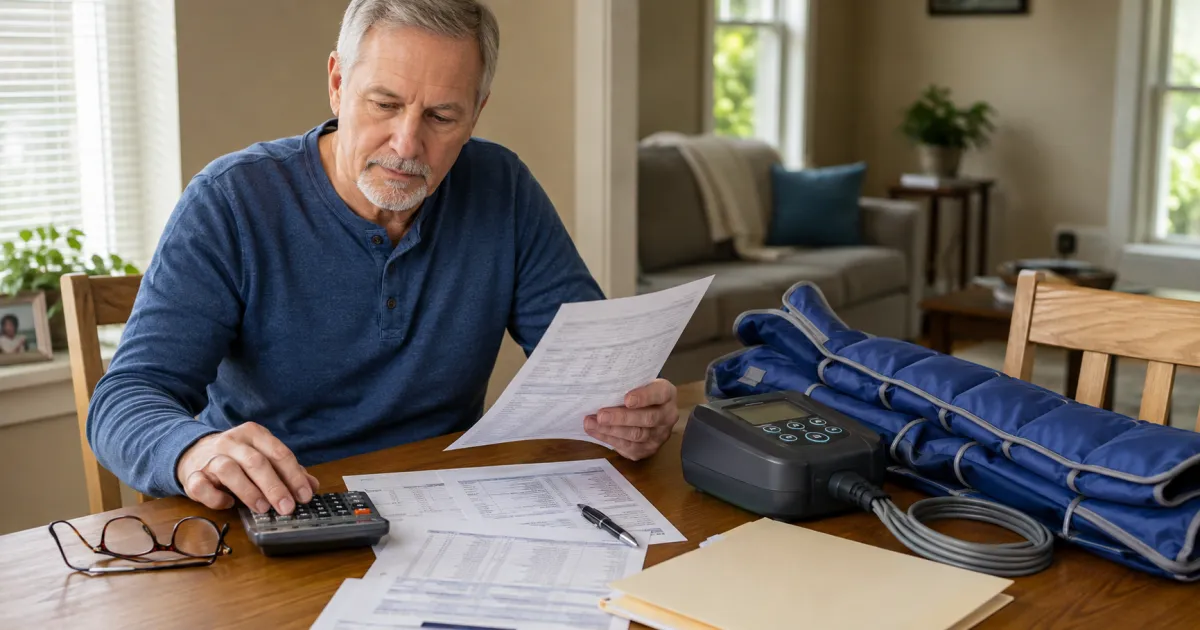
How Much Does a Lymphedema Pump Cost? (2026 Medicare Guide)
If a clinician has recommended a pneumatic compression pump, the question that follows is almost always about money. It is a fair question, and most of what you will find online answers the wrong version of it.
Search "lymphedema pump cost" and you get sticker prices: figures in the thousands, quoted without context, usually attached to a specific brand configuration that may have nothing to do with what you have been prescribed. Those numbers are real, but for the large majority of patients they are not the number that lands on the bill. What you actually pay is a different calculation entirely, and it is usually a fraction of what those pages suggest.
This guide walks through the real math: what Medicare pays, what you owe after it, what drives the price up or down, what commercial insurance does differently, and how to get a firm number for your specific situation instead of a range from the internet. It is written for patients and caregivers weighing a pump, and for clinicians who get asked the cost question in the exam room and want a straight answer to hand over.
Quick Answer: What Does a Lymphedema Pump Cost?
For most patients with Medicare, the out-of-pocket cost of a lymphedema pump is the annual Part B deductible plus 20 percent of the Medicare-approved amount, not the device's retail price. The Federal Register notice setting 2026 rates confirms that the Part B annual deductible for 2026 is $283 for all beneficiaries. After that deductible is met, you generally owe 20 percent of the approved amount when your supplier accepts Medicare assignment, and a Medigap or secondary policy may cover some or all of that 20 percent. Retail or cash prices for pneumatic compression devices run into the low thousands and vary widely by device tier and garment configuration, but that figure applies mainly to patients paying without coverage. The single most useful thing you can do is a benefits check before anything is ordered.
Why There Is No Single Price
Three variables move the number, and they compound.
The device tier. Pumps bill under three HCPCS codes with meaningfully different capability and cost, covered in the next section.
The garment configuration. A single-leg sleeve, bilateral legs, an arm, or a trunk and chest garment are different builds at different prices. Two patients with the same pump can have very different totals because one needs one garment and the other needs three.
Rental versus purchase. Medicare pays for different categories of durable medical equipment differently. Some items are rented, some purchased outright, and some transfer to you after a set number of rental payments. Which path applies changes the shape of what you pay and when, even when the total is similar.
That is why a single published price would mislead more people than it helped. It is also why we quote patients individually after a benefits check rather than posting a number here.

The Three HCPCS Codes and What They Mean for Cost
Every lymphedema pump on the market bills under one of three codes, and the code drives coverage more than the brand name does.
E0650 is a single-chamber, non-segmented pump. The most basic tier.
E0651 is a segmented pump without calibrated gradient pressure. Multiple chambers inflating in sequence.
E0652 is a segmented pump with calibrated gradient pressure. The advanced tier, with individually calibrated chambers.
Higher tier does not mean better outcome for you, and it does not mean automatic approval. Medicare covers the device that matches your documented clinical need. E0652 carries a specific restriction that catches a lot of patients by surprise, and we cover the full rule in Does Medicare Cover a Lymphedema Pump?
The practical cost implication is simple. Because your coinsurance is a percentage of the approved amount, and approved amounts differ by tier, the code on your order does affect what you owe. But it is set by your documentation and clinical need, not by preference.
What Has to Happen Before Any of This Applies
There is a gate, and it is the reason most pump claims get denied. The Medicare National Coverage Determination governing these devices states that pneumatic compression devices are covered in the home setting for treating lymphedema if the patient has completed a four-week trial of conservative therapy and the treating physician determines there has been no significant improvement or that significant symptoms remain after the trial. That trial must include an appropriate compression bandage system or compression garment, exercise, and elevation of the limb, and the garment may be prefabricated or custom-fabricated but must provide adequate graduated compression.
Four weeks. Documented. Before the order is written.
Coverage also requires genuine physician involvement. Per the CGS Medicare documentation checklist for these devices, pumps in the E0650, E0651, and E0652 family are covered only when prescribed by a physician and used with appropriate physician oversight, meaning an evaluation of the patient's condition to determine medical necessity, suitable instruction in operating the machine, a treatment plan defining the pressure to be used and the frequency and duration of use, and ongoing monitoring of use and response to treatment. CGS Medicare
Skip any of that and the cost question becomes moot, because the answer becomes one hundred percent of the price. We map the whole timeline in How Long Does Lymphedema Pump Treatment Take?
Prior Authorization Changed in 2026
This is new and it affects timing more than cost, but patients should know it is coming. Per that same CGS checklist, effective April 13, 2026, E0651 and E0652 require prior authorization. Note that this is both codes, not just the advanced tier. CGS Medicare
The process has a defined clock. Noridian, one of the DME MAC contractors, states that prior authorization requests for pneumatic compression devices are reviewed within five business days, and that in very rare emergent circumstances an expedited review may be requested.
Five business days for the review is the good news. The bad news is that an incomplete submission restarts the process, which is where most of the delay in getting a pump actually comes from. MCB DME assembles and tracks that submission on your behalf.
What Commercial Insurance Does Differently
Most commercial plans follow criteria close to Medicare's: a documented conservative therapy trial, demonstrated medical necessity, a written order, and prior authorization in many cases. What differs is your cost share. A plan with a $6,000 deductible you have not touched produces a very different number than a plan you have already maxed out for the year.
There is no shortcut here. Your plan documents and a benefits verification are the only reliable source, and both are worth doing before anything ships rather than after.
Paying Without Insurance
Some patients do pay cash: those who do not qualify under the four-week trial rule, those whose documentation will not support the tier they want, and those who would rather not wait out an authorization. Cash prices for pneumatic compression systems run into the low thousands and scale with the same three variables above, primarily garment count and device tier.
If you are in this position, ask about two things most people do not think to ask about: whether a lower tier device would meet your clinical need at meaningfully lower cost, and whether a rental arrangement makes more sense than a purchase for your situation.
From Our Office: Where the Money Actually Goes Wrong
Patients budget for the pump and forget the garments. The pump is one line item. You also need daytime compression and, for most people, a nighttime garment, plus replacements every three to six months. Since the Lymphedema Treatment Act, Medicare covers those as a separate benefit, which we cover in The Lymphedema Treatment Act in 2026. Many patients still do not know this and are paying out of pocket for garments Medicare would cover.
People shop the brand instead of the code. A patient calls having researched a specific system and wanting a price. The brand rarely determines coverage. The code and the documentation do.
Assignment gets overlooked. A supplier that accepts Medicare assignment can bill you only the deductible and the coinsurance on the approved amount. One that does not may charge more. It is worth asking directly.
The benefits check gets skipped. It takes one phone call and it is free. Ordering first and learning the number later is how people end up with a bill they did not plan for.
How to Get Your Actual Number
Confirm the four-week conservative therapy trial is documented. Without it, nothing else matters.
Get the written order, specifying the device and the garment configuration.
Ask your supplier for a benefits verification before anything is ordered. This is the step that produces a real number.
Ask whether the supplier accepts Medicare assignment. MCB DME does.
Ask what your secondary or Medigap policy picks up. For many patients this covers most of the 20 percent.
Ask about the garments separately, since they fall under a different benefit than the pump.
Frequently Asked Questions
How much does a lymphedema pump cost with Medicare?
After the 2026 Part B annual deductible of $283, you generally pay 20 percent of the Medicare-approved amount when your supplier accepts assignment. A Medigap or secondary policy may cover part or all of that 20 percent.

How much does a lymphedema pump cost without insurance?
Cash prices run into the low thousands and vary substantially by device tier and garment configuration. A single-leg system and a bilateral system with a trunk garment are not comparable purchases. Ask for a quote based on your specific prescription.
How much does a lymphedema pump for legs cost?
The same coverage rules and codes apply regardless of limb. What changes the price is the garment build: one leg, both legs, or legs plus trunk. Bilateral systems cost more than single-limb systems.
Does Medicare cover the full cost of a lymphedema pump?
No. Medicare covers the approved amount less your deductible and 20 percent coinsurance. Supplemental coverage may reduce your share further, and in some cases eliminate it.
Is a lymphedema pump rented or purchased?
It depends on the item's Medicare payment category. Some durable medical equipment is rented, some purchased, and some becomes your property after a set number of rental payments. Your supplier can tell you which applies to your device before you commit.
Why do prices differ so much between brands?
Because configurations differ, not because coverage does. Every major system bills under the same E0650, E0651, and E0652 framework. For a feature comparison, see our lymphedema pump comparison.
Does prior authorization cost me anything?
No. Prior authorization is a payer process, not a charge. It affects timing, not price. Requests for pneumatic compression devices are reviewed within five business days.
Are compression garments included in the pump cost?
No. Garments fall under a separate Medicare benefit created by the Lymphedema Treatment Act, with its own 20 percent coinsurance after the deductible. Budget for both.
Key Takeaways
What you pay is the Part B deductible ($283 in 2026) plus 20 percent of the approved amount, not the device's retail price.
Three variables drive cost: HCPCS tier, garment configuration, and whether the device is rented or purchased.
A documented four-week conservative therapy trial is required before coverage applies at all.
As of April 13, 2026, both E0651 and E0652 require prior authorization, reviewed within five business days.
Coverage rules are identical across brands. The code and your documentation decide, not the name on the box.
Ask whether your supplier accepts Medicare assignment. It caps what you can be charged.
Garments are a separate covered benefit. Budget for them and do not pay out of pocket for something Medicare covers.
A free benefits check before ordering is the only way to get a real number.
Next Steps
Patients: We will run a benefits check before anything is ordered, so you know your actual out-of-pocket rather than a range from the internet. MCB DME is a Medicare-enrolled DMEPOS supplier and accepts assignment. Start at mcbdme.com/patients or contact our team. We are at 293 Lafayette Avenue, Suite 104, Hawthorne, NJ 07506, serving Bergen County, Passaic County, and Northern New Jersey. For quick questions, ask Lumi, our 24/7 chatbot in the bottom right corner of every page on mcbdme.com.
Referring clinicians: We handle prior authorization assembly and tracking for E0651 and E0652, and verify documentation completeness with your practice before submitting. Prescription forms and conservative-therapy documentation templates are at mcbdme.com/providers. See also When to Refer a Patient for a Lymphedema Pump.
Related reading: Does Medicare Cover a Lymphedema Pump? | Lymphedema Therapy at MCB DME | How Long Does Lymphedema Pump Treatment Take? | The Lymphedema Treatment Act in 2026
Disclaimer: This article is for educational purposes only and is not a substitute for medical, billing, or financial advice. Coverage, pricing, documentation requirements, and HCPCS coding change and vary by plan. Always verify current payer policies and your specific benefits before making decisions.