Traveling with a Lymphedema Pump: The Complete Guide for Lymphedema Awareness Month
A note from Michele Kattine, MCB DME
March is Lymphedema Awareness Month — and here at MCB DME, we don't just observe it. We use it.
Every March, we think about the patients we serve throughout New Jersey who are managing lymphedema every single day — quietly, consistently, often without the recognition they deserve. And every March, we ask ourselves: what can we do to make that daily management a little easier, a little less stressful, and a little more possible for the life they actually want to live?
This year, I want to talk about something our patients ask us about constantly: traveling.
Not the clinical side of lymphedema. Not the diagnosis. Not the billing. The real, practical, "I have a trip coming up and I'm terrified about my pump getting flagged at security" kind of question. Because that fear is real — and it doesn't have to be.
My name is Michele Kattine, and I have been fitting lymphedema patients with compression garments and pumps at MCB DME for years. I've seen what happens when patients are prepared for travel, and I've seen what happens when they aren't. The difference is enormous — not just for their swelling, but for their confidence, their independence, and their quality of life.
Lymphedema should not keep you home. It should not keep you from your grandchildren's graduation, your cousin's wedding, your first cruise, or your annual spring trip to Florida. The National Lymphedema Network dedicated the entire month of March to patient education for exactly this reason — to empower patients with the knowledge they need to live fully with this condition.
So let's talk about the gold standard for traveling with lymphedema — your pump, your garments, the airport, and everything in between.
Why March Matters: World Lymphedema Day and the Month of Action
World Lymphedema Day is observed every year on March 6 — an annual advocate-driven event established in 2016 by the United States Senate in response to a bill written by the Lymphatic Education and Research Network (LE&RN). It has grown into a global movement covering not just lymphedema but the full spectrum of lymphatic diseases including lipedema, lymphatic filariasis, and lymphatic malformations.
The National Lymphedema Network — the organization that first initiated World Lymphedema Day, with March 6 chosen to honor the date the NLN was incorporated as a nonprofit — uses the entire month of March for patient education sessions designed to empower patients with knowledge and resources.
At MCB DME, we believe awareness without action is just noise. So our contribution to Lymphedema Awareness Month this year is practical, specific, and immediately useful: a complete guide to traveling with your lymphedema pump and compression garments, including a resource that we are offering directly to our patients — the BioCompression travel letter.
More on that shortly.
The Gold Standard: What "Managed Well" Actually Looks Like
Before we get into the airport checklist, I want to establish something important. The gold standard for lymphedema management is not a destination — it's a daily practice. And that practice does not stop when you leave your house.
The gold standard for lymphedema treatment has four non-negotiable pillars:
1. Daily compression — every day, all day Your compression garments are not optional, and they are not just for bad days. They are the foundation of everything. Without consistent compression, nothing else works as well as it should.
2. Your pump — used consistently, not just when you're in a flare Your pneumatic compression pump is prescribed for daily use — typically one hour per day — as a maintenance tool, not an emergency measure. Patients who use their pump daily before a flare have far better outcomes than patients who scramble to use it after swelling has already progressed.
3. Skin care and infection prevention Lymphedema creates permanent elevated risk for cellulitis. Clean, moisturized, intact skin is your first line of defense — at home and especially while traveling, where exposures are unpredictable.
4. Movement and elevation Your lymphatic system depends on muscle activity to move fluid. Sitting still — in a car, on a plane, in a hotel room — is one of the biggest triggers for swelling flares during travel. Movement is medicine.
When you travel, the goal is to maintain all four of these pillars as consistently as possible. Not perfectly — travel is imperfect — but deliberately and proactively.
Why Air Travel Is a Specific Risk for Lymphedema Patients
This is not anxiety — it's physiology.
When we fly, altitude changes our tissue pressure. Normally, tissue pressure has a slight suction effect that helps keep fluid in the blood and lymphatic vessels. At altitude, that tissue pressure shifts toward positive — meaning the force that normally keeps fluid in the vessels weakens, and more fluid can accumulate in the tissues. This shows up as swelling.
The National Lymphedema Network recommends compression garments during air travel specifically because they provide external pressure that compensates for the weakened tissue pressure at altitude — enhancing resorption of fluid at the capillary level and stimulating the lymphatic system via the muscle pump to prevent fluid accumulation.
In practical terms: the cabin environment combines reduced pressure, reduced humidity, prolonged immobility, and often increased sodium intake — all of which work against your lymphatic system simultaneously. If you are traveling without compression, you are traveling without your most important tool.
For patients with chronic lymphedema, the NLN via OncoLink recommends applying compression bandaging for all air travel, to be worn before the flight and kept on for one to two hours after reaching the destination. If bandaging is not possible, a properly fitted compression garment is an acceptable alternative.
Taking Your Pump Through Airport Security: What You Need to Know
This is where patients get nervous. And I understand why — the last thing you want is to have your medical equipment questioned, inspected, or held up at a security checkpoint when you have a flight to catch.
Here is the truth: your lymphedema pump is allowed through TSA security. It is a medical device. You have every right to travel with it. And with the right preparation, getting through security with your pump is genuinely straightforward.
What TSA says
The TSA requires that all items — including supplies associated with medically necessary pumps and other devices — be screened before being permitted into the secure area of the airport. Medical devices are allowed in carry-on baggage. TSA officers may ask you to power up electronic devices, and powerless devices will not be permitted onboard. TSA also states that passengers may provide an officer with a TSA notification card or other medical documentation to describe their condition. Transportation Security Administration
For external medical devices, TSA recommends informing the officer about the device and where it is located before screening begins. If the device can be safely disconnected, it can be submitted for X-ray screening. If you cannot disconnect from the device, it may require additional screening. Transportation Security Administration
The single most important thing you can do: carry documentation
A laminated doctor's letter shown at the security checkpoint can significantly expedite the screening process for patients traveling with compression pumps. Nortonschool
This is exactly why MCB DME has secured a travel letter from BioCompression Systems for our patients.
The BioCompression Travel Letter — Available to MCB DME Patients
BioCompression Systems — our New Jersey-based lymphedema pump partner — has provided MCB DME with an official letter that patients can carry when traveling with their BioCompression pump. The letter clearly identifies the device as FDA-cleared durable medical equipment prescribed for the treatment of lymphedema, explains its medical purpose, and requests that TSA and airline personnel accommodate the patient's need to travel with the device.
This letter is available to any MCB DME patient who has a BioCompression pump. All you need to do is contact our team and we will provide it to you at no charge.
Contact MCB DME for your BioCompression travel letter →
Having this letter in hand — ideally printed, laminated, and in your carry-on — does several important things:
It confirms the device is legitimate medical equipment, not an unknown electronic item
It gives TSA officers immediate context so they can screen quickly and appropriately
It reduces the likelihood of additional questioning or delays
It gives you confidence and a sense of control at the checkpoint
Do not underestimate the value of that confidence. Travel with a chronic condition is stressful enough. Anything that reduces friction at security is worth having.
Packing Your Compression and Pump: The Pre-Travel Checklist
Being prepared before you leave the house is what separates a manageable trip from a miserable one. Here is the MCB DME gold standard packing checklist for lymphedema patients.
Compression garments — what to pack
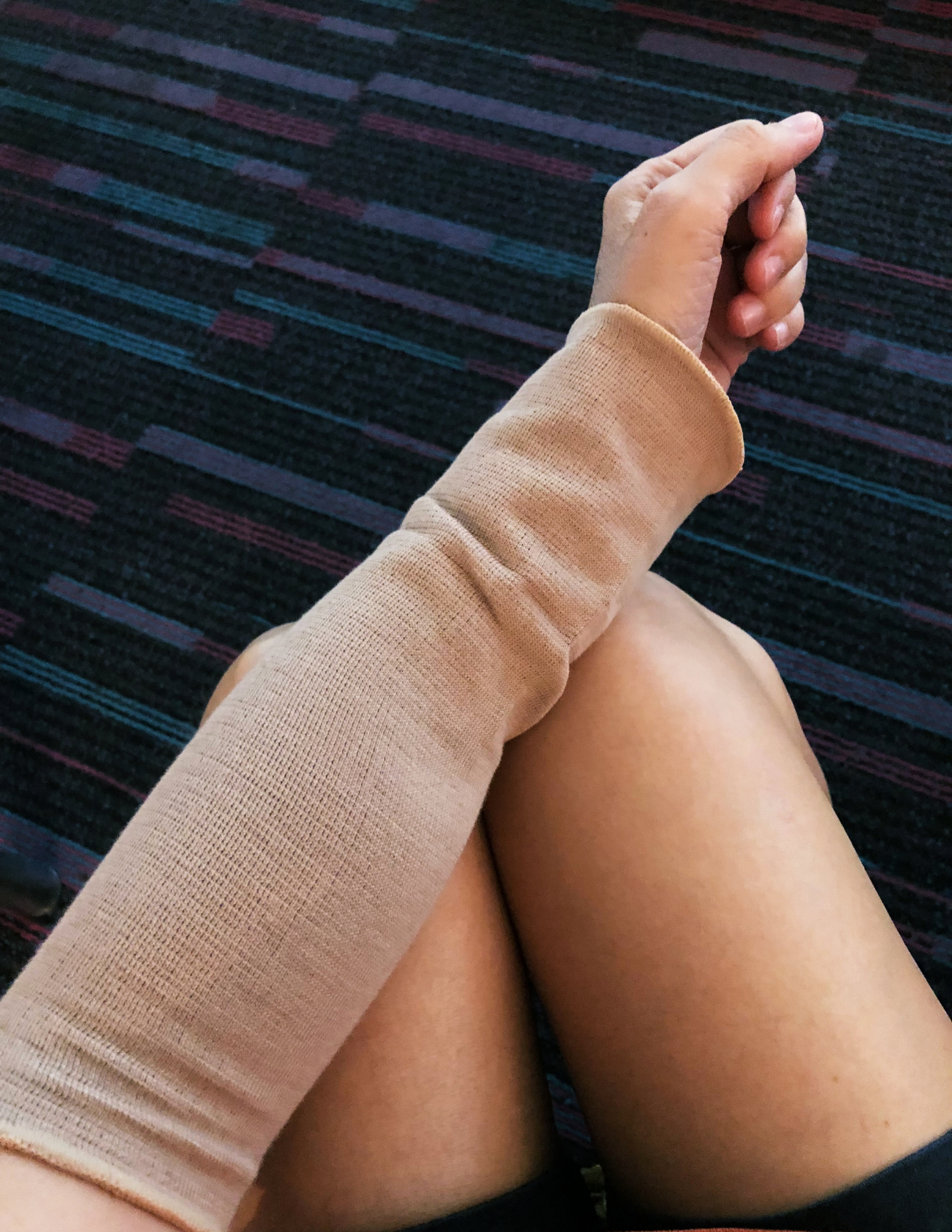
For arm lymphedema: At least 20 to 30 mmHg compression is recommended for upper extremity conditions. A hand piece — either a glove or gauntlet — should always be worn alongside the arm sleeve. Wearing just a sleeve without hand coverage can cause hand swelling, which defeats the purpose of the garment.
Primary compression sleeve (well-fitted, recently replaced — garments should be replaced every six to twelve months)
Backup sleeve — always pack a second one. Bags get lost. Garments get wet. Having a backup is non-negotiable.
Glove or gauntlet to pair with the sleeve
Nighttime garment if you use one
For leg lymphedema: At least 30 to 40 mmHg is recommended for lower extremity conditions during air travel.
Primary compression stockings or leggings at the appropriate mmHg
Backup pair — same rule as above
Open-toed footwear that accommodates the garment comfortably at your destination
Your pump — carry-on only
Your lymphedema pump should always travel in your carry-on bag, not in checked luggage. Checked luggage is delayed, lost, damaged, or simply unreachable when you land and immediately need your device. Your pump is prescribed medical equipment and it belongs in the cabin with you.
Pack:
The pump unit
All hoses, connectors, and tubing
Your garment sleeves (these can go in checked baggage as a backup if space is tight, but keep at least one set with you)
Power adapter
Your BioCompression travel letter (or documentation for your pump brand)
A copy of your prescription if you have one available
Documentation to carry
BioCompression travel letter (available from MCB DME — contact us)
Your prescription or a physician's note describing your condition and the medical necessity of your compression equipment
Your insurance card and MCB DME contact information in case anything needs to be replaced at your destination
Skin care travel kit
Moisturizer for twice-daily application — travel-sized
Antiseptic wipes or small tube of antibiotic ointment for cuts or insect bites
Sunscreen — sunburn is a lymphedema risk trigger
Insect repellent for outdoor destinations
At the Airport: Step by Step
Before you leave for the airport
Put your compression garment on before you leave home. The garment should be on before you board — especially for early morning flights when swelling is at its minimum and the garment will fit best. Putting a garment on over swollen tissue is harder and less effective.
Drink a full glass of water. Avoid or limit caffeine and alcohol, which dehydrate you and can worsen swelling. Pack water and low-sodium snacks in your carry-on.
At security
Let the TSA officer know before screening begins that you are traveling with a prescribed medical device
Present your BioCompression travel letter or other documentation
Place the pump unit in a bin separately if requested
Be calm and matter-of-fact — you have every right to travel with this equipment and your documentation proves it
If you encounter any difficulty, ask to speak with a TSA Passenger Support Specialist or Supervisory TSA Officer
TSA officers are trained to accommodate passengers with disabilities and medical conditions, and passengers may consult a TSA officer about the best way to navigate the screening process. Providing documentation in a discreet manner through a notification card or medical letter helps facilitate that conversation.
If you want additional peace of mind, TSA Cares — reachable at 855-787-2227 — can be contacted at least 72 hours before your trip to coordinate assistance through security.
On the plane
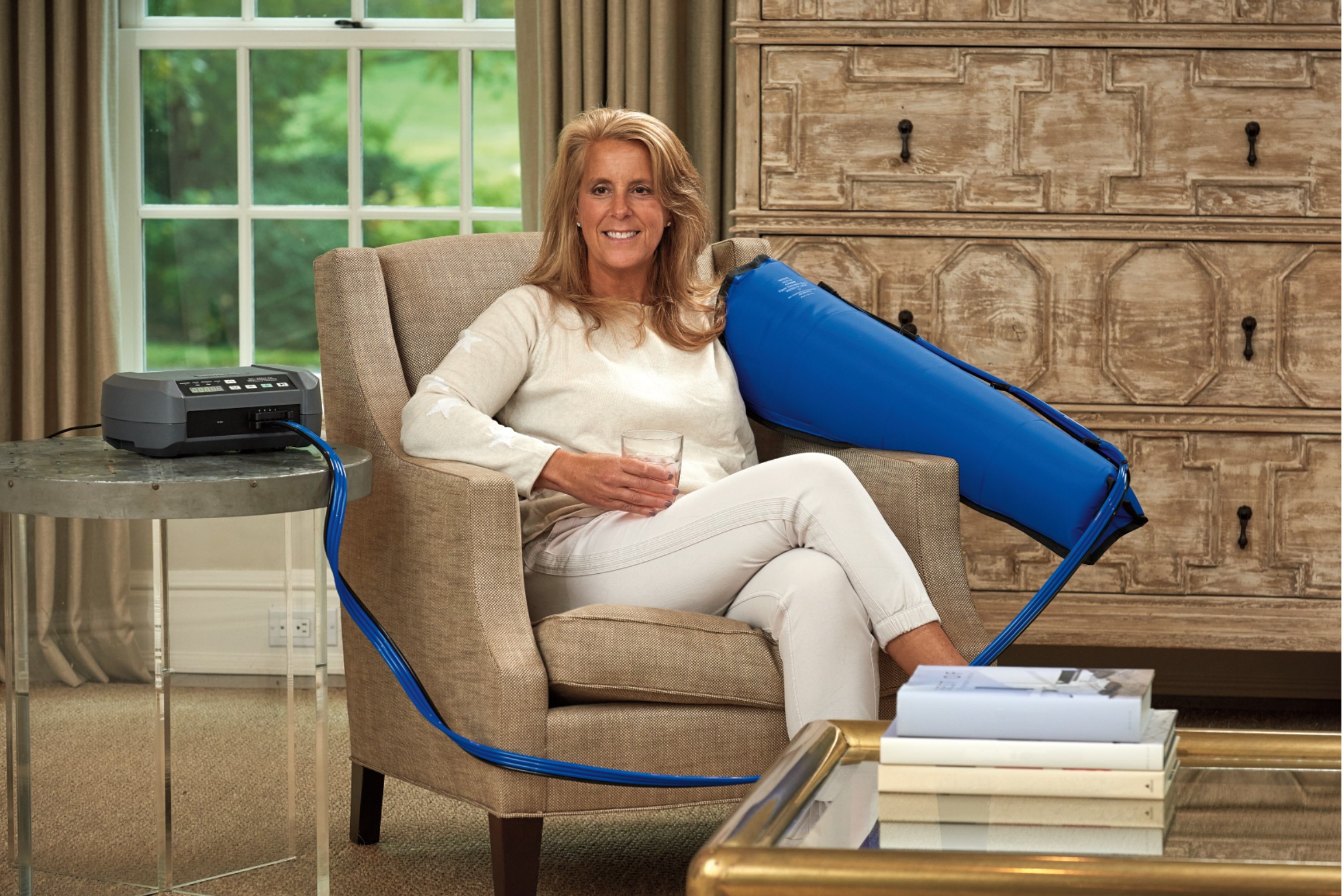
Use your pump if you have a long flight and can do so in your seat — most pumps can run on battery or through an in-seat power outlet
Move every 60 minutes: walk to the back of the plane, perform ankle pumps in your seat, flex and point your toes, roll your shoulders
Choosing an aisle seat gives you more opportunities to move and avoids being trapped for extended periods. Request bulkhead seating for extra leg room if traveling with lower extremity lymphedema
Stay hydrated — airplane air is very dry and dehydration worsens fluid retention
Keep loose-fitting clothing over your compression — tight waistbands or elastics at the groin or axilla can restrict lymphatic flow even while you are wearing compression on the limb
Elevate when possible — a small bag or pillow under the feet for leg elevation, or an armrest for arm elevation
After landing
Keep your compression garment on for one to two hours after arriving at your destination before removing it. Do not go straight from the plane to dinner and take your garment off at the table. Let your body stabilize first.
Use your pump the evening after arrival if your routine allows — this is especially important after a long flight.
If your limb feels significantly more swollen than usual on arrival, elevate it above heart level for 20 to 30 minutes before doing anything else. If swelling is significantly worse than your baseline and does not respond to elevation and pump use, contact your physician or locate a certified lymphedema therapist at your destination.
Traveling by Car: The Same Rules Apply
Air travel gets most of the attention, but long car trips carry the same risks — prolonged immobility, poor posture, heat, and reduced movement.
When possible, elevate your affected limb to help reduce swelling. On long car trips, legs can be propped on luggage, and arms can be rested on an elevated surface or a pillow. OncoPelvic PT
Stop every 60 to 90 minutes to walk for at least five minutes. Do not wait until the limb feels uncomfortable — by then, fluid has already accumulated. Prevention is always easier than management.
Wear your compression garment for the entire drive. Pack your pump so it is accessible at the hotel without digging through checked bags.
Do not carry or lift heavy luggage with an at-risk arm. Use rolling luggage, ask for help, or use a cart. Shoulder bags with straps can create a tourniquet effect that impedes lymphatic circulation in the upper body — switch to a rolling carry-on or backpack with wide, padded straps that distribute weight evenly.
Quick Travel Tips: Michele's Favorites
After years of fitting patients and hearing their travel stories — good and bad — these are the practical tips I find myself repeating most often:
Measure your limb the morning you leave. Take a baseline measurement before you travel so you have an objective reference point if swelling increases. Keep it in your phone notes.
Pack your garments in your carry-on, not your checked bag. If your checked bag is lost, you do not want to discover that on a two-week trip without your compression.
Bring more garments than you think you need. One pair of compression stockings is not enough for a 10-day trip. Garments need to be washed and dried between wearings, and accidents happen.
Tell your travel companions. If you are traveling with family or friends, let them know what your routine involves. They can help remind you to move, assist with garment application if needed, and know what to do if your swelling flares.
Find a CLT at your destination before you leave. The Norton School Therapist Referral Directory can help you locate a certified lymphedema therapist near your hotel in case you need a tune-up session.
Use your pump at your destination, not just at home. The pump goes with you. Do not leave it behind thinking you will only be gone a few days. A few days without your pump at a high-swelling-risk time is exactly when you need it most.
Frequently Asked Questions About Traveling with Lymphedema
Can I take my lymphedema pump on a plane?
Yes. Lymphedema pumps are FDA-cleared medical devices and are permitted in carry-on baggage. TSA may ask you to place the device in a screening bin and may conduct additional inspection. Having a travel letter from your pump manufacturer or a physician's note significantly reduces friction at the checkpoint. MCB DME patients with BioCompression pumps can contact us for an official travel letter at no charge.
Do I need to wear my compression garment on the plane?
Yes — and ideally you should put it on before you leave for the airport. If you have lymphedema, it is advised to wear your compression garment before, during, and after a flight, and to keep it on until bedtime after arrival. This is not optional — it is the gold standard for air travel with lymphedema.
What mmHg compression should I wear during a flight?
The NLN recommends at least 20 to 30 mmHg for upper extremity lymphedema and at least 30 to 40 mmHg for lower extremity lymphedema during air travel. Always wear a glove or gauntlet with an arm sleeve — a sleeve alone can cause hand swelling. Consult your lymphedema therapist or MCB DME for personalized guidance on your compression level.
What if TSA questions my compression pump?
Stay calm and present your travel letter and documentation. Let the officer know the device is prescribed durable medical equipment for a diagnosed medical condition. If you encounter difficulty, request a Passenger Support Specialist or Supervisory TSA Officer. For additional support, TSA Cares can be reached at 855-787-2227 up to 72 hours before your trip.
Should I bring my pump on a short trip?
Yes. There is no such thing as a "short enough" trip to skip your daily pump routine — especially during travel, when all the risk factors for swelling flares are elevated. The pump is prescribed daily for a reason. Pack it.
What is World Lymphedema Day and how can I participate?
World Lymphedema Day is observed on March 6 each year — established in 2016 through patient advocacy and officially recognized by the United States Senate. It is part of March's Lymphedema Awareness Month and is a platform for patients, healthcare professionals, and advocacy groups to raise awareness, share support, and push for better treatment and research. You can participate by sharing your story, connecting with the National Lymphedema Network or the Lymphatic Education and Research Network, wearing lymph-green, and — most importantly — making sure the people in your life understand what lymphedema is and what managing it actually requires.
How do I get a replacement compression garment if mine is lost or damaged during a trip?
Contact MCB DME as soon as possible. We can coordinate emergency replacement options and help you locate an in-network fitter near your destination. That's why we recommend packing a backup garment in your carry-on — not in your checked bag — but if the unexpected happens, call us at (973) 553-0777 and we will work to get you what you need.
Key Takeaways
March is Lymphedema Awareness Month — with World Lymphedema Day on March 6 — a time to educate, advocate, and take action
The gold standard for lymphedema treatment is daily compression, daily pump use, consistent skin care, and regular movement — and none of that stops when you travel
Air travel creates specific physiological risks for lymphedema patients through reduced cabin pressure, immobility, dehydration, and heat
Your lymphedema pump is allowed on planes — always travel with it in your carry-on, never in checked luggage
Carrying a travel letter or physician documentation significantly reduces friction at TSA security
MCB DME patients with BioCompression pumps can contact us for an official BioCompression travel letter at no charge
Wear your compression garment before you leave for the airport — not on the plane
Move every 60 minutes in transit: walk the aisle, pump your ankles, roll your shoulders
Pack more garments than you think you need — always bring a backup
Use your pump on arrival at your destination, especially after a long flight
Get Your BioCompression Travel Letter — Free for MCB DME Patients
If you are an MCB DME patient managing your lymphedema with a BioCompression pump, we have an official travel letter from BioCompression Systems that you can carry any time you travel. The letter identifies your device as FDA-cleared prescribed medical equipment and requests that TSA and airline staff accommodate your medical needs.
It is one of the most practical things we can offer you — and it is completely free.
Contact our team to request your travel letter →
Or call us directly at (973) 553-0777. We are here to help you travel with confidence.
How MCB DME Can Help You Travel Ready
MCB DME serves patients throughout New Jersey from our Hawthorne location. If you are preparing for a trip and need support with your lymphedema management, our team can help with:
Lymphedema pump setup and travel documentation — including BioCompression travel letters for eligible patients
Compression garment fittings — including travel-ready backup garments and replacements
Diabetic and orthopedic footwear — for patients managing diabetic complications alongside lymphedema during travel
Insurance verification — we confirm your coverage before you travel so there are no surprises if you need supplies at your destination
Patient support — our team is reachable by phone at (973) 553-0777 if you encounter any issues while traveling
Visit our patients page to learn more, or contact us to get started.
Related Topics You May Find Helpful
How Do You Know You Have Lymphedema? Signs, Symptoms & What to Do
How to Catch Lymphedema Early: A Step-by-Step Detection Guide
Lymphedema Pump Comparison: Lymphapress vs Tactile vs Koya vs BioCompression
Made in the USA: Bio Compression's Breakthrough in Lymphedema Care
Lymphedema Diet Guide: Anti-Inflammatory Foods & Nutrition Tips
What Is Lymphedema and Why Do I Have It: A Comprehensive Guide
About Michele Kattine and MCB DME
Michele Kattine is a medical equipment specialist at MCB DME in Hawthorne, New Jersey, where she has spent years fitting lymphedema patients with compression garments, pumps, and diabetic footwear. Her hands-on experience working directly with patients and their clinical teams informs everything MCB DME does — from the products they carry to the way they handle insurance authorizations to the travel letters they make available to patients.
MCB DME is a durable medical equipment provider based in Hawthorne, New Jersey, specializing in lymphedema management, compression therapy, diabetic footwear, arterial pumps, bracing, and prosthetics — serving patients and healthcare providers throughout New Jersey.
This article is for educational purposes only and does not constitute medical advice. Always consult your physician or certified lymphedema therapist before traveling.