Lymphedema Pump & Compression in Rockland County, NY
Looking for a lymphedema pump in Rockland County? If you live in Nyack, New City, Spring Valley, Pearl River, Suffern, Haverstraw, or Nanuet and your doctor has said you need one, you have a practical option just over the state line. MCB DME, a Medicare-enrolled supplier in Hawthorne, NJ, works with patients in New York, especially Rockland County, on lymphedema pumps and medical-grade compression garments. Your New York doctor can write the prescription. Medicare rules are the same on both sides of the border. And a lot of the paperwork can be handled before you ever get in the car.
Have a quick question at 10 p.m.? Lumi, our 24/7 chat assistant, sits at the bottom right of every page on mcbdme.com and can help you get started any time.
The quick answer
- You do not need a New Jersey doctor. A prescription from your New York physician or qualified practitioner works.
- Medicare is a federal program. New York and New Jersey are both handled by the same Medicare equipment contractor (Jurisdiction A, run by Noridian), so the coverage rules for pumps and garments are the same.
- Medicare Part B covers lymphedema compression garments when you have a lymphedema diagnosis and a provider orders them.
- For pumps, Medicare expects documentation: your diagnosis, measurements, and what you have already tried (like garments, exercise, and elevation).
- NY Medicaid, Medicare Advantage, and commercial plans each have their own rules. MCB DME verifies your benefits before anything ships.
- Hawthorne is a short drive from most of Rockland via the Garden State Parkway or the Palisades Parkway. Ask us what can be handled without a trip.
Who usually needs a lymphedema pump or compression garments
Lymphedema is swelling that happens when lymph fluid can't drain normally. It often shows up in an arm or leg, and it tends to stick around. According to MedlinePlus from the National Library of Medicine, the most common cause is removal or enlargement of lymph nodes, and other causes include surgery, radiation, injury, infection, and tumors. That is why so many of the patients we see are breast cancer survivors, people treated for gynecologic or prostate cancers, and people with long-standing leg swelling from venous disease.
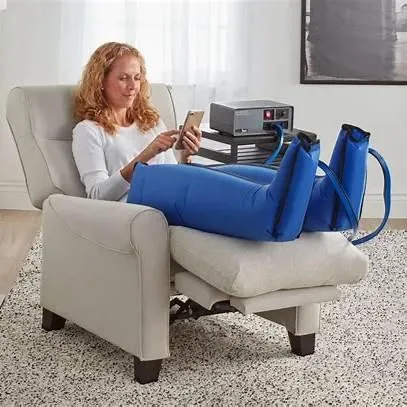
Compression is the base of almost every treatment plan. That might mean bandaging at first, then garments you wear every day. A pneumatic compression pump (a sleeve or garment that inflates in a set pattern to move fluid out of the limb) is often added when garments and therapy alone aren't keeping the swelling under control.
You might be a good candidate if:
- You have a lymphedema diagnosis from your doctor, oncologist, vascular specialist, or lymphedema therapist.
- Your swelling keeps coming back even though you wear your garments and do your exercises.
- You have had cellulitis or skin problems in the swollen limb.
- You live alone or have trouble getting to therapy appointments several times a week, and need something you can do at home.
For a deeper look at the condition itself, our lymphedema therapy page explains how pumps and garments fit together.
How a referral works for New York patients
This is the part people worry about most, and it's simpler than it sounds. Your prescription can come from the doctor you already see in Rockland, Westchester, or the city. It does not have to be a New Jersey physician.
Here is what a typical referral looks like:
- Your doctor writes the order. For garments, CMS says items must be prescribed by a physician, or by a physician assistant, nurse practitioner, or clinical nurse specialist where state law allows. For a pump, the order comes from your treating practitioner.
- The office sends us the paperwork. That usually means the prescription, your demographics and insurance, and a recent office note showing why you need the item. Our provider page has Rx forms for lymphedema pumps and compression garments, plus fax instructions your doctor's staff can use.
- We check your benefits. Before anything is ordered, MCB DME looks at your plan, any prior authorization rules, and what you may owe.
- We call you. We go over what's covered, what the next steps are, and whether you need to come in for a fitting.
If your doctor's office has never sent an order to a New Jersey supplier before, that's fine. Have them call us at (973) 553-0777 and we'll walk them through it.
Medicare coverage is the same in New York and New Jersey
Medicare equipment claims are processed by regional contractors called DME MACs. Noridian's Jurisdiction A DME covers New York, New Jersey, and the rest of the Northeast (Connecticut, Delaware, Maine, Maryland, Massachusetts, New Hampshire, Pennsylvania, Rhode Island, Vermont, and Washington, D.C.). So a Medicare patient in Pearl River and one in Paramus are working under the same equipment policies.
Compression garments under Medicare
Since the Lymphedema Treatment Act took effect, Medicare Part B covers compression garments for people with lymphedema. Per Medicare.gov, this includes standard and made-to-measure graduated compression garments, wraps with adjustable straps, and bandaging supplies, as long as you have lymphedema and a provider orders them. You pay your Part B deductible first, then 20% of the Medicare-approved amount.
The CMS lymphedema compression page spells out how often garments can be replaced:
| Item | How many Medicare allows | Notes |
|---|---|---|
| Daytime garments | 3 per affected body part every 6 months | Lets you rotate while one set is being washed |
| Nighttime garments | 2 per affected body part every 2 years | Usually softer, lower-profile options |
| Replacements outside that schedule | As needed | If lost, stolen, damaged beyond repair, or your limb size changes |
| Accessories | Covered when needed | Donning aids, padding, fillers, liners, zippers |
Lymphedema pumps under Medicare
Pumps have stricter paperwork. Noridian's documentation checklist for pneumatic compression devices lays out what Medicare looks for. In plain terms, your medical record generally needs to show:
- Your lymphedema diagnosis and how long you've had it.
- Measurements and findings that show how severe the swelling is.
- What you've already tried, such as a trial of compression garments or bandaging, regular exercise, and elevating the limb, and how that went.
- Your response to a first treatment with the pump, and whether you or a caregiver can use it at home.
The checklist also says that orders alone don't prove medical necessity. Your doctor's notes carry the weight. This is where a lot of claims stall, so we work with your doctor's office ahead of time to make sure the record is complete.
Not sure whether your situation fits? Our earlier post on what sets MCB DME apart covers how we handle insurance follow-up for patients.
NY Medicaid, Medicare Advantage, and commercial plans
This is the part we can't answer in a blog post, because it depends on your exact plan. Medicare Advantage plans in New York often have their own supplier networks and prior authorization steps. NY Medicaid and Medicaid managed care plans have their own rules. Commercial plans through an employer or the marketplace vary widely on garments, which some plans treat differently than pumps.
What we can say: MCB DME verifies your benefits before anything ships. If your plan requires a different supplier, we'll tell you upfront so you're not stuck with a surprise bill. Please call with your insurance card in hand and we'll check.
What getting a pump looks like
MCB DME works with BioCompression Systems pumps, which come in different configurations for arms, legs, and the trunk. Once your coverage is confirmed, the process usually goes like this:
- Delivery and setup. A member of our team brings the pump, sets it up, and fits the sleeve or garment to your limb. If you're in Rockland, call us to confirm how delivery and setup will be arranged for your town.
- Training. We show you how to put on the garment, turn the pump on, and run the settings your doctor prescribed (pressure, how long, how often). Bring a family member or caregiver if they'll be helping you.
- First sessions. Most people feel a firm, rhythmic squeeze that moves from the hand or foot toward the body. It should not hurt. If it does, stop and call us or your doctor.
- Follow-up. We check in to see how it's going, answer questions, and help if the garment doesn't fit right or the pump isn't working.
A pump doesn't replace your daytime garments. Most people use the pump at home, then wear compression the rest of the day to hold the results.
Garment fittings: what to expect
Compression only works if the garment fits. Too loose and it does nothing. Too tight, or bunched at the knee or elbow, and it can actually trap fluid. We carry medical-grade lines from Medi, Juzo, Jobst, and Thuasne, both ready-made and custom, in sleeves, gloves, gauntlets, stockings, and wraps. You can see the range on our compression garments page.
A fitting typically includes:
- Several circumference and length measurements along the limb.
- A conversation about your skin, how easy it is for you to get garments on, and your daily routine.
- A choice between ready-made and custom garments, and between knit styles, based on your swelling and shape.
- Help with donning aids if pulling the garment on is a struggle.
Measurements are best done in the morning, when swelling is lowest. Our guide on how to measure for compression garments explains what we measure and why.
Coming to Hawthorne vs. what can be handled remotely
Our office is at 293 Lafayette Avenue, Suite 104, Hawthorne, NJ. From most of Rockland, it's a straightforward drive south on the Garden State Parkway or the Palisades Parkway. Parking is easy, and we schedule fittings so you're not waiting around.
That said, not every step needs a visit. Insurance checks, paperwork with your doctor's office, questions about your plan, and some reorders can usually be handled by phone. Some fittings and setups need hands-on time. Every case is a bit different, so ask us what can be handled without a trip before you plan your day.
Common mistakes and red flags
- Buying "compression sleeves" online for lymphedema. Athletic and drugstore sleeves usually aren't graduated the right way or sized to your limb. They can make swelling worse.
- Skipping the trial documentation. If your chart doesn't show you tried garments, exercise, and elevation, a pump claim may be denied. Ask your doctor or therapist to note it.
- Waiting until garments are worn out. Elastic loses pressure over time. Medicare's replacement schedule exists for a reason.
- Assuming your plan is the same as Medicare. Medicare Advantage and Medicaid plans can have different rules and networks. Let us check before you order.
- Using a pump through pain or new symptoms. Sudden pain, redness, heat, or swelling that gets worse quickly can signal infection or a clot. Stop and call your doctor right away.
Frequently asked questions
Do I need a New Jersey doctor to get a pump or garments from MCB DME?
No. A prescription from your New York physician or qualified practitioner is fine. We work directly with offices in Rockland and beyond to get the paperwork right.
Does Medicare cover lymphedema pumps in New York?
Medicare can cover a pneumatic compression pump for lymphedema when your medical record documents the diagnosis, severity, and the conservative treatments you've tried. New York and New Jersey fall under the same Medicare equipment contractor, so the rules are the same. We verify your coverage before ordering.
Does Medicare cover compression garments for lymphedema?
Yes. Part B covers standard and custom compression garments, wraps, and bandaging supplies for people with lymphedema when a provider orders them. You pay your Part B deductible, then 20% of the approved amount.
Do you take NY Medicaid?
Coverage depends on your specific plan, including Medicaid managed care plans. Call us with your card and we'll check your benefits and let you know your options before anything ships.
Will I have to drive to Hawthorne?
Possibly for a fitting, but not always. Paperwork, insurance checks, and many questions are handled by phone. Ask us what can be handled without a trip.
How long does it take to get a pump?
It depends mostly on how quickly we get complete records from your doctor and whether your plan needs prior authorization. The fastest cases are the ones where the office note already documents your measurements and the treatments you've tried.
Can I use the pump instead of wearing garments?
Usually no. The pump helps move fluid out, and garments help keep it from coming back. Your doctor or therapist will tell you how to combine them.
Key takeaways
- MCB DME works with patients in New York, especially Rockland County, from our Hawthorne, NJ office.
- Your New York doctor's prescription is all you need to get started.
- Medicare garment and pump rules are the same in NY and NJ because both are in Jurisdiction A.
- Pumps need solid documentation of your diagnosis, measurements, and prior treatments.
- Other plans vary, so we verify benefits before anything ships.
- Not every step needs a visit. Call and ask.
Related reading: Are lymphedema pumps covered by Medicare?, what a lymphedema pump costs in 2026, portable vs. stationary pumps, and how to use your pump at home.
Next steps
If you're in Rockland County and looking for a lymphedema pump or compression garments, here's how to start:
- Call us at (973) 553-0777 with your insurance card handy.
- Send us a message through our contact page.
- Ask your doctor's office to use the Rx forms on our provider page.
- Chat with Lumi, our 24/7 assistant at the bottom right of any page on mcbdme.com, if you want to ask a question after hours.
We'll check your coverage, coordinate with your doctor, and tell you exactly what needs a trip to Hawthorne and what doesn't.
This article is for general education and is not medical advice. Talk with your doctor or therapist about your symptoms and treatment, and contact your insurance plan or MCB DME to confirm your specific coverage.