Lymphedema Compression Pump: Portable vs. Stationary Guide
If you've been told you need a compression pump for lymphedema, you may have been shown two very different devices. One is a console that sits by your chair and connects to a sleeve or boot. The other is a lightweight garment you wear while you move around the house. Both are FDA cleared. Both have published research behind them. Neither one is automatically the right answer.
The device that works best for you depends on where your swelling is, how advanced it is, what your tissue feels like, and what your insurance plan requires before it will pay. That last part matters more than most patients are told up front.
At MCB DME in Hawthorne, New Jersey, we fit compression pumps for patients across the state every week. We work with your physician and your insurance carrier, and we see which devices get approved, which ones get denied, and which ones end up unused in a closet six months later. This guide walks you through how that decision actually gets made, so you can ask better questions before you commit.

What Is a Lymphedema Compression Pump?
A lymphedema compression pump is a prescription medical device that applies controlled, repeating pressure to a swollen limb to move excess lymph fluid toward healthy lymphatic tissue where the body can clear it.
Most pumps work in a sequence. Pressure starts at the far end of the limb (the hand or the foot), then moves upward toward the trunk, chamber by chamber. That directional pattern is the point. Squeezing the whole limb at once would push fluid in both directions.
Compression pumps are not a standalone treatment. They are one part of complete decongestive therapy, alongside manual lymphatic drainage, compression garments, skin care, and exercise. A pump supplements that program. It does not replace it.
The Two Categories of Devices Available Today
Stationary pneumatic compression pumps
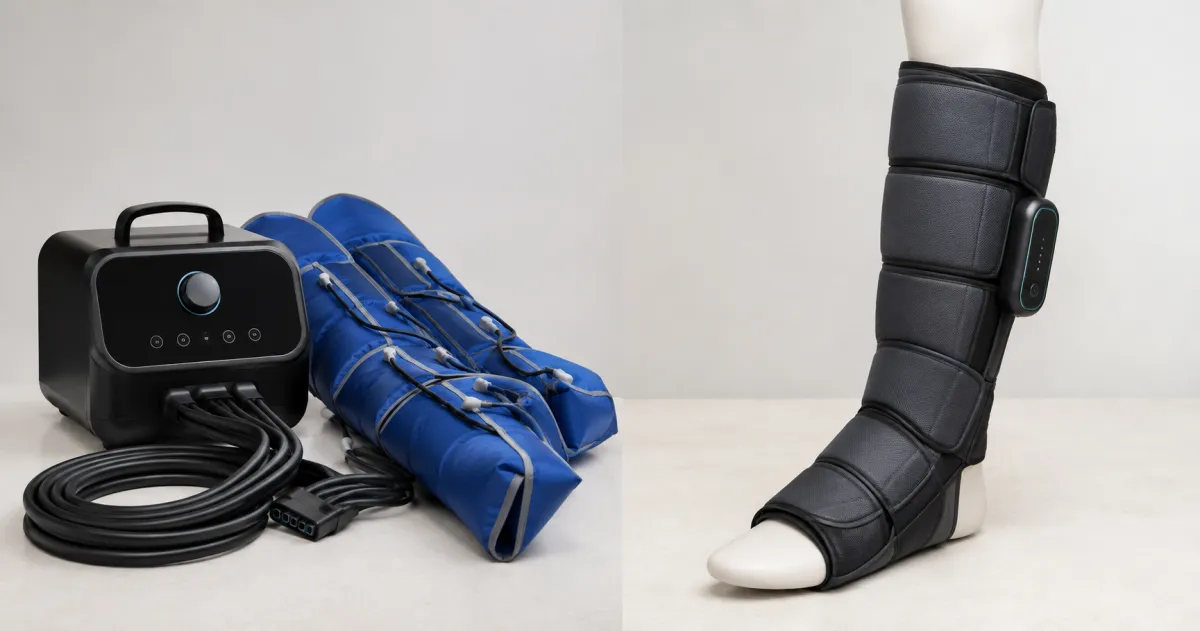
These are the traditional devices. A console pushes air into a multi-chamber sleeve or boot, inflating and deflating each chamber in a programmed order. Sessions typically run 30 to 60 minutes, once or twice a day, with the patient seated or reclined.
The pressure range is adjustable, often chamber by chamber. Garment options extend well beyond arms and legs: chest, abdomen, groin, and head-and-neck configurations exist for patients whose swelling involves the trunk.
In Medicare coding, these fall under E0650, E0651, and E0652.
Wearable non-pneumatic active compression systems
The Koya Dayspring is the device most patients ask about here. It is worth being precise about what it is, because the marketing language gets blurry. It is not a small pneumatic pump. It uses a flexible frame built into a lightweight garment, driven by a rechargeable handheld controller, and it applies sequential compression mechanically rather than with air.
The practical difference is that you can walk around, cook dinner, or run errands while it runs. It is currently made for arm and leg lymphedema.
Because it is not pneumatic, it sits outside the Medicare policy that governs traditional pumps. CMS assigned it its own HCPCS codes in 2022. That is a real distinction with real consequences for how your claim gets processed, which we cover below.
Why This Choice Is Harder Than It Looks
Here is the honest version of what happens in a lot of exam rooms. A device rep visits a physician's office and demonstrates a product. The physician, who may treat lymphedema occasionally rather than daily, writes an order for that product. The patient is sent to a supplier to have it fitted.
Nothing about that is improper. It is how medical devices reach the market. But a product demonstration is not a clinical fitting, and the person who benefits most from a careful match is the patient who has to live with the device.
The failure mode we see is not patients getting a bad device. It is patients getting a device that does not reach the tissue that is actually swollen, or that cannot generate the pressure their tissue needs, or that gets denied by their plan after a month of waiting.
Matching the Device to the Condition
Where the swelling is located
This is the first filter and the one that eliminates the most options. Wearable systems are currently built for arms and legs.
If your lymphedema involves the trunk, the chest wall, the abdomen, the genital region, or the head and neck, you need a stationary system with garment configurations that reach that tissue. There is no wearable equivalent yet. Patients with breast cancer related lymphedema frequently have some degree of chest wall or truncal involvement even when the arm is what they notice, so this is worth measuring rather than assuming.
How advanced the swelling is
Early-stage lymphedema, where the tissue still pits under thumb pressure and swelling improves overnight, responds well to a broad range of devices.
Advanced lymphedema with fibrotic tissue change is different. The tissue is firmer, denser, and less responsive to a fixed pressure profile. These patients often need longer cycles and a wider adjustable pressure range than a wearable system currently delivers. Stage matters more than limb size here.
Whether you will actually use it
This is the factor most often left out of the clinical conversation, and it is the one that most often determines the outcome.
A device you use six days a week beats a technically superior device you use twice. Sitting still for an hour twice a day is a genuine barrier for people who work, care for family members, or simply cannot stay seated that long. If a stationary pump would go unused, that is clinical information, not a personality flaw, and it belongs in the conversation with your physician.
Skin condition and other diagnoses
Open wounds, active cellulitis, untreated deep vein thrombosis, uncontrolled heart failure, and significant arterial disease all change what is safe. Some rule out compression pumping entirely until treated. Others change the pressure settings. Arterial insufficiency in particular needs to be ruled out before any lower-limb compression device is applied, which is why we handle arterial assessment and pump therapy as its own service line.
What the Research Says, and What It Does Not
Wearable non-pneumatic devices have real published evidence, and patients deserve a straight summary of it.
The head-to-head trials compared a non-pneumatic wearable against an advanced pneumatic compression device in patients with breast cancer related lymphedema. The wearable produced greater limb volume reduction and substantially higher adherence. In a published subanalysis of patients aged 65 and older, the pattern held: better edema reduction, better quality of life scores, and adherence of roughly ninety-seven percent versus fifty-eight percent for the pneumatic device. Participants also reported that the wearable made exercise easier and travel more practical.
That is a meaningful result and we do not want to soften it.
Three limits belong alongside it. The trials ran 28 days per device, which is short for a lifelong condition. The studies were funded by the device manufacturer, and the lead investigator discloses consulting fees from that manufacturer. This is standard in device research and does not make the findings wrong, but it does mean the comparison has not yet been replicated by a neutral party. And the participants had arm or leg lymphedema. None of this tells you how a wearable performs on truncal swelling or advanced fibrotic tissue, because those patients were not studied.
So the fair reading is this: for arm and leg lymphedema in patients who struggle to sit still, the wearable evidence is genuinely strong. Outside that population, the evidence does not yet exist, and choosing on convenience means choosing on hope.

How Medicare Coverage Works, and What Changed in 2026
Coverage rules drive real-world availability, so it is worth understanding them before you pick a device.
For traditional pneumatic pumps, the governing policy is Medicare National Coverage Determination 280.6. It requires a documented four-week trial of conservative therapy that failed to resolve your symptoms. That trial has to include an appropriate compression bandage system or graduated compression garment, regular exercise, and limb elevation. Your physician has to document your diagnosis, objective measurements showing severity, what was tried and failed, and your clinical response to initial pump treatment.
That four-week clock is why we tell patients to start their compression garment program the day it is prescribed, not the day they decide they want a pump. Skipping or under-documenting the trial is the single most common reason a pump claim gets denied.
The bigger recent change: as of April 13, 2026, both E0651 and E0652 require prior authorization nationwide. This is new. Prior authorization is a condition of payment, which means the device cannot be delivered and billed before approval without risking a full denial. In New Jersey, those requests go to Noridian as the Jurisdiction A DME contractor. Their published timeline is five business days for a standard decision, and an affirmative decision is valid for 60 days.
One detail inside NCD 280.6 that surprises patients: the calibrated gradient pump (E0652) is only covered when you have documented characteristics that prevent satisfactory treatment with a less complex device. Medicare will not approve the more sophisticated pump simply because it is better. Your record has to describe the specific reason. Listing "unique characteristics" without explaining them results in denial.
Because non-pneumatic wearables carry their own HCPCS codes rather than the E0651 and E0652 codes, they follow a different review path. Commercial plans vary widely in how they handle that newer category, and some have not published a policy at all. We check your specific plan before anything is ordered.
What We See in Practice
A few patterns from fitting these devices across New Jersey:
The garment matters more than the console. Patients spend a lot of energy comparing pump brands and almost none comparing garment fit. A poorly fitted garment on an excellent pump underperforms a well-fitted garment on a basic one. Measurement is not a formality.
Combination approaches are underused. Some patients do best with a stationary pump for a longer evening session and a wearable during the day. Payers rarely cover both at once, but knowing the combination exists changes how you sequence requests over time.
Denials are usually documentation problems, not medical necessity problems. In most denied cases we review, the patient clearly qualified. The chart just did not say so in the language Medicare requires.
Adherence drops around week six. The first weeks are motivating because swelling visibly improves. Then the improvements get smaller and the routine gets boring. Building the session into an existing habit, a specific TV show or a morning routine, holds up better than willpower.
Common Mistakes and Misconceptions
"The newest device is the best device." Newer means fewer years of data, not better fit. The right question is which device matches your presentation.
"A pump replaces my compression garments." It does not. Pumping moves fluid out. Garments keep it out. Stop wearing garments and the swelling returns between sessions.
"More pressure works better." Higher pressure can collapse the superficial lymphatic vessels you are trying to recruit, and can be dangerous with arterial disease. Follow the prescribed settings.
"If my doctor ordered it, insurance will cover it." A prescription is necessary but not sufficient. Coverage depends on documentation of the conservative therapy trial, plus prior authorization approval.
"I can wait on the compression garment trial." The four-week trial has to happen and be documented before the pump claim. Waiting only delays your own approval.
Frequently Asked Questions
What is the difference between a lymphedema pump and a compression sleeve?
A sleeve provides constant graduated pressure and is worn throughout the day. A pump provides active, sequential pressure during timed sessions to move fluid. Most patients need both. Our guide to lymphedema compression sleeves covers how they work together.
Can I use a portable lymphedema pump if I have truncal swelling?
Not as your only device. Current wearable systems treat arms and legs. Truncal, genital, or head-and-neck involvement requires a stationary system with garment configurations that reach that tissue.
How long does Medicare prior authorization take for a compression pump?
Standard review is five business days, with an expedited path of two business days in rare urgent circumstances. An approval is valid for 60 days, so delivery has to happen inside that window.
Is the Koya Dayspring covered by insurance?
It has its own CMS-assigned billing codes and is covered by some plans, but it does not fall under the pneumatic pump policy that governs traditional devices. Coverage varies by plan and needs to be verified individually before ordering.
How often should I use a compression pump?
Your prescription sets frequency and duration. Most stationary protocols run 30 to 60 minutes once or twice daily. Wearable systems are typically worn for longer stretches at lower pressure. Do not change the schedule on your own.
Do I still need a lymphedema therapist if I have a pump?
Yes. A certified lymphedema therapist handles manual lymphatic drainage, remeasures your limb, and adjusts your plan as you change. LE&RN maintains a directory of certified therapists with guidance on credentials to look for.
Can I travel with a compression pump?
Both categories travel, though wearables are easier. We provide a travel letter for airport security when you need one. Ask us before your trip.
When to Talk to a Professional
Reach out to your physician or a certified lymphedema therapist if your swelling is increasing despite consistent garment wear, if the tissue is getting firmer, if you have had two or more episodes of cellulitis, if the limb feels heavy or restricted enough to affect daily activities, or if you have been using a pump for six weeks with no measurable change.
Get urgent care for sudden swelling with redness, warmth, fever, or spreading skin changes. That pattern suggests infection and needs treatment right away, not more compression.
Key Takeaways
Stationary pneumatic pumps and wearable non-pneumatic systems solve different problems. Neither is universally better.
Location of swelling is the first filter. Truncal, genital, and head-and-neck lymphedema require a stationary system.
Wearable devices have strong published data on adherence and volume reduction in arm and leg lymphedema, from short, manufacturer-funded trials.
Medicare requires a documented four-week conservative therapy trial before covering a pneumatic pump.
As of April 13, 2026, E0651 and E0652 require nationwide prior authorization. In New Jersey, that runs through Noridian, with a five business day standard review.
A pump supplements complete decongestive therapy. It does not replace garments or manual lymphatic drainage.
If your doctor has recommended a pump and you want a second look before you commit, our team will evaluate your presentation against what each device can actually do, verify your specific plan's requirements, and handle the prior authorization documentation. Call us or reach out through our contact page. You can also ask Lumi, our 24/7 chatbot, any follow-up question on this page at any hour.
For referring clinicians: we manage the full NCD 280.6 documentation package, including the four-week conservative therapy trial record and the E0652 justification language that prevents denials. See our provider resources or contact our clinical team directly to discuss a patient.
Related reading
Lymphedema Compression Sleeve Guide: Sizing, Compression Classes, and Daily Wear
Lymphedema Pump Comparison: Lympha Press, Tactile, Koya, and BioCompression
This article is for general patient education and does not replace a medical evaluation. Talk with your physician or a certified lymphedema therapist about the treatment approach that fits your condition.