Leg Pain When You Walk: Claudication Options in NJ
If a cramp or ache starts in your calf after a predictable distance of walking, and it goes away within a few minutes of standing still, that is intermittent claudication. It is the classic symptom of peripheral artery disease, and it means the muscle is asking for more blood than the narrowed arteries can deliver.
The good news is that most people with claudication are treated without surgery. Walking programs, risk factor management, medication, and in some cases an arterial pump make up the first several rungs of the ladder, and procedures sit at the top rather than the start.
September is Vascular Disease Awareness Month. This one is written for people who have been told they have PAD, or who suspect it, and want to know what actually happens next. Lumi, our 24/7 chatbot, is at the bottom right of every page on mcbdme.com if a question comes up as you read.
The quick answer
- What it is: muscle pain from too little blood during exertion, relieved by rest. Not an injury, not a cramp from dehydration.
- The pattern that identifies it: same distance, every time. Worse uphill or hurrying. Gone within about ten minutes of stopping. Returns when you start again.
- First-line treatment is not surgery. It is stopping smoking, a structured walking program, and controlling blood pressure, cholesterol, and blood sugar.
- Supervised exercise therapy is one of the most effective and most underused treatments for claudication, and Medicare covers it for qualifying patients.
- Arterial pumps (pneumatic arterial compression) are an in-home option used alongside the above, particularly for people who cannot walk enough to make an exercise program work.
- The urgent version is pain in the foot at rest, especially at night, or a wound that will not heal. That is not claudication anymore and needs prompt vascular attention.
Everything below walks through the ladder in the order it is usually climbed.
What claudication is, in one paragraph
Muscles need more oxygen when they work. A healthy artery widens and delivers it. An artery narrowed by plaque cannot, so once you start walking, the calf or thigh runs an oxygen deficit and the muscle sends pain. Stop walking, demand drops, supply catches up, and the pain clears. Start again, and the same thing happens at roughly the same distance. That reproducibility is what distinguishes claudication from almost everything else that makes legs hurt.
The word comes from the Latin for limping, which is a fair description of what it looks like from the outside.
Where it hurts tells you roughly where the narrowing is
| Pain location | Typical level of narrowing |
|---|---|
| Buttock, hip, or thigh | Aortoiliac, high in the abdomen and pelvis |
| Calf, the most common site | Femoral and popliteal arteries, in the thigh and behind the knee |
| Foot or arch | Often the smaller arteries below the knee |
This is a rough guide rather than a rule, and disease often sits at more than one level. The Merck Manual notes that claudication usually occurs in the calves, that aortoiliac disease can cause buttock, thigh, or calf claudication and hip pain, and that femoropopliteal disease typically causes calf claudication. It is why your doctor asks where it hurts before ordering anything.
The distance test
The number matters more than the pain. Before your appointment, work out two things:
- How far can you walk on level ground before it starts? In blocks, in minutes, or in a known distance like the length of a supermarket aisle.
- Has that distance changed over the past six to twelve months?
A shrinking distance is more clinically useful than any adjective you could use for the pain. It also gives you a way to measure whether treatment is working, which becomes important a few months into a walking program when progress is real but gradual.
Write it down. People consistently underestimate how much their walking has changed, because the adaptation happens quietly. You start parking closer. You stop taking the long way. You sit down at the halfway bench and call it a rest rather than a symptom.
Step one: the things that change the trajectory
None of these are glamorous and all of them outperform the interventions people ask about first.
Stopping smoking. This is one of the largest levers available. It slows progression, improves walking distance, and improves the odds that any future procedure holds. The American Heart Association notes that smokers may have almost three times the risk of PAD compared with nonsmokers.
Managing diabetes, blood pressure, and cholesterol. PAD is arterial disease, and the arteries in your legs are not a separate system from the ones in your heart and brain. Statin therapy and antiplatelet medication are standard parts of PAD management for reasons that go well beyond your legs.
Foot care, especially with diabetes. A leg with reduced blood flow heals badly. Daily foot checks and properly fitted footwear are preventive medicine here, not comfort. See Diabetic Shoes and Medicare.
Step two: supervised exercise therapy
This is the treatment most people have never heard of and one with the strongest evidence for claudication.
The structure is counterintuitive. You walk on a treadmill until the leg pain reaches a moderate level, stop and rest until it clears, then walk again. Typically three sessions a week for twelve weeks, supervised by trained staff who adjust speed and incline as you improve.
Walking into the pain, under supervision, is the point. Over weeks it improves the distance you can cover, and it does so reliably enough that guidelines put it ahead of procedures for people whose claudication is stable.
Medicare covers supervised exercise therapy for beneficiaries with symptomatic PAD. Under the CMS national coverage determination for supervised exercise therapy, you need a face-to-face visit with the physician responsible for your PAD treatment to get the referral. Coverage is up to 36 sessions over a 12-week period, in a hospital outpatient setting or a physician's office, and Medicare contractors may cover an additional 36 sessions with a second referral.
If you cannot get to a supervised program, a structured home walking program is a reasonable second choice, and better than nothing by a wide margin. Ask your physician before starting either one, particularly if you have known heart disease.
Step three: medication
Two medications come up specifically for claudication symptoms, as distinct from the statins and antiplatelets used to manage the underlying disease.
Cilostazol is the one with evidence for improving walking distance. It has meaningful contraindications, most notably heart failure, so it is not for everyone.
Pentoxifylline has been used for the same purpose, but US guidelines have concluded it is not effective for claudication and do not recommend it.
Both are prescribing decisions for your physician. They are mentioned here so that the word is familiar when it comes up in the room, not as a recommendation.
Step four: where arterial pumps fit
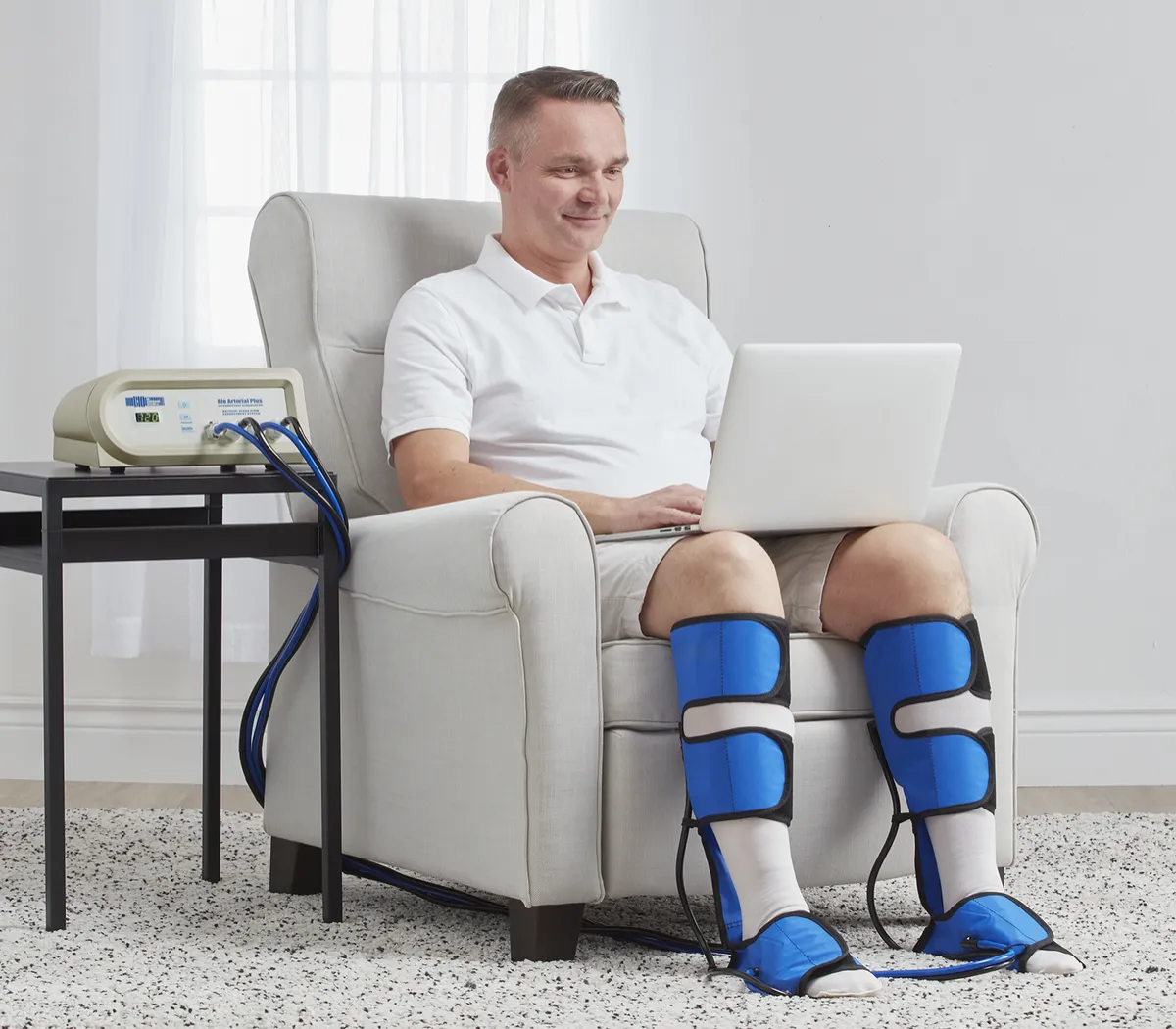
An arterial pump, also called a pneumatic arterial compression device, is a sleeve that wraps the leg or foot and inflates in a timed, rapid sequence. The mechanism is different from a lymphedema pump despite the family resemblance. Rather than moving fluid out of the limb slowly, it uses quick pressure cycles to increase blood flow through the limb.
It is used as an addition to the steps above, not a replacement for them. In practice, the people it tends to help most are:
- Those who cannot participate in a supervised exercise program because of arthritis, balance, heart or lung limits, or transport
- Those who are not currently candidates for a procedure, or who want to try everything conservative first
- Those with ongoing symptoms after a procedure
- Those managing a slow-healing wound alongside the claudication, where a wound care team wants to support perfusion
MCB DME added arterial pumps to the product line for exactly this population. We wrote about the clinical reasoning in Arterial Compression Therapy for PAD.
What the setup looks like. A technician delivers the unit to your home, fits the sleeve, sets the pressure and cycle parameters to the prescription, and trains you and whoever helps you on how to run it. Nothing arrives in a box for you to figure out. If the equipment develops a problem, we respond within 48 hours.
Who it is not for. A pump is not a substitute for revascularization when revascularization is indicated. It is not appropriate for acute limb ischemia, active deep vein thrombosis, or certain wound and infection situations. Your prescriber makes that call.
What it costs and what insurance does
Medicare's coverage policy for pneumatic compression devices, National Coverage Determination 280.6, is written for lymphedema and for chronic venous insufficiency with venous stasis ulcers. It does not address arterial disease. That means coverage for an arterial pump depends on your specific plan and on the clinical documentation from your physician, and it works differently from the lymphedema pump coverage described in our other posts.
Because of that, MCB DME checks your benefits and talks through cost with you before anything is delivered. That conversation is part of our free arterial pump assessment, so you know where you stand before you commit to anything. Call (973) 553-0777 or ask Lumi to get it started.
When it stops being claudication
Claudication happens during exertion. If the pain arrives at rest, the situation has changed.
Watch for:
- Pain in the forefoot or toes at night that eases when you hang the leg over the side of the bed
- A wound on the foot or leg that is not healing
- A sudden cold, pale, painful, or numb leg, which is an emergency and belongs in the emergency department
The first two point toward what clinicians call chronic limb-threatening ischemia, and they call for prompt vascular evaluation rather than a wait-and-see approach. The National Heart, Lung, and Blood Institute explains in patient-level terms that leg and foot pain at rest signals severe PAD, and that without treatment PAD may cause sores, infections, and even loss of a limb.
Frequently asked questions
Is intermittent claudication serious?
It is a warning worth acting on. The leg symptom itself is manageable for most people, but it signals arterial disease that is rarely confined to the legs, which is why PAD is treated as a cardiovascular risk marker as much as a leg problem.
Can PAD be reversed?
The plaque itself is generally not reversed. What changes substantially is your symptoms and your walking distance, and how fast the disease progresses. People who stop smoking and complete an exercise program frequently walk considerably farther than they could at diagnosis, and that improvement is real even though the underlying narrowing is still there.
Should I walk if my legs hurt?
In most cases yes, and this is the part that surprises people. Walking to moderate discomfort, resting, and repeating is the mechanism by which walking programs work. Ask your physician first, especially if you have heart disease, and stop if you get chest pain, unusual shortness of breath, or dizziness.
How long before a walking program helps?
Improvement is usually gradual over weeks rather than days, with meaningful change often appearing around the six to twelve week mark. This is why the distance measurement at the start matters. It is easy to miss steady progress without a baseline.
Do I need surgery for claudication?
Most people with stable claudication do not. Procedures are generally considered when symptoms are limiting your life despite conservative treatment, or when the disease has progressed to rest pain or a non-healing wound. That is a conversation for a vascular specialist.
Does an arterial pump replace a procedure?
No. It is used alongside conservative management, often for people who cannot do a walking program or who are not current candidates for a procedure. Where revascularization is indicated, a pump is not a substitute for it.
Key takeaways
- Claudication is reproducible leg pain on walking that clears within minutes of rest. The consistency of the distance is what identifies it.
- Where the pain sits gives a rough map of where the narrowing is.
- Stopping smoking and a supervised walking program do more for walking distance than most people expect, and both sit below any procedure on the treatment ladder.
- Medicare covers supervised exercise therapy for qualifying patients, and it remains badly underused.
- Arterial pumps are an in-home addition to conservative care, delivered and fitted by a technician, and are most useful for people who cannot make an exercise program work.
- Pain at rest, a wound that will not heal, or a suddenly cold and painful leg mean the situation has changed and needs prompt attention.
Next steps
MCB DME is a Medicare-enrolled DMEPOS supplier at 293 Lafayette Avenue in Hawthorne, NJ. We serve patients across northern New Jersey and New York, including Rockland County. We deliver and fit arterial pumps in the home, train you and your caregiver on the equipment, and respond to equipment problems within 48 hours.
If your physician has raised arterial pump therapy, or you want to understand whether it fits your situation, we offer a free arterial pump assessment. Start on our arterial pump page, read more about pneumatic compression devices in New Jersey, or call (973) 553-0777. You can also reach the team here, or ask Lumi, our 24/7 chatbot, at the bottom right of any page.
If you are not sure yet whether what you have is arterial at all, start with Signs of Poor Circulation in Legs.
This article is for general education and is not medical advice. Treatment decisions belong to you and your physician.