Signs of Poor Circulation in Legs: When It's PAD
The signs of poor circulation in legs usually show up in small ways first: feet that stay cold, legs that ache after a short walk, hair that stopped growing on your shins, a scrape on your ankle that has not closed in a month. Any one of these can be nothing. Together, they are the pattern that peripheral artery disease makes, and it is worth checking.
September is Vascular Disease Awareness Month, which is as good a reason as any to take the legs seriously.
This guide is for anyone who has noticed a change in their legs or feet, and for the family members who notice it first. If you would rather just ask a question, Lumi, our 24/7 chatbot, is at the bottom right of every page on mcbdme.com.
The quick answer
- The most common early signs are cold feet, aching or cramping in the calf when you walk, hair loss on the lower legs, thin or shiny skin, and toenails that thicken and grow slowly.
- The single most telling sign is leg pain that starts when you walk a predictable distance and stops within a few minutes of standing still. That is called claudication, and it points at the arteries.
- The most urgent sign is pain in the forefoot or toes at night that eases when you hang the leg over the side of the bed. Call your doctor about that one promptly.
- Not all poor circulation is arterial. Swelling that is worse by evening and better by morning usually points to veins or lymphatics, which is a different problem with a different treatment.
- The test that settles it is an ankle-brachial index, or ABI. It is a short, painless test that uses blood pressure cuffs and involves no needles.
- Why it matters before compression: compression helps venous and lymphatic swelling and can cause real harm on a leg with poor arterial flow. The arterial question has to be answered first.
Everything below explains each of these in plain terms.
What "poor circulation" actually means
People use the phrase to mean two opposite problems, and the distinction changes everything that follows.
Arterial problems are about blood struggling to get down into the leg. Arteries carry oxygen-rich blood from the heart outward. When plaque narrows them, the muscles and skin in the lower leg and foot run short of oxygen, especially when you ask them to work. That is peripheral artery disease, or PAD. The Centers for Disease Control and Prevention estimates that about 6.5 million people age 40 and older in the United States have PAD, and notes that up to 4 in 10 people with it have no leg pain at all.
Venous and lymphatic problems are about fluid struggling to get back up. Valves in the leg veins weaken, or the lymphatic system cannot keep up, and fluid pools in the tissue. That shows up as swelling rather than pain on walking.
Both get called poor circulation. Only one of them is dangerous to the limb in the short term, and only one of them responds to compression. We wrote about the swelling side of this in Why Are My Legs Swollen? 9 Causes and When to See a Doctor.
The eight signs worth paying attention to
None of these is a diagnosis on its own. The pattern is what matters.
- Cold feet, or one foot colder than the other. Temperature difference between the two legs is more meaningful than both being cold. Compare them with the back of your hand.
- Cramping or aching in the calf, thigh, or buttock when you walk. It comes on at a fairly consistent distance, gets worse if you speed up or go uphill, and goes away within a few minutes of stopping. It is not a stitch and it is not random.
- Hair loss on the lower legs, ankles, or toes. Skin that is short on oxygen stops maintaining hair follicles. Many people assume this is just aging.
- Skin that looks thin, shiny, or tight across the shin and top of the foot. It can look almost polished.
- Toenails that thicken, yellow, and grow slowly. Often mistaken for fungus, and sometimes it is both.
- Sores, scrapes, or blisters below the knee that do not close. A minor injury on a healthy leg heals in a week or two. On a poorly perfused leg it can sit open for months.
- Color changes. The foot goes pale or white when you raise it, and turns dusky red or purple when you lower it. That swing is called dependent rubor and it is worth mentioning to a clinician.
- Numbness, weakness, or a heavy feeling in the leg that is not clearly tied to activity.
The signs people write off, which are the ones that matter most
Three of these deserve extra attention because they are so easy to explain away.
"My feet are always cold, that is just me." Maybe. But if one foot is reliably colder than the other, that asymmetry is a circulation question, not a personality trait.
"I stopped walking as far because my knee bothers me." Sometimes people adapt to claudication without noticing they adapted. They just walk less, take the car, stop at the bench halfway. If the distance you can walk comfortably has shrunk over the past year, that is data.
"I have to hang my foot off the bed to sleep." This one is not subtle once you know what it means. Pain in the forefoot or toes at night, relieved by dangling the leg down, suggests the arteries can barely deliver blood without gravity's help. In clinical terms that is rest pain, and it belongs in front of a doctor promptly rather than at the next routine visit. The National Heart, Lung, and Blood Institute describes leg and foot pain at rest as a sign of severe PAD, called critical limb ischemia.
Who is most at risk
Risk does not diagnose anything, but it changes how seriously to take a vague symptom. According to the American Heart Association, the main risk factors include:
- Smoking, current or past. The AHA notes smokers may have almost three times the risk of PAD compared with nonsmokers
- Diabetes
- Age 65 and older, or age 50 to 64 with other risk factors such as diabetes or a history of smoking
- High blood pressure
- High cholesterol
- Low physical activity
- A personal or family history of PAD, heart disease, or stroke
If you have diabetes, there is a second problem stacked on the first. Neuropathy dulls the sensation that would normally tell you something is wrong, so a wound can get established before you feel it. That is the reason daily foot checks matter so much, and it is the logic behind Medicare's therapeutic shoe benefit.
When it is not circulation at all
Three conditions imitate PAD closely enough that they get confused regularly.
Spinal stenosis also causes leg pain on walking. The tell is what relieves it. Claudication eases when you stand still. Stenosis pain usually eases when you sit down or lean forward over a shopping cart, and standing still does not help much.
Peripheral neuropathy causes burning, tingling, and numbness that is often worse at night, but it does not follow the walk-stop-relief pattern, and the pulses in the foot are usually normal.
Arthritis in the hip, knee, or ankle causes pain that starts with the first few steps and often loosens up as you keep moving, which is nearly the reverse of claudication.
A clinician sorts these out quickly. The point is that "my legs hurt when I walk" has more than one answer, and guessing is not the move.
Arterial, venous, or lymphatic: a quick comparison
| Arterial (PAD) | Venous | Lymphatic | |
|---|---|---|---|
| Main complaint | Pain on walking, cold foot | Swelling, heaviness, aching | Swelling, often one limb |
| Swelling | Usually minimal | Worse by evening, better by morning | Persistent, does not fully resolve overnight |
| Skin | Thin, shiny, pale or dusky, hairless | Brown staining around the ankle, often itchy | Thickened over time, Stemmer sign positive |
| Wounds appear | Toes, heel, outer ankle, pressure points | Inner ankle area | Less common, but skin breakdown occurs |
| Pulses in the foot | Weak or absent | Usually present | Usually present |
| Compression | Only after arterial assessment, and often modified or avoided | Mainstay of treatment | Mainstay of treatment |
If the right-hand columns describe your legs better, our lymphedema resources are the better starting point. If the left column fits, keep reading.
Why this matters before anyone puts compression on your leg
This is the part that sends people to us, so it is worth being direct about.
Compression is the correct treatment for venous and lymphatic swelling. On a leg where the arteries are already struggling, external pressure can further reduce the blood getting in, and a leg that was managing can develop a wound instead. Compression socks are sold in every pharmacy and airport with no gatekeeping, which means plenty of people put them on without anyone checking the arterial side first.
We covered the full safety picture in Who Should Not Wear Compression Socks, and it is the companion piece to this one.
At MCB DME, an arterial question gets answered before a compression garment gets fitted. Sometimes that means we ask your physician for an ABI result before we measure you. That is not us being difficult. It is the difference between a garment that helps and one that causes a problem.
What to do next, and what a clinician will check
Bring the specifics. "My legs hurt" is much less useful to a doctor than "I get a cramp in my right calf after about two blocks, it goes away in three or four minutes of standing, and it has been getting shorter since spring."
At the visit, expect some combination of:
- Feeling for pulses at the top of the foot and behind the inner ankle
- Comparing the two legs for temperature, color, hair, and skin texture
- An ankle-brachial index (ABI), which compares blood pressure at the ankle to blood pressure in the arm using cuffs and a small Doppler device. The National Heart, Lung, and Blood Institute notes that the ABI is usually the first test used to diagnose PAD.
- Imaging such as a duplex ultrasound if the ABI or the exam suggests it
We cover the ABI in detail, including what each number range means for your treatment plan, in Ankle-Brachial Index: The Test Before Compression.
Frequently asked questions
Can poor circulation in the legs be reversed?
Arterial narrowing itself is not usually reversed, but the trajectory can change substantially. Stopping smoking, walking programs, blood sugar and cholesterol control, and in some cases a procedure can improve both symptoms and how far you can walk. The earlier it is caught, the more room there is to work with.
Are cold feet always a circulation problem?
No. Thyroid conditions, anemia, Raynaud's, certain medications, and simply being cold all cause cold feet. What raises the concern is a consistent difference between the two feet, or cold feet alongside two or three other signs on the list above.
Do compression socks help poor circulation?
It depends entirely on which kind. For venous and lymphatic problems, yes, they are a mainstay. For arterial disease, compression can make things worse and should only be used after an arterial assessment, if at all. See Who Should Not Wear Compression Socks.
How fast does PAD progress?
It varies widely. Some people stay stable for years, especially if risk factors are managed. Others progress more quickly, and diabetes and continued smoking are two of the biggest accelerators. Left untreated, PAD can lead to sores, infections, and in the worst cases loss of a limb, which is why catching it early matters.
Does walking make it better or worse?
Better, in most cases, and this surprises people. Supervised walking programs are a first-line treatment for claudication precisely because walking to the point of discomfort, resting, and repeating improves walking distance over time. Ask your doctor before starting one, particularly if you have heart disease.
My swelling goes down overnight. Is that PAD?
Probably not. Swelling that improves substantially overnight points toward veins. Swelling that never fully resolves points toward the lymphatic system. Neither pattern is typical of arterial disease, which tends to produce pain and skin changes rather than swelling.
Key takeaways
- Poor circulation is two different problems. Arterial means blood struggles to get down the leg. Venous and lymphatic mean fluid struggles to get back up.
- The arterial pattern is pain on walking that stops with rest, cold feet, hair loss, shiny skin, and wounds that will not close.
- Night pain in the forefoot relieved by dangling the leg is the sign that needs prompt attention.
- An ABI is a quick, needle-free test and the standard first way to answer the arterial question.
- Compression is right for venous and lymphatic swelling and can be harmful on a leg with poor arterial flow, so the arterial question comes first.
Next steps
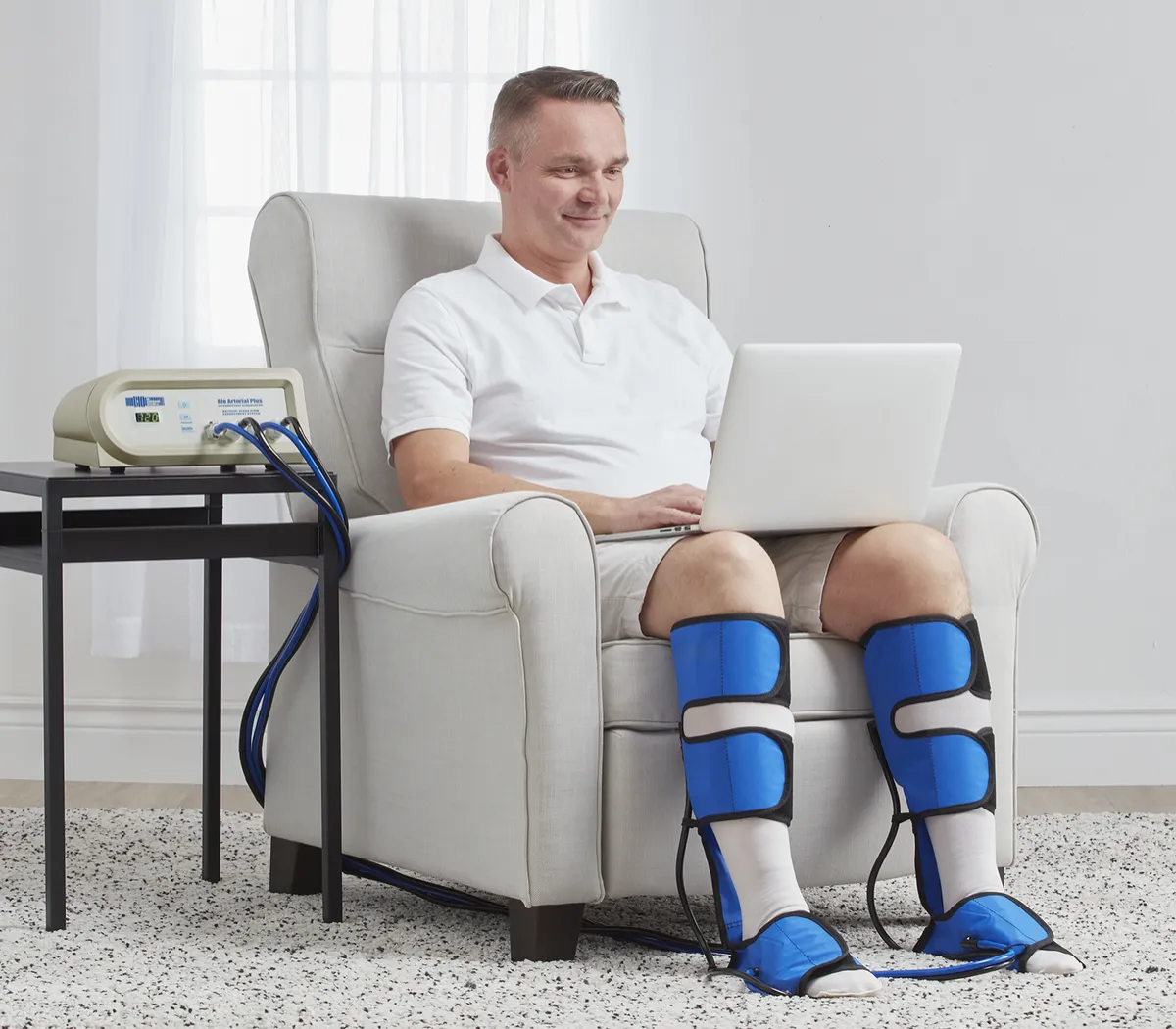
MCB DME is a Medicare-enrolled DMEPOS supplier based in Hawthorne, NJ. We serve patients across northern New Jersey and New York, including Rockland County. We fit compression garments, supply arterial and lymphedema pumps, and coordinate with your physician when an arterial assessment needs to happen before anything else.
If you are not sure which side of this your legs are on, that is exactly the conversation to have. Learn about our arterial pump program, browse our compression therapy options, or call (973) 553-0777. You can also reach the team here, or ask Lumi, our 24/7 chatbot, at the bottom right of any page.
This article is for general education and is not medical advice. Talk to your physician about symptoms in your legs or feet.