Medical Grade Compression Socks: mmHg, Fit & Medicare
Medical grade compression socks are knit to deliver a measured, graduated pressure, firmest at the ankle and easing off toward the knee or thigh, at a pressure your provider picks for your condition. Drugstore and athletic compression socks may feel snug, but they are usually sized by shoe size, sold in loose "firm" or "extra firm" labels, and are not built or fitted to a prescription. The difference matters most if you have lymphedema, venous disease, a past blood clot, or diabetes. It matters a lot less if you just want fresher legs on a long drive.
With Thanksgiving travel coming up, plenty of people grab compression socks at the pharmacy checkout. For some that is fine. Others need something different, or need a circulation check first. Below: what "medical grade" really means, the mmHg levels, why measuring matters, who needs a prescription, and when Medicare pays. If you want help choosing a specific style or brand, our guide to choosing compression socks covers that side in detail. Have a question as you read? Lumi, our 24/7 chat assistant, sits at the bottom right of every page on mcbdme.com.
The quick answer
- "Medical grade" means graduated compression at a stated mmHg range, made to a recognized standard, in sizes based on your actual limb measurements.
- Common US levels are 15-20, 20-30, 30-40, and 40-50 mmHg. Under 20 is mostly over the counter. 20 and up is where a prescription normally comes in.
- Drugstore and athletic socks are not useless. They are just not a treatment, and the pressure printed on the box is only true if the sock fits your leg.
- A certified fitter measures you, ideally in the morning before swelling builds, and picks a garment that fits your shape.
- Medicare Part B covers compression garments for lymphedema. It generally does not cover them for varicose veins, tired legs, or travel. There is a narrow exception for stockings used to treat an open venous ulcer.
- People with blocked leg arteries, severe neuropathy, fragile or infected skin, or uncontrolled heart failure should not start compression without a doctor's OK.
What "medical grade" actually means
In the US, anyone can print "medical grade" on a box. When clinicians and the major manufacturers use the phrase, they mean three things together.
1. Graduated compression
A true medical garment is not just tight. It squeezes hardest at the ankle and the pressure steps down as it moves up the leg. That helps move blood and lymph fluid back toward the heart instead of pooling at the ankles. A sock that is tightest at the calf (because it is too small there) can do the opposite and trap fluid lower down.
2. A stated pressure range in mmHg
Pressure is measured in millimeters of mercury (mmHg), like blood pressure. A medical garment states a range, such as 20-30 mmHg at the ankle. Many athletic socks skip the number. No number, no dose.
3. Made and tested to a standard
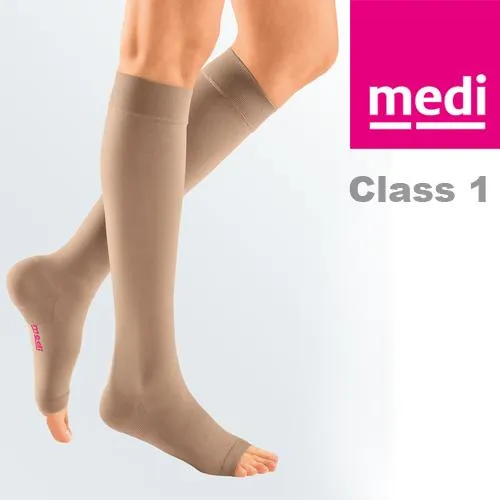
Medical garment makers test the pressure, how it steps down the leg, and how the fabric holds up. In Europe, the German RAL quality standard (RAL-GZG 387/1 for legs, 387/2 for arms) is the benchmark many manufacturers cite. Medi's explanation of compression classes lists the RAL ranges: Class I is 18 to 21 mmHg, Class II is 23 to 32, Class III is 34 to 46, and Class IV is 49 and up. US products usually use the simpler ranges below, so a European "Class 2" and a US "20-30" are close but not identical. The brands we fit at MCB DME (Medi, Juzo, Jobst, and Thuasne) all make medical lines with stated pressure ranges and full size charts.
Compression levels at a glance
Juzo describes the four common US ranges as support, mild, moderate, and firm. Your provider decides the level. This table is a general orientation, not a prescription.
| Level | What it is often used for | Prescription? | Fitting |
|---|---|---|---|
| 8-15 mmHg (light) | Long days on your feet, everyday comfort | No | Shoe-size or S/M/L is usually fine |
| 15-20 mmHg (support) | Tired, achy legs, mild swelling, long flights or drives | No | Measuring still helps |
| 20-30 mmHg (mild) | Varicose veins, moderate swelling, after vein procedures, some lymphedema maintenance | Often required by suppliers and insurers | Measured by a fitter |
| 30-40 mmHg (moderate) | More serious venous disease, history of venous ulcers, post-thrombotic syndrome, many lymphedema cases | Yes | Measured, sometimes made to measure |
| 40-50 mmHg (firm) | Severe venous disease and lymphedema, under close medical supervision | Yes | Measured, often made to measure or flat knit |
The white "TED" stockings from the hospital are a different thing: anti-embolism stockings for people lying in bed after surgery. They are not a substitute for a daytime medical stocking once you are up and walking.
Drugstore and athletic socks: where they fit
A pharmacy sock is not a scam. For a healthy person who wants less ankle puffiness after a flight, a 15-20 mmHg sock in the right size is reasonable.
The problems start when someone with a medical condition uses one as treatment. Juzo's guidance on buying compression puts it plainly: consumer socks may help your legs feel better for a while, but if you have a circulatory or lymphatic condition they may be the wrong dose, the wrong size, or the wrong type, and could be dangerous to wear. Juzo also warns against stockings sized only by shoe size, because your shoe size says nothing about your ankle or calf.
On a swollen leg, a drugstore sock often ends up tighter at the calf than the ankle, digs in at the top band like a tourniquet, or is simply too weak to hold back real lymphedema, so swelling keeps creeping up while you think you are "doing compression."
Why fit and measurement matter so much
The mmHg on the label is only true for a leg inside the size range it was made for. On a bigger leg the pressure goes up. On a smaller one it drops. Two people in the "same" sock can get very different doses.
A proper fitting takes several circumference measurements (ankle, calf, sometimes below the knee and thigh) plus lengths. The best time is first thing in the morning, before gravity has made your legs swell for the day. With lymphedema, garments are usually measured right after therapy has reduced the limb, so they hold that result.
Very short or tall legs, a big ankle-to-calf difference, deep skin folds, or legs of different sizes often need made-to-measure. Stiffer flat-knit fabric, which does not cut into folds, is common for lymphedema and lipedema.
Want to see what a fitter actually measures? Our step-by-step measuring guide and size chart walks through each point. We still recommend an in-person fitting for anything 20 mmHg and up.
Who needs a prescription and a fitter
Cleveland Clinic's overview of compression therapy notes that stockings under 20 mmHg are available over the counter, while 20 mmHg and higher need a prescription. In real life you will see 20-30 mmHg socks for sale online with no questions asked. Juzo's own FAQ says a prescription may not be required by law at that level, but most dealers will want one. Insurance always will.
You should get a provider's order and a professional fitting if:
- You have lymphedema, or swelling in one limb that does not go away overnight.
- You have varicose veins with aching, skin color changes, or a past venous ulcer.
- You had a deep vein thrombosis (DVT), now or in the past.
- You have diabetes, especially with numbness in your feet.
- You have any history of poor circulation, leg pain when walking, or cold, pale feet.
- You need 30 mmHg or more, or your legs do not match standard size charts.
Your prescription should list the pressure, length, and diagnosis. A fitter turns that into a specific garment you can actually get on, and shows you how. Our fitters see patients in Hawthorne from across northern New Jersey and from New York, including a lot of families in Rockland County who find it easier than going into the city.
When Medicare covers compression garments
This is where most of the confusion lives, so here is the short version, based on CMS and its contractors as of November 2026.
Covered: lymphedema
Since the Lymphedema Treatment Act took effect on January 1, 2024, Medicare Part B covers compression for people with lymphedema. Medicare.gov's lymphedema compression page lists standard and custom-fitted gradient compression garments, wraps with adjustable straps, and bandaging supplies, when you have lymphedema and your provider orders them. After the Part B deductible, you generally pay 20% of the Medicare-approved amount. CMS allows up to 3 daytime garments per affected body part every 6 months and 2 nighttime garments every 2 years, with replacements when a garment is lost, stolen, damaged beyond repair, or your limb size changes.
Narrow exception: an open venous ulcer
Under Medicare's surgical dressing benefit, certain gradient compression stockings can be covered while they are being used to treat an open venous stasis ulcer. A 2025 surgical dressings training from CGS, a Medicare equipment contractor, spells out that the same stockings are not covered for venous insufficiency without an ulcer, or to prevent an ulcer from coming back after it heals.
Generally not covered
- Varicose veins or venous insufficiency without an open ulcer
- Tired or achy legs
- Travel or flight socks
- Athletic or recovery socks
- Socks bought on your own without an order from your provider
Medicare Advantage, NJ and NY Medicaid, and commercial plans set their own rules, and some do cover stockings for venous disease. That is exactly why MCB DME verifies your benefits before anything ships, so you know what you will owe up front. More on our compression garments page.
Common mistakes we see
- Buying by shoe size. Your ankle and calf decide the size, not your foot.
- Going stronger "to be safe." Too much pressure is hard to get on and may be unsafe for your arteries.
- Measuring at night. Evening swelling makes you pick a size that is too big for the morning, when you put it on.
- Rolling or folding the top band down. That doubles the pressure in one ring around your leg.
- Sleeping in daytime socks. Unless your provider says otherwise, they come off at bedtime.
- Ignoring pain, numbness, or color changes. Those mean take it off and call your provider.
Who should not wear compression socks without a doctor's OK
Compression is safe for most people, but not everyone. Get checked first if any of these apply:
- Peripheral artery disease (PAD). If arteries to your legs are narrowed, squeezing the leg can cut blood flow further. Your provider may order an ankle-brachial index (ABI) test before prescribing compression.
- Severe peripheral neuropathy. If you cannot feel your feet, you may not notice a sock that is too tight or rubbing a sore.
- Uncontrolled heart failure. Pushing a lot of fluid back toward the heart quickly can be a problem.
- Fragile skin, open wounds, a fresh skin graft, or skin infection. Cellulitis needs treatment first.
- Allergy to the material. Latex-free and cotton-blend options exist.
- A new, painful, swollen leg. That could be a blood clot and needs to be checked the same day, not wrapped.
Cleveland Clinic also advises talking with a provider before starting compression if you have a DVT and take blood thinners. Our full guide to who should not wear compression socks goes deeper on each of these.
FAQ
Are medical grade compression socks better than regular compression socks?
For a medical condition, yes: tested graduated pressure and sizing by limb measurements. For comfort on a long day, a well-fitting 15-20 mmHg sock is often enough.
What mmHg is considered medical grade?
Most clinicians treat 20-30 mmHg and up as medical-strength compression, and 15-20 as support. What makes a garment medical grade is the graduated design, stated range, and proper fit, not only the number.
Do I need a prescription for 20-30 mmHg compression socks?
Often, yes. Many suppliers require one at 20 mmHg and above, and any insurance claim does. You can find them online without one, but you skip the measurement and the safety check.
Does Medicare cover compression socks for varicose veins?
Generally no. Medicare covers garments for lymphedema, and certain stockings while treating an open venous ulcer. Varicose veins without an ulcer, travel socks, and comfort socks are generally not covered. Other plans vary, so we verify benefits first.
Are drugstore compression socks OK for flying?
For most healthy travelers, a 15-20 mmHg sock in the correct size is reasonable. If you have had a blood clot, have lymphedema, or have circulation problems, ask your provider what you should wear.
Can I wear compression socks to bed?
Usually not daytime socks. Most guidance says take them off at night unless your provider tells you otherwise. People with lymphedema may be prescribed separate nighttime garments built for lying down.
Key takeaways
- 15-20 mmHg is support. 20-30 and up is where a provider, a prescription, and a fitter belong.
- The label pressure is only accurate if the garment fits your leg.
- Medicare covers garments for lymphedema and, narrowly, stockings for an open venous ulcer. Not travel socks or general varicose veins.
- If you have PAD, severe neuropathy, uncontrolled heart failure, or a new painful swollen leg, see your doctor before any compression.
Next steps
If your provider has recommended compression, or you are not sure the socks you bought are doing anything, we can help. MCB DME is a Medicare-enrolled supplier at 293 Lafayette Avenue, Suite 104, in Hawthorne, NJ, fitting patients from northern New Jersey and New York, including Rockland County. We measure you in person, work with your provider on the order, and verify benefits before anything ships.
- Comparing styles and brands? Start with our compression socks buying guide.
- Call us at (973) 553-0777 to book a fitting.
- Contact us online and we will call you back.
- Or ask Lumi, our 24/7 chat assistant at the bottom right of this page, any time.
This article is for general education and is not medical advice. Talk with your doctor or other qualified provider about your symptoms, whether compression is safe for you, and what level you need. Coverage depends on your specific plan.