Foot, Wrist & Tendonitis DME Solutions | Provider Guide | MCB DME
For physicians, podiatrists, physical therapists, occupational therapists, and any provider managing musculoskeletal conditions, durable medical equipment is one of the most direct pathways from diagnosis to functional recovery. The right brace, orthotic, or support device — properly fitted and covered by insurance — can mean the difference between a patient who improves consistently and one who cycles through repeated flares, delayed recovery, and preventable complications.
This guide is designed to give providers a clear, practical overview of the most common foot, wrist, and tendonitis conditions they see in clinical practice — and the specific DME solutions available to support conservative management, post-surgical recovery, and long-term self-care. It also covers documentation requirements, HCPCS coding fundamentals, and how to streamline the referral process so your patients get the right equipment without administrative delay.
Whether you're a provider looking for a reliable DME partner in Northern New Jersey or simply need a refresher on what bracing and orthotic options are available, this guide is for you.
Why DME Belongs in Your Conservative Management Protocol
Across foot, ankle, wrist, and hand conditions, conservative management remains the first-line recommendation for the vast majority of musculoskeletal pathologies. According to a widely referenced clinical review published in the Journal of the American Academy of Orthopaedic Surgeons, nonsurgical treatment — including orthotics, bracing, and shoe modification — is almost always considered before surgical intervention for common foot and ankle disorders.
The clinical rationale is straightforward. Orthotic braces and supports accomplish several simultaneous goals:
Immobilization and protection — allowing inflamed or damaged tendons, ligaments, and soft tissue to rest and heal without complete activity cessation
Biomechanical correction — addressing the structural misalignments that cause or perpetuate conditions like plantar fasciitis, posterior tibial tendon dysfunction, and de Quervain's tenosynovitis
Swelling and inflammation management — graduated compression within bracing constructs reduces edema and dampens the inflammatory cascade
Patient compliance — well-fitted, comfortable bracing increases adherence to conservative protocols compared to verbal rest recommendations alone
For providers managing these conditions, DME is not a secondary consideration — it is an active therapeutic intervention with documented clinical outcomes. The challenge is knowing which device is appropriate for which presentation, and how to get it into the patient's hands efficiently. That's exactly what this guide addresses.
Section 1: Foot Conditions and DME Solutions
Plantar Fasciitis
What it is: Plantar fasciitis is inflammation of the plantar fascia — the thick band of connective tissue running along the bottom of the foot from the heel to the base of the toes. It is one of the most common causes of heel pain in adults, characterized by sharp, stabbing pain most intense with the first steps in the morning or after prolonged rest.
Who presents with it: Active adults, runners, people who stand for long periods occupationally, and patients with flat feet, high arches, or tight calf musculature. It is also common in overweight and obese patients due to increased load on the plantar fascia.
DME solutions:
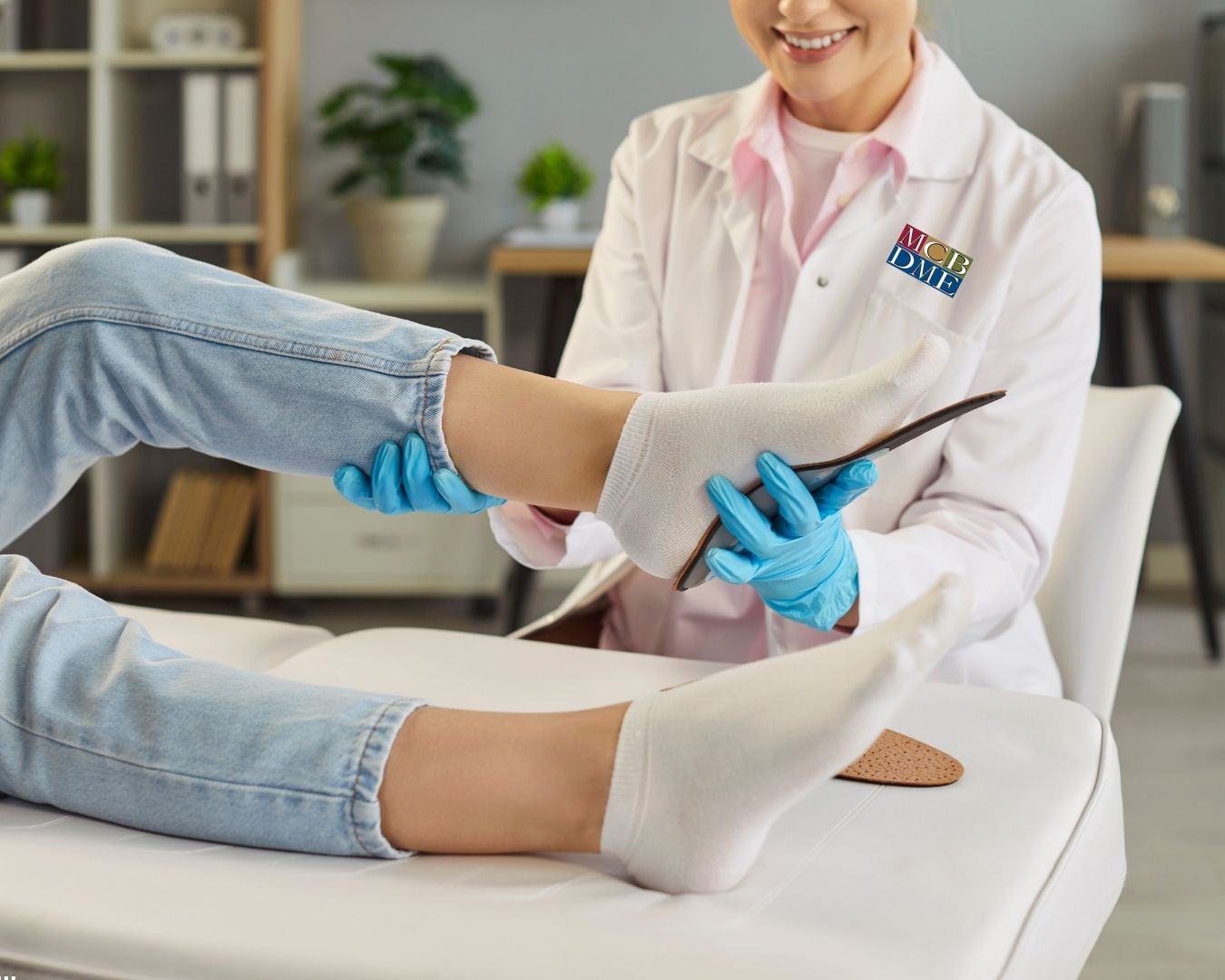
Prefabricated plantar fasciitis orthotics provide arch support and heel cushioning that redistributes pressure away from the inflamed fascia insertion. Over-the-counter options are appropriate for mild to moderate cases; custom-molded orthotics are indicated when the deformity is more complex or when prefabricated options have failed after a trial period.
Night splints maintain the foot in a dorsiflexed position during sleep, preventing the plantar fascia from contracting overnight — which is the primary cause of the characteristic morning pain. Research consistently supports night splints as an effective adjunct in cases that have not resolved with orthotics and stretching alone.
Diabetic and orthopedic footwear with extra depth and cushioned soles reduces plantar loading and accommodates orthotic inserts. For patients whose plantar fasciitis is compounded by diabetic neuropathy or structural foot deformity, diabetic and orthopedic shoes from MCB DME provide both therapeutic support and insurance coverage under Medicare Part B.
HCPCS reference codes: L3000–L3030 (foot inserts, removable, custom molded), L3040–L3090 (foot, arch support prefabricated), A5500–A5513 (diabetic shoes and inserts)
Achilles Tendonitis and Posterior Tibial Tendon Dysfunction (PTTD)
What it is: Achilles tendonitis is inflammation of the Achilles tendon, most commonly at the insertion point on the calcaneus (insertional) or 2–6 cm proximal to it (non-insertional). It presents with posterior heel or mid-tendon pain that worsens with activity. PTTD — sometimes called adult-acquired flatfoot — involves progressive dysfunction of the posterior tibial tendon, causing medial arch collapse, pain along the inner ankle, and a characteristic inability to perform a single-leg heel rise.
Who presents with it: Achilles tendonitis is common in runners, active adults, and patients who have recently increased activity volume. PTTD predominantly affects middle-aged and older women and patients with obesity, hypertension, or diabetes, though it can occur in any adult.
DME solutions:
For Achilles tendonitis, heel lift inserts reduce the mechanical load on the tendon by decreasing the angle of dorsiflexion required during gait. Ankle-foot orthoses (AFOs) — particularly those with a hinged design — are used in more symptomatic cases to limit the end-range dorsiflexion that aggravates the tendon.
For PTTD, bracing goals differ by disease stage. In Stage II (flexible deformity), a UCBL (University of California Biomechanics Laboratory) insert or custom MAFO (molded ankle-foot orthosis) attempts to restore the medial arch and correct hindfoot valgus. In Stage III (rigid deformity), the brace is molded in situ to provide comfort and prevent further collapse rather than attempt correction.
Silicone Achilles sleeves reduce tendon irritation from shoe friction and provide mild compression. For patients whose Achilles tendonitis is chronic or in a post-surgical healing phase, an offloading boot or cam walker may be appropriate short-term to allow near-complete tendon rest.
HCPCS reference codes: L1900–L1990 (ankle foot orthoses), L3000–L3030 (custom foot orthotics), L4360–L4386 (walking boots/cam walkers)
Ankle Instability and Peroneal Tendonitis
What it is: Chronic lateral ankle instability results from repeated ankle sprains that stretch or tear the lateral ligament complex, leaving patients with residual instability, proprioceptive deficits, and a heightened risk of re-injury. Peroneal tendonitis — inflammation of the peroneal tendons running along the outer ankle — is a frequent co-condition and can develop independently from overuse or biomechanical stress.
Who presents with it: Athletes, patients with a history of multiple ankle sprains, those with cavus (high-arch) foot structure, and workers in occupations requiring uneven terrain navigation.
DME solutions:
Lace-up ankle braces and semi-rigid AFOs are the primary DME interventions for lateral ankle instability. They limit inversion and plantarflexion — the movement pattern that causes lateral sprains — while allowing enough functional range of motion for ambulation and activity. Research supports lace-up braces as effective in preventing re-sprain in functionally unstable ankles.
For peroneal tendonitis, lateral ankle supports with figure-eight strapping provide targeted compression and stability to the peroneal tendon course. Custom orthotics addressing hindfoot valgus or varus correct the biomechanical environment that drives peroneal overload.
HCPCS reference codes: L1900, L1902, L1904, L1906 (prefabricated ankle foot orthoses by rigidity level)
Diabetic Foot and Neuropathy
What it is: Diabetic peripheral neuropathy causes sensory loss, motor weakness, and autonomic dysfunction in the feet, increasing the risk of undetected wounds, pressure ulcers, deformity, and infection. Charcot arthropathy — a severe complication involving progressive destruction of foot and ankle joints — can develop rapidly in neuropathic patients. Proper footwear is not optional in this population; it is a medical intervention.
Who presents with it: Patients with Type 1 or Type 2 diabetes, particularly those with established neuropathy, poor glycemic control, peripheral vascular disease, or a history of foot ulceration.
DME solutions:
Diabetic and orthopedic shoes from MCB DME are specifically constructed with extra depth, seamless interiors, roomy toe boxes, and accommodative insoles to prevent pressure points that cause ulceration in insensate feet. They are covered by Medicare Part B for eligible patients who meet the Therapeutic Shoe Bill criteria — including a diabetes diagnosis and at least one qualifying foot condition.
Custom-molded diabetic inserts redistribute plantar pressure away from high-risk zones, complementing the protective function of the shoe. AFOs are indicated for patients with foot drop, Charcot deformity, or significant motor neuropathy affecting gait.
For prescribing providers: Medicare's Therapeutic Shoe Program (HCPCS A5500–A5513) requires certification of medical necessity from the treating physician and a separate prescription from a podiatrist, orthotist, or qualified prescriber. MCB DME manages all documentation and insurance coordination to make the referral process seamless for your practice.
Section 2: Wrist Conditions and DME Solutions

Carpal Tunnel Syndrome
What it is: Carpal tunnel syndrome (CTS) is the most common peripheral nerve entrapment disorder, caused by compression of the median nerve at the wrist within the carpal tunnel. It presents as numbness, tingling, and pain in the thumb, index, middle, and radial ring finger — often worse at night or with sustained wrist flexion or extension. In moderate to severe cases, thenar muscle weakness and atrophy may develop.
Who presents with it: Middle-aged adults, women more than men (roughly 3:1), patients with repetitive hand and wrist occupations (assembly line workers, data entry, construction), pregnant women, and those with diabetes, hypothyroidism, rheumatoid arthritis, or obesity as comorbidities.
DME solutions:
Wrist splints in a neutral (0–2° extension) position are the first-line non-surgical intervention for CTS. By preventing the wrist from flexing during sleep — the position that maximally narrows the carpal tunnel and provokes nocturnal symptoms — a proper neutral-position splint provides significant symptom relief in mild to moderate CTS. Night splints are the standard recommendation; daytime splinting may be added during activity in more symptomatic patients.
Prefabricated vs. custom wrist orthoses: For most patients, a well-fitted, medical-grade prefabricated wrist splint (HCPCS L3908) is clinically appropriate and insurance-covered. Custom-fabricated wrist orthoses are indicated when prefabricated options do not achieve adequate fit due to anatomical variation, post-surgical requirements, or complex combined pathology.
Prescribing note: Wrist splinting for CTS often precedes or accompanies corticosteroid injection and should be recommended before surgical consultation unless there is evidence of thenar atrophy or electrodiagnostically confirmed severe CTS. A documented conservative treatment trial including splinting strengthens the medical necessity case for any subsequent intervention.
HCPCS reference codes: L3908 (wrist-hand orthosis, prefabricated), L3900 (wrist-hand orthosis, custom fabricated)
De Quervain's Tenosynovitis
What it is: De Quervain's tenosynovitis is inflammation of the tendons in the first dorsal compartment of the wrist — specifically the abductor pollicis longus and extensor pollicis brevis — as they pass through a narrow fibrous tunnel at the radial styloid. The hallmark clinical sign is a positive Finkelstein test. It causes pain and swelling along the radial (thumb) side of the wrist, worsening with thumb and wrist motion.
Who presents with it: New parents (sometimes called "mommy thumb" due to infant lifting mechanics), patients with repetitive pinching and gripping occupations, and adults between ages 30 and 50. Women are affected more frequently than men.
DME solutions:
Thumb spica splints are the primary DME intervention, immobilizing the carpometacarpal (CMC) and metacarpophalangeal (MCP) joints of the thumb while leaving the fingers free for functional use. The splint holds the wrist and thumb in a position of rest, eliminating the motion that aggravates the inflamed first dorsal compartment tendons.
Both prefabricated and custom thumb spica orthoses are available. Prefabricated options (HCPCS L3924) are appropriate for most presentations; custom-fabricated designs are used in complex or post-surgical cases.
HCPCS reference codes: L3924 (thumb spica, prefabricated), L3916 (wrist-hand orthosis with thumb control, custom)
Wrist Sprains and Post-Fracture Support
What it is: Acute wrist sprains involve partial or complete tearing of the carpal ligaments, most commonly the scapholunate ligament following a fall on an outstretched hand. Post-fracture recovery — particularly distal radius and scaphoid fractures — frequently requires progressive bracing following cast removal to protect the healing structures while restoring function.
DME solutions:
Wrist immobilizers and rigid wrist orthoses provide controlled stabilization during the healing phase following sprain or fracture. Progressive bracing — beginning with rigid support and transitioning to semi-rigid and then functional bracing — follows the healing continuum from protection to active rehabilitation.
Wrist-hand orthoses with adjustable range of motion allow providers to dial in the permitted arc of motion as healing progresses, facilitating controlled early mobilization without sacrificing structural protection.
HCPCS reference codes: L3908–L3916 (wrist-hand orthoses, prefabricated and custom, varying control levels)
Section 3: Tendonitis Conditions Across the Upper and Lower Extremity
Understanding Tendonitis as a Systemic Pattern
Tendonitis — or more accurately in many chronic cases, tendinopathy — refers to a spectrum of tendon disorders involving inflammation, degeneration, or failed healing response. While the term is applied broadly, the clinical presentation and DME approach vary significantly depending on the affected tendon, the stage of the condition (acute vs. chronic), and the underlying biomechanical contributors.
The American Academy of Orthopaedic Surgeons recognizes bracing and orthotic support as a core component of conservative tendinopathy management, with the primary goals of offloading the affected tendon, correcting biomechanical contributors to overload, and allowing graduated return to function.
Lateral Epicondylitis (Tennis Elbow)
While not a foot or wrist condition, lateral epicondylitis is one of the most commonly referred tendon conditions in clinical practice and frequently involves DME. A lateral elbow counterforce brace (also called a tennis elbow strap) applies targeted compression below the lateral epicondyle, redistributing the mechanical load on the extensor tendon origin and reducing pain during gripping and lifting. These are among the most commonly prescribed DME items for elbow conditions and are covered under HCPCS L3702.
Patellar Tendonitis and Achilles Tendinopathy
Both conditions involve overuse tendon degeneration in high-load structures. For patellar tendonitis, patellar tendon straps and knee orthoses (HCPCS L1820–L1830) reduce stress at the patellar tendon insertion during activity. For Achilles tendinopathy, heel lift inserts, Achilles sleeves, and AFOs are the primary orthotic interventions — as covered in Section 1 above.
Trigger Finger and Flexor Tendon Conditions
Trigger finger (stenosing tenosynovitis) involves thickening of the flexor tendon sheath, causing the finger to catch or lock during flexion. Finger extension splints that hold the affected digit in extension during sleep prevent the flexor tendon from lodging in the narrowed sheath overnight, reducing morning stiffness and locking. These are typically prefabricated, low-cost DME items that can significantly reduce symptom burden and may delay or prevent the need for corticosteroid injection or surgical release.
Section 4: Insurance Coverage and Documentation for Orthotic DME
Medicare Coverage Basics for Braces and Orthotics
Medicare Part B covers orthotics and braces under the Durable Medical Equipment benefit when they meet the following criteria:
Medical necessity: The device must be required to treat a specific medical condition, as documented in the patient's medical record
Physician prescription: A signed order from a treating physician, nurse practitioner, or physician assistant is required — per CMS guidelines, physical and occupational therapists are not considered treating practitioners for DME prescription purposes
Provided by a licensed DME supplier: The equipment must be supplied by a Medicare-enrolled DME provider
HCPCS L-Codes: A Quick Reference for Providers
Orthotic and prosthetic items are billed under HCPCS Level II "L" series codes. The specific L-code drives both the coverage determination and the documentation requirements. Key code families relevant to this guide:
L1900–L1990: Ankle-foot orthoses (prefabricated and custom, by level of rigidity)
L3000–L3090: Foot inserts and arch supports (custom and prefabricated)
L3700–L3762: Elbow orthoses (including lateral epicondylitis counterforce braces)
L3900–L3930: Wrist-hand orthoses (prefabricated and custom, by control type)
A5500–A5513: Diabetic shoes, inserts, and modifications
What Providers Need to Submit for Orthotic DME Referrals
Referring providers should ensure the following are in the patient's record and available to the DME supplier at time of referral:
Signed prescription with the patient's name, date of birth, diagnosis (ICD-10 code), specific device description, and prescribing provider's NPI
Clinical documentation supporting medical necessity — including relevant examination findings, imaging results, and a description of conservative treatment already attempted
Insurance information including the patient's Medicare or private insurance card and any relevant prior authorization requirements
MCB DME handles all of this for you. When you refer a patient to our team, we take over insurance verification, prior authorization, documentation coordination, and equipment fitting — providing timely updates to your office throughout the process. Learn more about our provider referral process.

Frequently Asked Questions for Providers
Does Medicare cover ankle foot orthotics and wrist braces?
Yes. Medicare Part B covers medically necessary orthotics and braces classified under HCPCS L-codes when prescribed by a physician and supplied by a licensed DME provider. Documentation of medical necessity and a signed prescription are required. Coverage determinations vary by specific L-code and whether the device is prefabricated or custom-fabricated.
What is the difference between off-the-shelf and custom orthotics for DME purposes?
Off-the-shelf (prefabricated) orthotics are sized and fitted from stock inventory without customization. They carry lower associated fees and typically require less documentation. Custom orthotics are individually fabricated from a cast or digital scan of the patient's foot or limb and are indicated when prefabricated options have failed, when the deformity cannot be accommodated by standard sizing, or when the clinical condition specifically requires custom fabrication. Both categories are coverable under Medicare with appropriate HCPCS codes and documentation.
What documentation is required to refer a patient for orthotic DME?
At minimum: a signed prescription, clinical notes documenting the diagnosis and conservative treatment history, and the patient's insurance information. For Medicare patients, a Letter of Medical Necessity (LMN) is strongly recommended and often required for prior authorization. MCB DME's team will guide your office through any additional documentation requirements specific to the device and payer.
Can diabetic shoes be combined with custom orthotic inserts?
Yes. Most diabetic and orthopedic footwear is specifically constructed with extra depth to accommodate custom or prefabricated orthotic inserts. MCB DME offers both shoe fitting and insert fabrication as a combined service, ensuring the complete diabetic footwear system is optimized for each patient's needs.
How quickly can patients receive their DME after referral?
For prefabricated off-the-shelf items, most patients can be fitted within days of insurance authorization. Custom-fabricated devices — including custom orthotics, AFOs, and custom shoes — typically require 6–8 weeks from order to delivery. MCB DME provides estimated timelines at the time of referral and communicates proactively with your office if any delays arise.
Does MCB DME work with private insurance as well as Medicare?
Yes. MCB DME is in-network with Medicare, Medicaid, and most major private insurance carriers serving Northern New Jersey. Our insurance verification team confirms coverage and obtains authorization before any equipment is provided, minimizing the risk of unexpected patient out-of-pocket costs.
Key Takeaways for Providers
Orthotic DME is a first-line conservative intervention for most common foot, wrist, and tendonitis conditions — not a fallback after other treatments fail
Device selection should match the condition, the stage of pathology, and whether the patient needs correction, accommodation, or immobilization
Medicare covers orthotics and braces under HCPCS L-codes with a physician prescription and documentation of medical necessity
Diabetic footwear is a covered medical intervention under Medicare's Therapeutic Shoe Program — not just a comfort product
Referring to a qualified, licensed DME provider eliminates the administrative burden on your practice and ensures patients receive properly fitted equipment efficiently
MCB DME has a licensed and board-certified orthotist and prosthetist on staff, ensuring clinical expertise at every step of the fitting and supply process
Partner With MCB DME for Your Patients' Orthotic and Bracing Needs
MCB DME serves providers and patients throughout Hawthorne, Passaic, Bergen, and Essex counties and the broader Northern New Jersey region. Our products catalog includes off-the-shelf and custom bracing, diabetic and orthopedic footwear, compression garments, lymphedema pump systems, and more — with full insurance coordination on every order.
When you refer a patient to MCB DME, you gain a clinical partner — not just a supplier. We communicate with your office, handle all the paperwork, fit every device with expertise, and follow up to ensure your patients are using their equipment correctly and getting results.
Contact MCB DME today to discuss a provider partnership or to refer your first patient.
This guide is intended for informational and educational purposes for healthcare providers and does not constitute clinical or legal advice. Coverage, documentation requirements, and HCPCS coding are subject to change; always verify current payer policies and consult your compliance team for guidance specific to your practice. MCB DME does not guarantee insurance approval for specific devices or patients.
Related Resources: