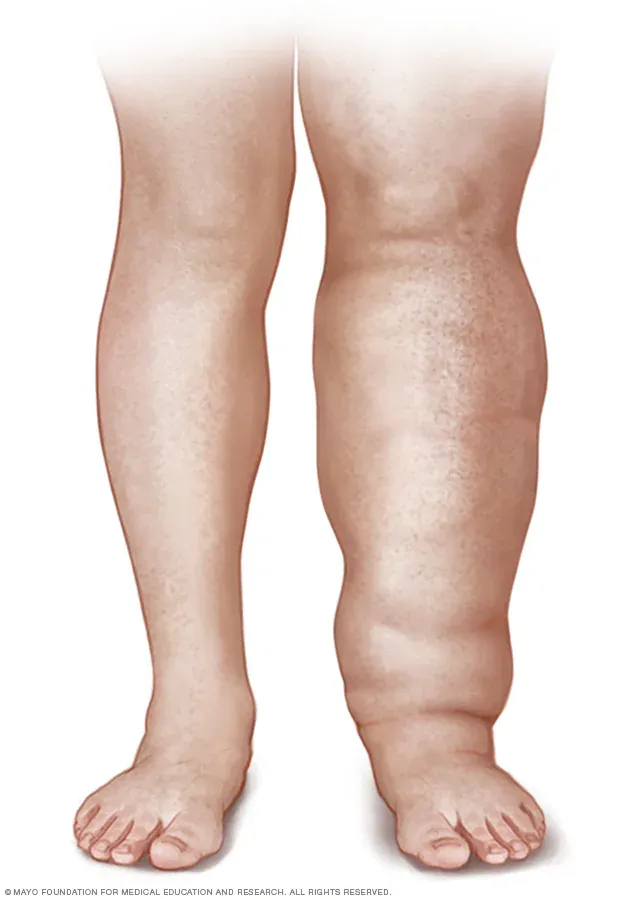
Edema vs Lymphedema: How to Tell the Difference
Edema vs lymphedema comes down to where the fluid comes from and whether your drainage system still works. Edema is extra fluid leaking out of blood vessels into the tissue, usually because of pressure from the heart, kidneys, liver, veins, or a medication. Lymphedema is protein-rich fluid that builds up because the lymphatic system itself is damaged or underdeveloped. Both make legs swell and both can start at the ankles, so they get mixed up a lot. But they behave differently, and they are treated differently.
Below: how to tell them apart at home, which signs mean see a doctor today, and where compression fits for each. If you are in northern New Jersey or over the line in Rockland County, NY, and have a question while you read, Lumi, our 24/7 chat assistant at the bottom right of every page on mcbdme.com, can help.
The quick answer
- Edema usually affects both legs, leaves a dent when you press it, and is often smaller in the morning.
- Lymphedema often starts in one leg (not always), tends to involve the foot and toes, and over time the skin gets firm and stops dimpling.
- If you can't pinch up the skin at the base of your second toe, that is a positive Stemmer sign, which points toward lymphedema.
- Sudden swelling in one leg with calf pain, redness, or warmth needs a doctor today. Swelling with shortness of breath or chest pain means call 911.
- Edema is treated by fixing the cause. Lymphedema is managed long term with decongestive therapy, compression, skin care, and sometimes a pump.
- Get your arterial circulation checked before starting compression for either one.
Edema in legs: what it usually means
Blood vessels always leak a little fluid into the surrounding tissue, and the lymphatic system normally picks it back up. Edema in legs happens when more fluid leaks out than the lymphatics can handle. The lymph vessels are fine. They are just overwhelmed.
The usual drivers fall into a few groups:
- The heart. With heart failure, blood backs up on its way home and gravity pulls the extra fluid into the lower legs.
- Kidneys and liver. Kidney disease makes the body hold salt and water. Cirrhosis and some kidney conditions lower the blood protein that keeps fluid inside the vessels.
- Veins. In chronic venous insufficiency, worn-out valves let blood pool in the lower legs. A blood clot (DVT) blocks a vein outright.
- Medications. Mayo Clinic lists some blood pressure medicines, NSAIDs like ibuprofen, steroids, estrogens, a class of diabetes drugs called thiazolidinediones, and certain nerve pain medicines. Calcium channel blockers are a well-known one for swollen ankles.
- Everyday stuff. Long flights, standing all day, heat, salty food, pregnancy.
We go through the most common causes one by one in Why Are My Legs Swollen?, so we won't repeat that here. This article is about the next question: is it ordinary edema, or lymphedema?
Lymphedema: when the drainage system is the problem
With lymphedema, the lymph vessels or nodes can't move fluid out of the tissue. There are two main types. Primary lymphedema comes from a lymphatic system that didn't develop normally. It is inherited, often affects the legs, and can show up in infancy, puberty, pregnancy, or later adulthood. Secondary lymphedema follows damage, such as cancer surgery that removes lymph nodes, radiation, serious infection, or trauma. For the legs, surgery or radiation in the pelvis or groin is a common trigger.
Because the trapped fluid is rich in protein, it causes inflammation and scarring under the skin over time, and fat tissue grows. That is why long-standing lymphedema feels firm or woody while ordinary edema feels soft. It is also why lymphedema skin gets infected more easily.
The two aren't always separate boxes. Years of vein-related swelling can wear out the lymphatics too, a mix sometimes called phlebolymphedema.
How to tell the difference: five home checks
None of these diagnose anything alone. Together they give you and your doctor a much better picture. For a step-by-step version, use our lymphedema self-check.
1. The press test (pitting vs non-pitting)
Press your thumb firmly into the swollen shin or top of the foot for a few seconds, then let go. If a dent stays, that is pitting edema. Heart, kidney, liver, vein, and medication swelling usually pits easily.
The catch: early lymphedema pits too. As it progresses and the tissue firms up, the dent gets shallower and eventually stops forming. So pitting doesn't rule lymphedema out, but a swollen leg that feels hard and won't pit leans toward it.
2. The Stemmer sign
Try to pinch and lift a fold of skin on top of your foot at the base of the second toe. If it lifts easily, the sign is negative. If the skin is too thick to pinch up, it is positive, which points toward lymphedema.
In a study available through the National Library of Medicine, a positive Stemmer sign caught 92% of lymphedema cases confirmed by imaging, but obesity caused false positives, and a negative sign did not rule lymphedema out, especially early on. One clue, not a verdict.
3. One leg or both?
Whole-body problems (heart, kidneys, liver, medications) push fluid into both legs, fairly evenly. Lymphedema after cancer treatment usually shows up on the treated side. Primary lymphedema can be in both legs, often one worse than the other. Sudden swelling in only one leg is the pattern doctors worry about most, because it can be a clot.
4. Elevation and overnight
Ordinary edema follows gravity. It is worst at the end of the day, better after a night lying flat, and putting your legs up above heart level helps.
Lymphedema depends on the stage. Cleveland Clinic describes stage I as swelling that goes down when the limb is raised, and stage II as nearly constant swelling with firmer skin. If your leg looks just as big when you wake up as when you went to bed, tell your doctor.
5. Where the swelling sits
Leg lymphedema usually involves the foot and toes. The top of the foot gets puffy, toes can look squared off, and the ankle creases deepen. Venous swelling sits more around the ankles and lower shins, often with brownish skin or varicose veins.
One lookalike: lipedema, a fat disorder mostly in women, makes both legs heavy and tender but typically stops at the ankle and spares the feet. It isn't fluid, so it doesn't pit or shrink overnight.
Side-by-side comparison
| Feature | Edema (heart, kidney, liver, veins, medications) | Lymphedema |
|---|---|---|
| What the fluid is | Mostly water leaked from blood vessels | Protein-rich lymph that can't drain |
| Usual pattern | Both legs, often evenly | Often one leg, or both but uneven |
| Press test | Pits easily | Pits early, less as tissue firms up |
| Stemmer sign | Usually negative | Often positive |
| Feet and toes | Ankles and shins more than toes | Top of foot and toes commonly involved |
| Overnight and with elevation | Usually better by morning | Better early on, persistent later |
| Skin over time | Shiny, stretched, or discolored with vein disease | Thicker, firmer, prone to infection |
| Main treatment | Treat the cause | Long-term decongestive therapy and compression |
Swelling from the knee down: when to see a doctor today
Most swollen ankles are not emergencies. Some are. Based on guidance from MedlinePlus (National Institutes of Health) and Mayo Clinic:
Call 911 if leg swelling comes with:
- Shortness of breath
- Chest pain, pressure, or tightness
- A racing or irregular heartbeat
See a doctor today (urgent care or the ER if you can't reach yours) for:
- New swelling in only one leg, especially with calf pain, warmth, or redness. This can be a DVT.
- A red, hot leg or swelling with fever or chills. This can be cellulitis, which is more common in legs with lymphedema.
- Worsening swelling when you already have heart or kidney disease
- New leg or belly swelling when you have liver disease
- Sudden or more than mild swelling in pregnancy
Book a regular appointment for swelling that has lasted more than a few days, doesn't go down overnight, is making the skin thicker, started after cancer treatment, or started with a new medication. Don't stop a prescribed medicine on your own. Ask the prescriber first.
How each is treated
Treating edema
Edema is a symptom, so treatment goes after the cause: adjusting heart failure medicines, a water pill (diuretic), managing kidney or liver disease, switching a blood pressure pill that swells your ankles, or blood thinners for a clot. Less salt, regular walking, and raising your legs when you sit all help. For venous insufficiency, compression stockings are often part of the plan once your doctor clears them.
Treating lymphedema
Lymphedema doesn't go away on its own, but it can be controlled, especially when caught early. Water pills generally don't do much, since the problem is drainage, not excess water in the blood. Standard care is complete decongestive therapy with a certified lymphedema therapist: manual lymphatic drainage, multilayer bandaging to shrink the limb, exercise, daily skin care, and then compression garments to hold the reduction.
Some people are also prescribed a pneumatic compression device, sleeves that inflate in timed sequences at home to move fluid out of the leg. Surgery helps in select cases but isn't a cure. LE&RN has a guide to finding a qualified lymphedema therapist, and you can see the pumps and garments we provide on our lymphedema page.
Where compression fits, and why the arterial check comes first
Compression helps both conditions in different ways. For venous edema, a graduated stocking supports the veins and keeps fluid from pooling. For lymphedema, compression holds the limb down after it has been reduced, often with garments made for a leg that isn't a standard shape, and sometimes alongside a pump.
Compression won't fix heart, kidney, or liver swelling by itself. If you have heart failure, ask your cardiologist before you start, since pushing that fluid back toward the heart isn't always safe.
The other must-do is an arterial check. Compression squeezes the leg from outside. If peripheral artery disease has narrowed the arteries feeding the leg, that pressure can cut blood flow further and damage the skin. Doctors usually check with an ankle-brachial index (ABI), a quick comparison of blood pressure at the ankle and arm. Our ABI guide explains the test and what the numbers mean for compression.
Once you're cleared, fit matters as much as wearing it. We measure in person and carry Medi, Juzo, Jobst, and Thuasne. See our compression page.
Common mistakes and red flags
- Assuming it's "just water." Swelling that doesn't go down overnight, or skin getting firmer, deserves a real look.
- Calling it lymphedema before ruling out a clot. Treat sudden one-sided swelling as a possible clot until a doctor says otherwise.
- Waiting for the dent to go away. Lymphedema pits early. By the time it stops, tissue changes have started.
- Buying drugstore compression without a circulation check, especially with diabetes, smoking, or leg pain when you walk.
- Ignoring small cuts on a swollen leg. That skin gets infected more easily.
FAQ
What is the main difference between edema and lymphedema?
Edema is fluid leaking from blood vessels faster than a normal lymphatic system can clear it, usually from heart, kidney, liver, vein, or medication causes. Lymphedema is fluid that builds up because the lymphatic system itself is damaged or didn't develop normally.
What causes edema in legs?
Common causes include long sitting or standing, heat, salty food, pregnancy, venous insufficiency, blood clots, heart failure, kidney or liver disease, and medications such as some blood pressure pills, NSAIDs, and steroids.
Can edema turn into lymphedema?
Yes. Long-standing swelling, especially from vein disease, can wear out the lymphatic system over time.
Does lymphedema pit when you press it?
Early on, it often does. As it progresses, the tissue firms up and pitting fades or stops.
Can lymphedema be in both legs?
Yes. It is often one-sided after cancer treatment, but primary lymphedema and some secondary cases affect both legs, usually unevenly.
Do water pills help lymphedema?
Generally not much, because lymphedema is a drainage problem. Management relies on decongestive therapy and compression. Your doctor may still prescribe a diuretic for another condition.
Key takeaways
- Edema is a pressure or leakage problem. Lymphedema is a drainage problem.
- Both legs, soft, pitting, and better by morning points toward edema. One leg, puffy toes, a positive Stemmer sign, and firm skin point toward lymphedema.
- No single home check is definitive. Bring what you notice to your doctor.
- Sudden one-leg swelling, a hot red leg, or swelling with breathing trouble or chest pain needs care today.
- Compression helps both, but only after an arterial check.
Next steps
If your doctor has diagnosed lymphedema or venous edema and prescribed compression garments or a pump, MCB DME can verify your benefits before anything ships, coordinate paperwork with your doctor, and fit you in person. We serve patients across northern New Jersey and New York, including Rockland County. Call (973) 553-0777, visit 293 Lafayette Avenue, Suite 104, Hawthorne, NJ 07506, or reach us through our contact page. Lumi, the chat assistant at the bottom right of every page on mcbdme.com, can answer questions any time.
This article is for general education and is not medical advice. Talk with your doctor about any new or changing swelling, and call 911 for swelling with shortness of breath or chest pain.